

What CDCP does cover for missing teeth is dentures, complete and partial. That is still subject to the plan's criteria, to approval in advance where it is required, and to any co-payment.
That is the short answer. The rest of this page is what to do with it.
Key takeaways
- CDCP does not cover dental implants, implant-related procedures, or fixed bridges
- It does cover eligible dentures, complete and partial, though not automatically. Criteria, preauthorisation and co-payments apply
- There is no program in Ontario that funds implants for ordinary tooth replacement. One narrow hospital-based program exists for maxillofacial rehabilitation, and it is not tooth replacement
- "Covered" is not the same as "free." The plan may pay less than a dentist's usual fee, and the difference is yours
- Eligibility is decided by the Government of Canada, not by any dental office. Check yours at canada.ca
- Dentistry on Britannia accepts CDCP. The plan is open to all ages for eligible Canadian residents; eligibility requires no access to private dental insurance, the required Canadian tax returns, adjusted family net income under $90,000, and Canadian residency for tax purposes. Bring your member card and you will have a written estimate before anything begins
What is the Canada Dental Care Plan?
CDCP is a federal dental benefit administered on the government's behalf by Sun Life. The plan exists to help with dental costs for eligible residents who have no access to private dental insurance.
Two things about it are commonly misunderstood, and both matter here.
This is not private insurance. Coverage is set nationally, not negotiated plan by plan. Some treatments need approval before they are carried out. And the amounts the plan pays may differ from a dentist's usual fees.
Being enrolled is not the same as being covered for everything. The plan has a defined list of what it will pay towards, and a defined list of what it will not. Implants are on the second list.
Who decides what you are eligible for
The Government of Canada. Not your dentist, and not this practice.
No dental office can enrol you, remove you, or change what the plan pays for, and any practice suggesting otherwise is overstepping. Where the plan operates a preauthorisation process, a dentist can supply clinical information to support it. What a dentist cannot do is get an excluded treatment covered, and implants are an explicit exclusion. What a dental office can do is check the benefit information available for you before treatment and give you a written estimate based on it.
The authoritative source is canada.ca. That page stays more current than anything a dental practice can tell you second-hand, so check it directly instead of relying on a summary.
Why are implants excluded?
The plan publishes a list of what it pays towards and a list of what it does not, and implants sit on the second list. The published guide does not set out a reason, so we will not invent one. What is worth knowing is that dentures, which are one way of replacing a missing tooth, are on the covered list.
Being excluded is not the same as being unnecessary, and the two get blurred constantly. An implant can be clinically the best choice for a particular patient and still not be something the plan pays for. Exclusion is a decision about public funding. It is not a clinical judgement about your mouth.
If you want an implant, you are paying for it privately. That means savings, private insurance if your plan includes major restorative coverage, or a payment arrangement spread over time. The plan will not contribute to part of it either. It does not partially fund a treatment it does not cover.
What does CDCP actually cover?
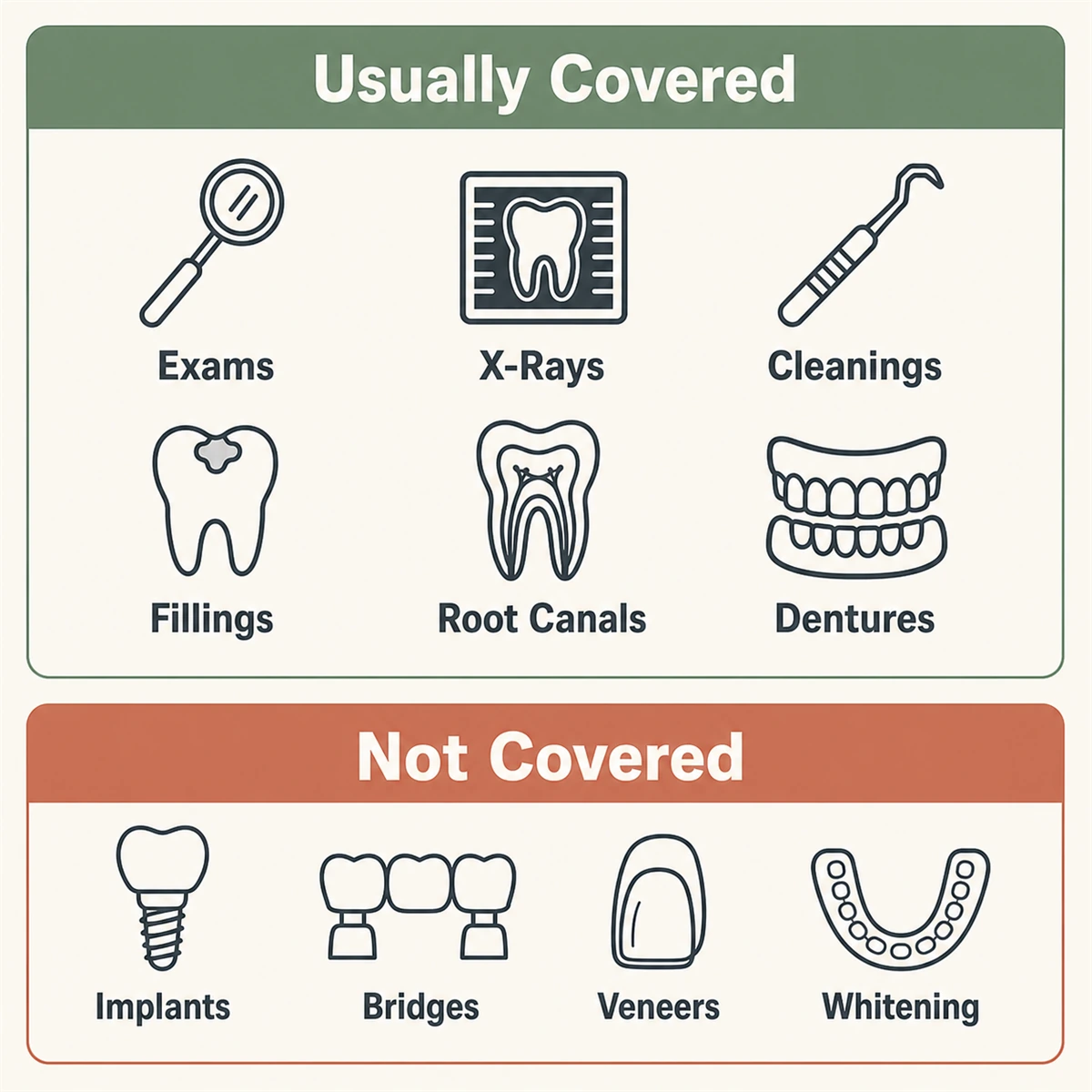
The plan is built around the dental care most people need most of the time.
Broadly, it helps with:
- Examinations and diagnostic X-rays
- Cleanings, scaling and preventive treatment
- Fillings
- Root canal treatment
- Treatment for gum disease
- Extractions and other oral surgery
- Complete and partial removable dentures
It does not help with:
- Dental implants and implant-related procedures
- Fixed bridges
- Teeth whitening
- Veneers
- Other treatment classed as cosmetic
Orthodontic treatment sits in a category of its own. A limited range of orthodontic services is planned, at a date still to be determined, requiring approval in advance and restricted to severe functional cases. It is not available yet. If you are counting on it, check the current position before making plans.
Are dental implants free for seniors in Ontario?
Not for ordinary tooth replacement, no. This is the second most common version of the question, and it deserves a direct answer, not a hedge.
CDCP does not cover implants at any age. The Ontario Seniors Dental Care Program is a separate provincial scheme, income-tested, and it is built around basic dental services, not implants.
The one exception, and why it almost certainly does not apply to you
Ontario runs an Oral and Maxillofacial Rehabilitation Program. It funds dental implants for a small group of patients who need them to hold a maxillofacial prosthesis in place, where no other treatment option exists.
This is not tooth replacement. The eligibility criteria are narrow, treatment happens only at designated centres, not in private dental practices, and the program explicitly excludes implants used to replace ordinary missing teeth or to retain dentures.
It is mentioned here because the flat statement that no program exists is not quite true, and this is a page about public funding. For almost everyone reading it the exception will not apply. It is still worth stating accurately.
What is genuinely available to seniors
For a senior who qualifies for CDCP, the plan helps with the examinations, cleanings, fillings, extractions and dentures that keep a mouth working. That is meaningful, and it is not nothing. It is simply not implants.
What CDCP denture coverage actually means
This section exists because it is where most disappointment happens.
Dentures are covered. They are not automatically covered, and covered does not mean free.
| What people assume | What is actually the case |
|---|---|
| Dentures are free under CDCP | The plan pays towards eligible dentures. There may be a co-payment |
| Approval is automatic | Some dentures require preauthorisation before treatment begins |
| You can have one whenever you like | Frequency limits apply |
| The plan pays the dentist's fee | The plan pays according to its own schedule, which may be less than a practice's usual fee |
The gap, where there is one, is yours to pay. You should know that number before you agree to anything, which is what a written estimate is for.
None of this is a reason not to use the plan. It is a reason to have the conversation before treatment, not at the front desk afterwards.
So what are your options for a missing tooth?
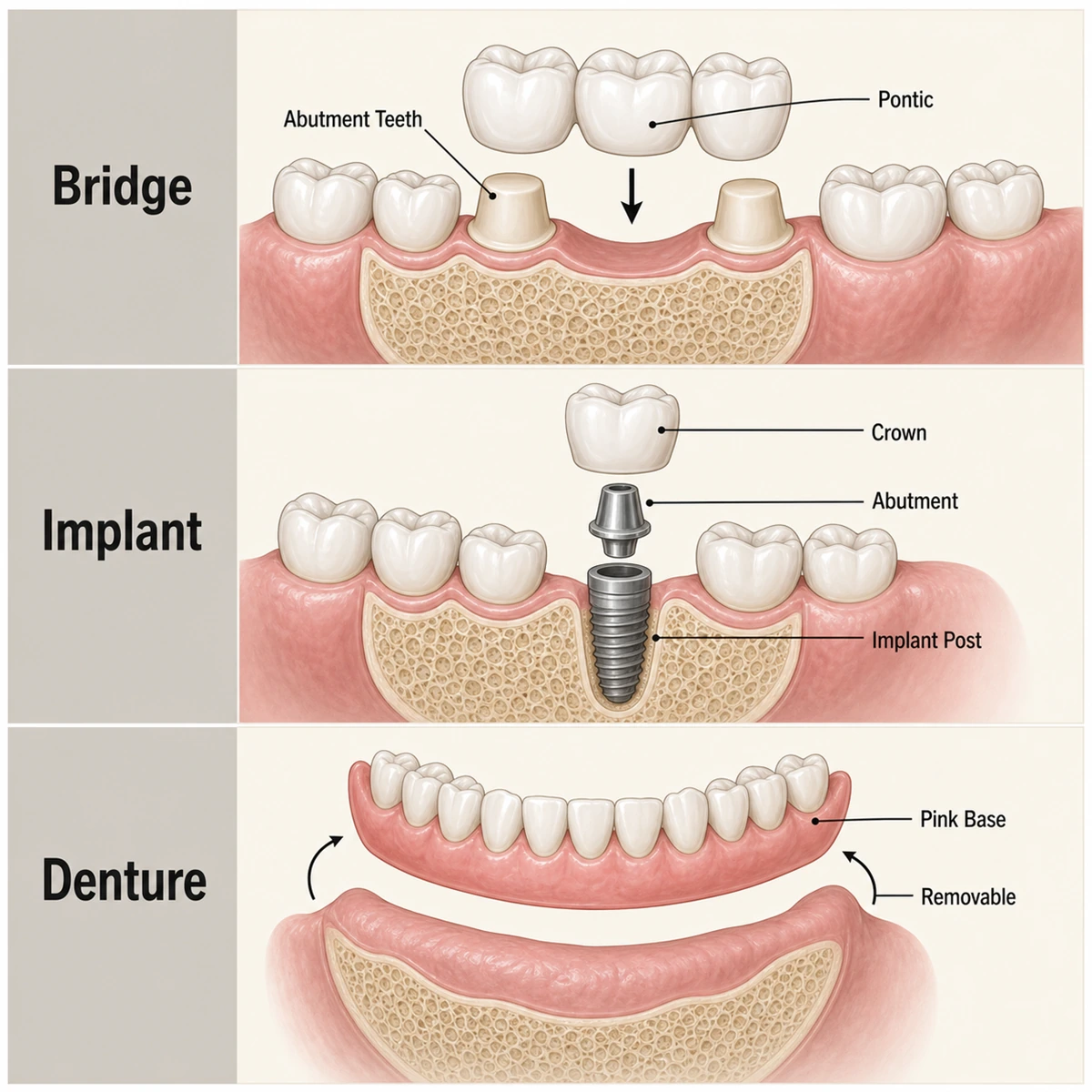
There are three common ones, plus the option of doing nothing for now. Depending on the case there can be others, which is what an examination establishes.
A denture
Removable, replacing one tooth, several, or a full arch. It is the option CDCP may help with.
Getting used to one takes weeks, not days, and both speech and eating need practice at first. It comes out for cleaning. The fit can change over time as the bone underneath reshapes, so a reline is sometimes needed.
A denture does not feel like natural teeth, because it is not. Setting that expectation properly at the start is the difference between someone who adapts and someone who leaves it in a drawer. Learn more about dentures.
A bridge
Fixed in place, supported by the teeth either side. No implant surgery and no integration period, so it suits people who do not want an operation or are not candidates for one.
With a conventional bridge, the supporting teeth are reshaped to carry it. How much preparation that involves depends on the design and on what condition those teeth are already in. If they are already crowned or heavily filled, it matters much less. If they are intact and healthy, it is a genuine cost worth weighing.
Not covered by CDCP. Learn more about dental bridges.
An implant
A replacement root placed into the jawbone, with a crown fitted on top once it has healed.
An implant stands on its own without borrowing support from its neighbours, and alone among the three it sits in the bone instead of resting on the gum or hanging from adjacent teeth. Fixed in place, cleaned like a tooth, and it cannot decay.
Surgery is involved, and the treatment is staged over months because the healing is what does the work. Enough bone of adequate quality and healthy gums are both prerequisites, which is why assessment involves imaging.
Not covered by CDCP. Learn more about dental implants.
Doing nothing, for now
This is a real option and it has real consequences, and it is what you are doing by default until you decide.
Teeth either side of a gap drift and tilt into it. The tooth opposite, with nothing meeting it, can over-erupt. How much of that happens varies a great deal with the site, the bite and the person. Some gaps stay stable for years.
The bone that held the root gradually reduces. Bone responds to being loaded, and once the root is gone that stimulus goes with it. This matters most if you might want an implant later, because the longer a gap has been there, the more likely grafting becomes necessary first. Learn more about bone grafting.
None of that means deciding today. It means the site is worth reviewing, not forgetting.
Comparing the three, honestly
| Denture | Bridge | Implant | |
|---|---|---|---|
| Fixed or removable | Removable | Fixed | Fixed |
| Involves surgery | No | No implant surgery | Yes |
| Affects neighbouring teeth | No | Yes, usually reshaped | No |
| Placed in the bone | No | No | Yes |
| Teeth replaced | One to a full arch | Usually one or two | One or several |
| Time to complete | Weeks | Weeks | Staged over months |
| CDCP | May help, conditions apply | No | No |
| When it is the wrong choice | When a fixed result matters more than cost | When the neighbouring teeth are healthy and intact | When bone is insufficient, gum disease is active, or surgery is not appropriate |
That last row is the most useful line in the table, and it is the one to bring to the consultation.
What affects the cost of an implant?
We do not publish prices. Treatment costs vary depending on your dental needs, and our team will provide a clear estimate before treatment begins.
What we can tell you is what actually moves the number, which is more useful than a headline figure that may not apply to your case:
- Whether grafting is needed first. The largest single variable, and it depends on how much bone is there
- How many teeth are being replaced, and whether they sit next to each other
- Where in the mouth the tooth is
- Whether existing teeth or roots need removing first
- The condition of your gums, since active disease has to be managed before placement
- The imaging needed to plan it
Anyone quoting a figure before examining you is quoting an average. Averages are made up of cases that are not yours.
On private insurance
Some plans include major restorative coverage that contributes towards implants. Some exclude them outright.
Ask us to submit a pre-determination. Your insurer replies in writing with what they will pay, before you commit to anything. It costs nothing and it turns a guess into a number.
Direct insurance billing is available at this practice.
Does Dentistry on Britannia accept CDCP?

We accept the Canada Dental Care Plan. It is open to all ages for eligible Canadian residents; eligibility requires no access to private dental insurance, the required Canadian tax returns, adjusted family net income under $90,000, and Canadian residency for tax purposes.
That wording is deliberate. The plan itself is open to eligible people of all ages, but a practice can accept it for a narrower group than the plan covers. Knowing which before you book saves you a wasted appointment, and an awkward conversation at reception.
What happens at your appointment
- Bring your CDCP member card, and any private insurance details.
- We check the benefit information available for you before treatment starts.
- You get a written estimate based on it, before anything is agreed.
- We tell you what any co-payment would be, so there is no surprise afterwards.
Checking is not the same as a guarantee. What the plan finally pays is decided when the claim is processed, not by our office. Learn more about CDCP coverage at our practice.
How to actually check your own coverage
Most articles on this topic tell you what the plan covers. Almost none tells you how to find out what applies to you.
Eligibility is decided by the Government of Canada. Not by a dental office, and not by us. Check it at canada.ca, which stays more current than anything a practice can tell you second-hand.
What decides eligibility includes your household income, your residency and tax filing, and whether you have access to private or employer dental coverage. That last one catches people out, because access matters, not whether you use it.
Once you are enrolled, you receive a member card and a start date. Coverage does not apply before that date, which is worth checking before booking treatment you are counting on.
What a dental office can actually do: check the benefit information available for you before treatment, and give you a written estimate based on it. Checking is not the same as a guarantee. What the plan finally pays is decided when the claim is processed.
The questions to ask before treatment starts
Whatever the treatment and whoever is providing it:
- Is this covered under my plan, as far as you can see?
- What would my co-payment be?
- Does this need approval in advance, and how long does that take?
- What happens if approval is refused?
- Is there a frequency limit that affects me?
- Can I have that in writing before I agree?
The last one is the important one. A written estimate turns a conversation into something you can check.
If the answer is no, and you still need the tooth replaced
Being told implants are excluded is not the end of the conversation.
Dentures are the covered option, and for many people they are a reasonable answer, not a consolation prize. Complete and partial, subject to the plan's criteria, approval in advance where required, frequency limits and any co-payment.
Staging treatment over time is legitimate. Dealing with what is urgent now and planning the rest is not a failure to commit.
Monitoring a stable gap is a real clinical option for some sites, particularly a back tooth with a stable bite, provided it is reviewed, not forgotten.
Say what your constraint actually is. Knowing that funding is the limit changes the conversation, and there is something sensible to do within it. Learn more about dentures.
Dentistry on Britannia is a general dental practice. Our dentists are general dentists, not specialists in any RCDSO-recognised specialty.