
Straightening teeth is about more than appearance
Appearance is what starts most people thinking about it, and that is a perfectly good reason.
There is more to it. Crowded and overlapping teeth are harder to clean, which raises the risk of decay and gum disease in exactly the places you cannot reach. A bite that does not meet properly loads some teeth harder than others. Over years that shows up as wear, cracks and recession.
Neither of those is a reason to have treatment you do not want. They are a reason the assessment looks at more than how your teeth photograph.
The two options
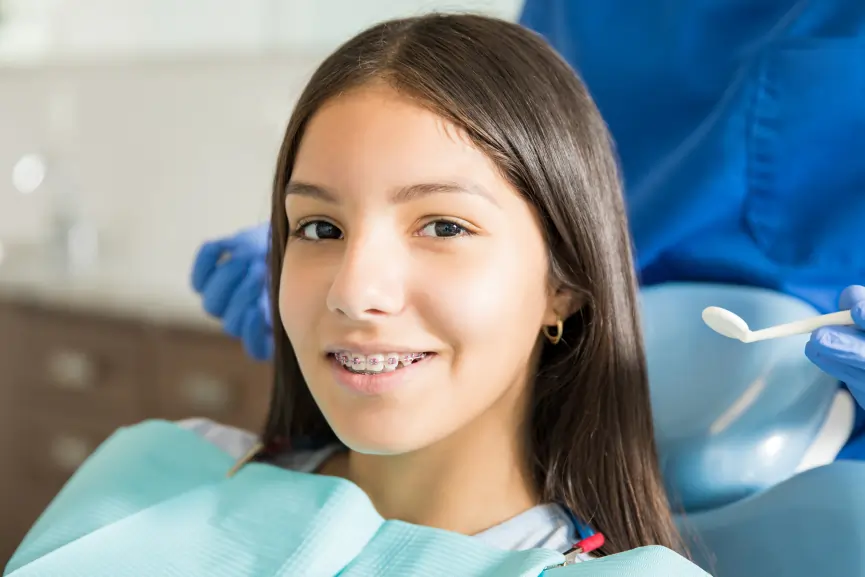
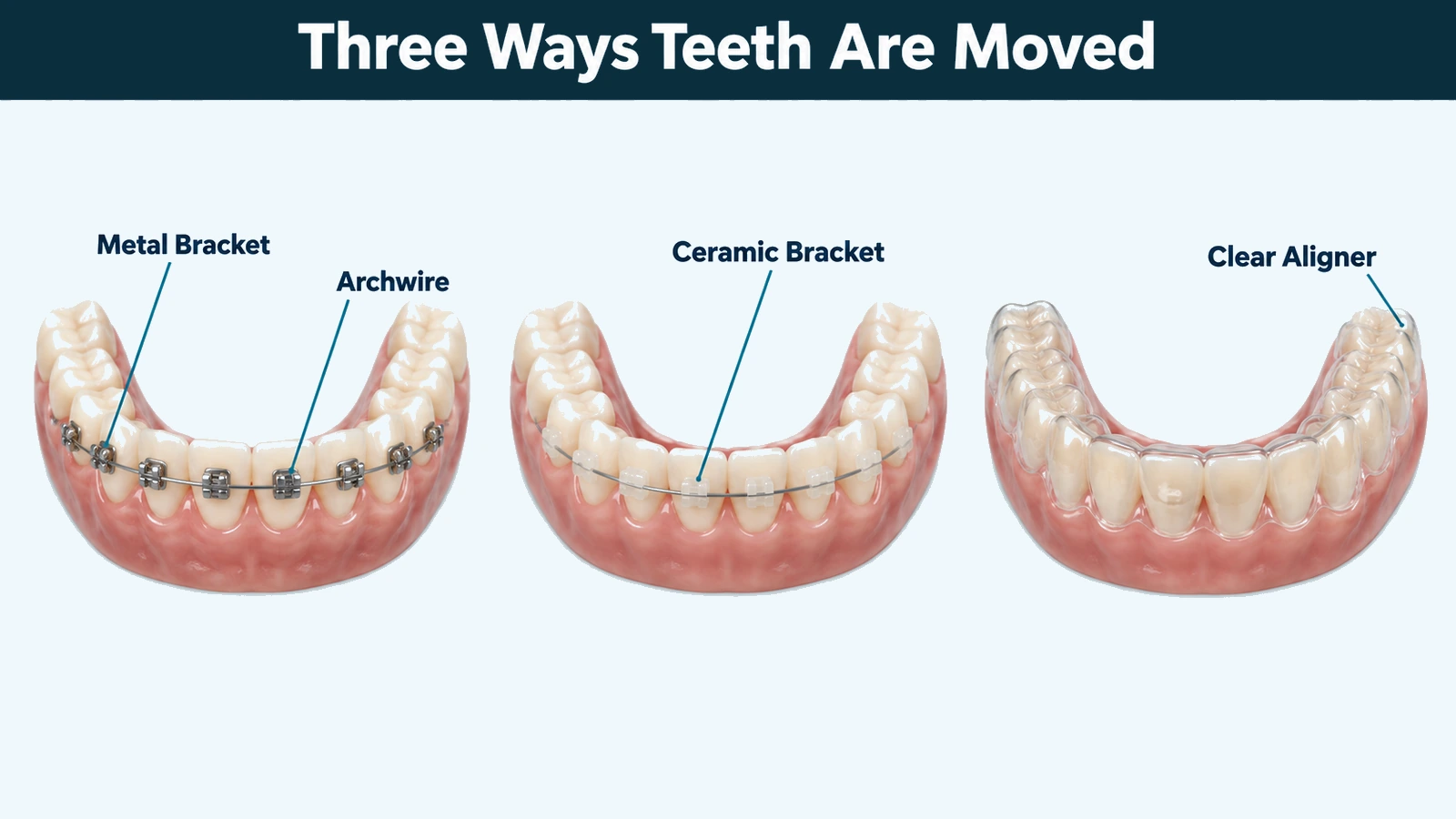
Braces and clear aligners both move teeth, slowly and under control. Both are available here in Mississauga, including clear braces where you want fixed treatment that is less visible.
What decides between them
In short: aligners suit people who will actually wear them and whose case sits within the range aligners handle. Fixed braces handle more, and do not depend on you.
| Clear aligners | Fixed braces | |
|---|---|---|
| Removable | Yes, the advantage and the risk | No |
| Depends on you remembering | Entirely | Much less |
| Complex movements | Within a range | Handles more |
| Visibility | Least noticeable | Visible; clear brackets much less so |
| Eating | Normal, trays come out | Hard and sticky foods avoided |
| Cleaning teeth | Normal, trays come out | More care around brackets |
| Unscheduled visits | Often fewer | Brackets detach, wires work loose |
| Retainers afterwards | Yes, indefinitely | Yes, indefinitely |
One row decides most cases: "depends on you remembering". Being honest with yourself about that in advance is worth more than any comparison table. It is not a character test. Plenty of organised people find the aligner routine inconvenient in ways they did not anticipate.
Read the full comparison: Invisalign or braces
Are you too old for this?
No. Adults make up a large share of orthodontic patients.
Age is not the qualifying test. Healthy gums and enough bone to move teeth through are. For adults, visibility weighs more heavily. That is a perfectly good reason to choose one appliance over another.
For teenagers, wearing it is the question. A fixed appliance takes one more thing off a teenager's list of things to remember. Some families want that. Others would rather their child had the choice. Decide it together at the consultation.
What has to happen first
Orthodontic treatment starts after your mouth is stable, not before.
Untreated decay, active gum inflammation, broken teeth, loose fillings or crowns and any tooth with an uncertain prognosis are all dealt with first. Moving teeth through inflamed gum tissue is a poor idea. A two-year treatment undermined by something that was there on day one is a waste of everyone's time. Learn more about dental examinations and check-ups.
When orthodontics is more than you need
If the complaint is colour and not position, orthodontics is the wrong tool. Two years of tooth movement will not make a tooth whiter, and it will not reshape a chipped edge. Whitening and bonding do both, in weeks instead of years. We will tell you when that is the shorter route. Learn more about teeth whitening.
Cost, insurance and CDCP
We do not publish prices. The figure depends on how much movement is needed, and a headline number that does not apply to your case is not useful. You get a written estimate before treatment begins.
What moves the number: how much movement is needed, whether extractions form part of the plan, how long treatment runs and whether retention is included in what you are quoted. Ask that one explicitly.
Ask about the current $500 offer on eligible braces and Invisalign treatment. It is advertised separately from CDCP, and the practice can confirm whether your case qualifies.
Insurance: where a plan includes orthodontic coverage, that coverage sits under its own limit, and on most plans the limit is a lifetime maximum instead of an annual one. It does not reset. A pre-determination gets the answer in writing before you commit.
CDCP: we accept the plan. It is open to all ages for eligible Canadian residents; eligibility requires no access to private dental insurance, the required Canadian tax returns, adjusted family net income under $90,000, and Canadian residency for tax purposes. CDCP orthodontic services are not available yet. A limited range is planned for a date still to be determined, requiring approval in advance and restricted to severe functional cases. Check the current position at canada.ca before making plans. Learn more about CDCP coverage at our practice.
Dentistry on Britannia is a general dental practice. Our dentists are general dentists, not specialists in any RCDSO-recognised specialty.