
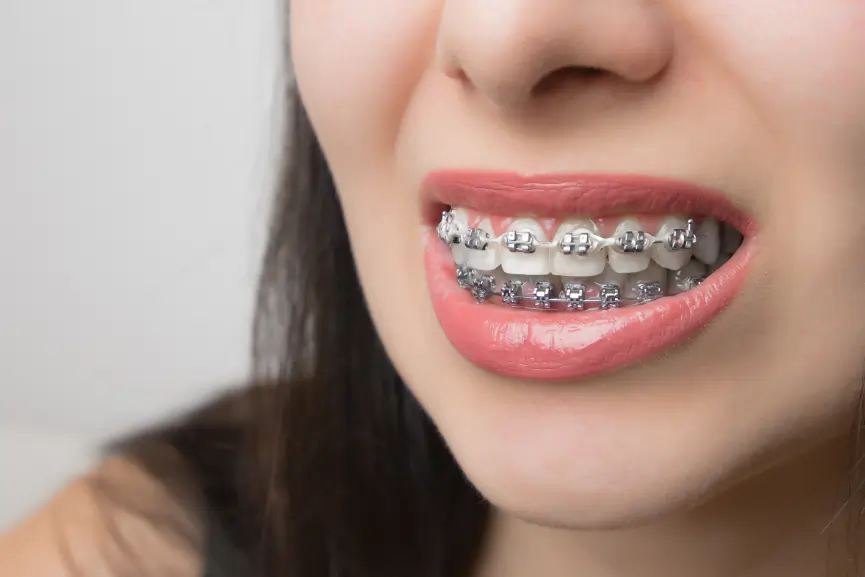
Clear braces cost $4,000 to $9,000 across five Canadian practices that publish figures. Metal braces run lower at $3,000 to $7,000.
They are the middle option. More discreet than metal, more control than removable trays, and they carry one trade-off worth knowing before you choose: ceramic brackets come off the tooth more often than metal ones do.
Not sure which type suits your case? Ring (905) 821-8632 or book your assessment online. We are on Britannia Road West with free parking.
What clear braces actually are
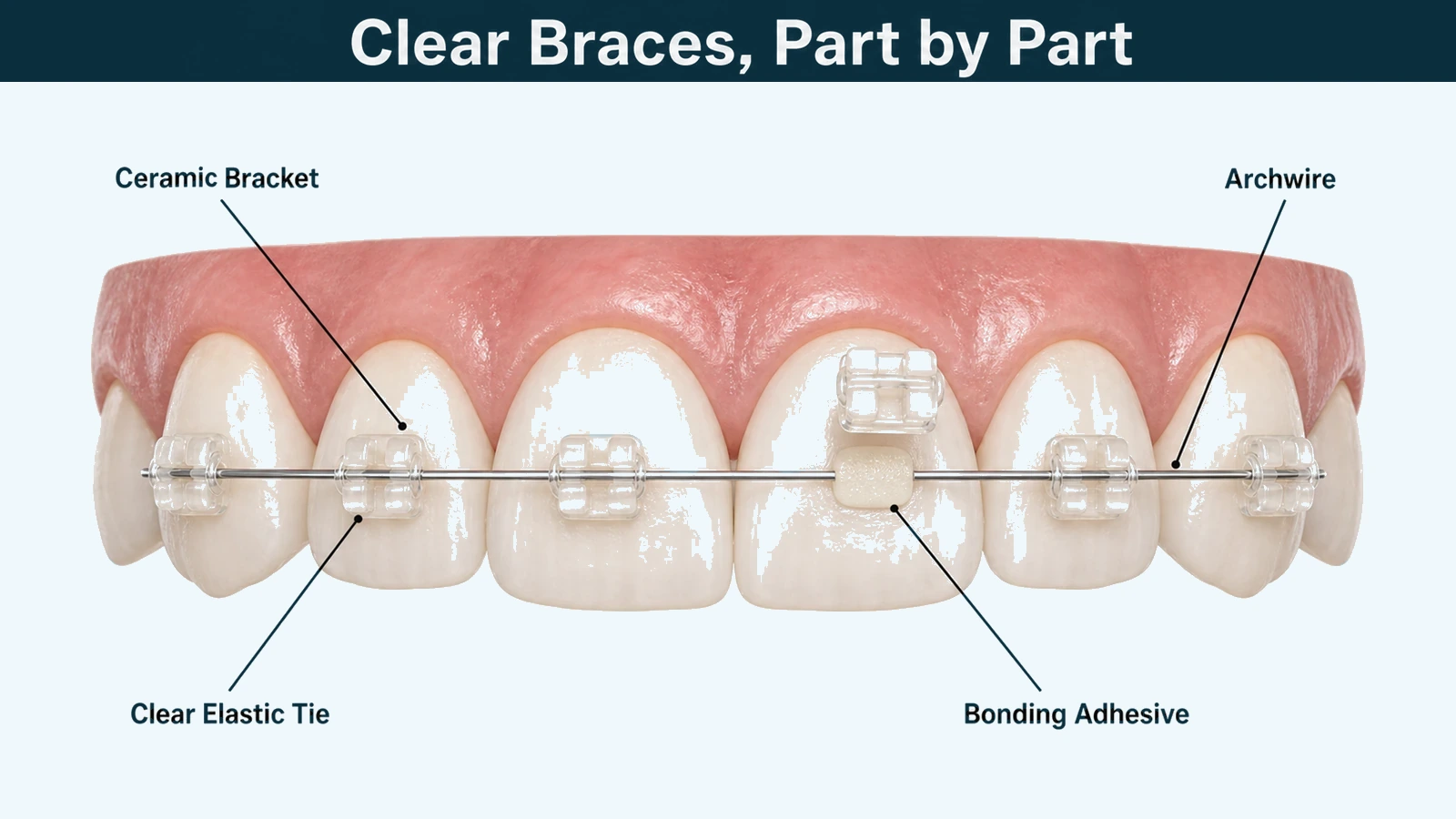
Each tooth gets a small ceramic bracket bonded to the front of it. A wire runs through all of them and is held in place by tiny elastic or metal ties. The wire is shaped, and over weeks it pulls the teeth toward the shape it wants to hold.
The ceramic is made to sit close to the shade of your enamel. Up close you see them. From across a room, most people do not.
The mechanics are the same as metal braces. Same wires, same adjustments, the same range of movements that removable trays find hard. The materials differ, and that difference shows up in bond strength and in how often a bracket comes off. You are paying the extra money for the appearance of the brackets and not for a different kind of treatment.
Clear braces against the alternatives
Three ways to straighten teeth, and they trade against each other in a way that is easy to state plainly.
| Clear braces | Metal braces | Clear aligners | |
|---|---|---|---|
| Visibility | low | high | lowest |
| Fixed to the teeth | yes | yes | no |
| Control over hard movements | high | high | limited |
| Depends on you | no | no | completely |
| Bracket or tray failures | higher, see below | lower | no brackets |
| Published price | $4,000 to $9,000 | $3,000 to $7,000 | $1,500 to $8,000 |
Read that table as three sensible answers to three different priorities. Our braces page covers metal in full and our clear aligners page covers the removable route. The Invisalign page covers that system.
The trade-off to weigh before you choose
Ceramic is a different material from stainless steel, and it behaves differently at the point where it is glued to the tooth.
A clinical trial published in 2024 followed 80 patients for 12 months in two equal groups, one in metal brackets and one in ceramic. The result was clear: significantly higher failure rates were found for ceramic brackets overall, in the lower jaw and at the back of the mouth.
The trial also found the archwire mattered. Round nickel-titanium wires raised the failure rate, and rectangular wires lowered it.
The authors ended with a direct instruction to the profession. Patients should be aware that treatment with ceramic brackets may involve delays and inconvenience from the higher failure rate compared with metal.
What that means for you. A bracket that comes off gets rebonded at an unscheduled visit. The trial counted 127 failures across 800 ceramic brackets, which is a rate across a group and not a forecast for one mouth. A run of failures adds appointments and can add weeks.
The evidence points at the lower back teeth in particular. Some treatment plans respond to that by putting ceramic brackets on the front teeth that show and metal on the back teeth that do not. Ask at your assessment whether that arrangement is available for your case and what it would cost.
Do clear braces stain?
Far less than the ties do. Glazed ceramic resists colour from coffee, tea, red wine and curry much better than plastic brackets, and laboratory testing still records some colour change over time.
The elastic ties around each bracket do. They are small and clear when fitted, and they pick up colour over a few weeks.
The fix is built into the treatment. Ties are changed at every adjustment appointment, so tie staining resets on that cycle. Tell us if you drink a lot of coffee and we will take it into account when we set your appointment interval.
The archwire is the other thing people notice. A tooth-coloured coated wire is less visible than bare metal, and the coating wears at the points where the wire slides.
Clear braces for adults
Adults are a large and growing share of orthodontic patients, and a discreet fixed brace is why.
Two things differ from a teenage case. Adult jaw growth has finished, so bites that depend on growth need a different plan. Adults also carry more dental history: fillings, crowns, implants and gum health all change how teeth are moved.
Ceramic brackets bond to enamel. They do not bond reliably to porcelain or metal restorations, so a tooth with a crown or a veneer may need a different bracket or a different approach. That comes out at the examination.
Adult gum tissue also needs closer attention. Teeth still move where bone support has been reduced. That needs the gum disease under control first and the case monitored through treatment. Gum health gets assessed and treated before any brace goes on.
What happens at the assessment
- Examination of the teeth, gums and bite. Decay and gum disease get treated before brackets go anywhere near enamel.
- X-rays where they are indicated. Roots, bone levels and any unerupted teeth have to be seen. Which images you need is decided after the examination.
- Scans or impressions and photographs, to build the record the plan is drawn from.
- A conversation about the options. Ceramic, metal, a combination or removable trays. Cost, visibility, failure rates and expected treatment length all laid out.
- A written estimate. What is included, what is not and what happens if the case needs longer.
You leave with a plan and a price, and nothing is decided for you.
Living with clear braces
Cleaning takes longer. Brackets create places plaque sits and a normal brushing routine does not reach. Interdental brushes and a floss threader stop being optional.
Some food is out. Hard things crack ceramic brackets. Sticky things pull them off. Nuts, ice, hard crusts, toffee and chewing gum are the usual list and whole apples and carrots get cut up instead of bitten.
Adjustments through the course. The wire gets changed or tightened and the ties get replaced. The interval is set by your plan and by the stage of treatment.
Discomfort after each adjustment. A day or two of tenderness while the teeth respond. Softer food helps and it settles on its own.
Rubbing at first. Lips and cheeks take a week or two to toughen up against the brackets. Orthodontic wax covers any spot that is catching.
White spots, and how to avoid them
Fixed braces carry one risk that removable trays largely avoid. Plaque sitting against enamel around a bracket demineralises it, and when the brace comes off there is a chalky white mark where the bracket used to be.
They are a well-recognised effect of fixed treatment and not a rare accident. A 2026 network meta-analysis pulled together 70 randomised trials with 4,634 participants testing ways to prevent and manage them, which tells you how much attention the problem gets.
Prevention is dull and it works: brush every surface around every bracket, use fluoride toothpaste, keep the sugary drinks down and come to your check appointments. Fluoride varnish applied at those appointments is the measure with the strongest evidence behind it. Our braces page has the full white spot section.
After the braces come off
The brackets are removed, the adhesive is polished off the enamel and the teeth are cleaned and polished with nothing in the way.
Then retainers, immediately. Teeth drift back toward where they started and the pull is strongest in the first months.
A 2026 network meta-analysis of 18 randomised trials covering 1,471 people compared fixed and removable retainers and found no statistically significant difference between them on gum health measures. The networks were sparse and the estimates imprecise. No difference was measured, and that is not the same as proof the two are equal. The choice comes down to your bite and whether you will wear a removable one.
Put the retainer question into the fee conversation early. It is a real cost and it runs for years.
What clear braces cost in Mississauga
We publish no fees of our own. A case needing eight months and a case needing two years are not the same purchase, and a number on a page would mislead you about both.
Published Canadian pricing, from practices that publish figures:
| Treatment | Published range |
|---|---|
| Ceramic or clear braces | $4,000 to $9,000 |
| Metal braces | $3,000 to $7,000 |
| Clear aligners in a dental office | $1,500 to $8,000 |
| Invisalign | $2,000 to $9,000 |
Your position in the range depends on how much movement is needed and how long the course runs, whether one arch or both are treated, whether ceramic goes on every tooth or only the visible ones and whether retainers are included.
Insurance
Orthodontic benefits are written differently from plan to plan. Where one exists it pays a share of the cost up to a maximum set for orthodontics. Most plans set that maximum for the whole benefit and not per year. Your own plan wording is what settles it.
Request a written pre-determination from your insurer before treatment starts. They will confirm in advance what they will pay on your plan for your treatment. Ask them specifically whether adult orthodontics is included, since plenty of plans stop at 18.
The Canada Dental Care Plan
The CDCP is open to all ages. Qualifying takes more than the income test. You also need no access to private dental insurance, a filed tax return for the previous year and Canadian residency for tax purposes.
The plan pays for no orthodontic treatment. Its coverage page records orthodontic services as not available and publishes no date for a change. Checked 21 September 2026.
Healthy Smiles Ontario
Children 17 and under in households below an income threshold qualify at a threshold that for a one-child household was $29,065 as of 1 July 2026.
Braces are excluded. The programme groups them with teeth whitening under cosmetic dentistry and does not fund them.
Dentistry on Britannia is a general dental practice. Our dentists are general dentists, not specialists in any RCDSO-recognised specialty.