

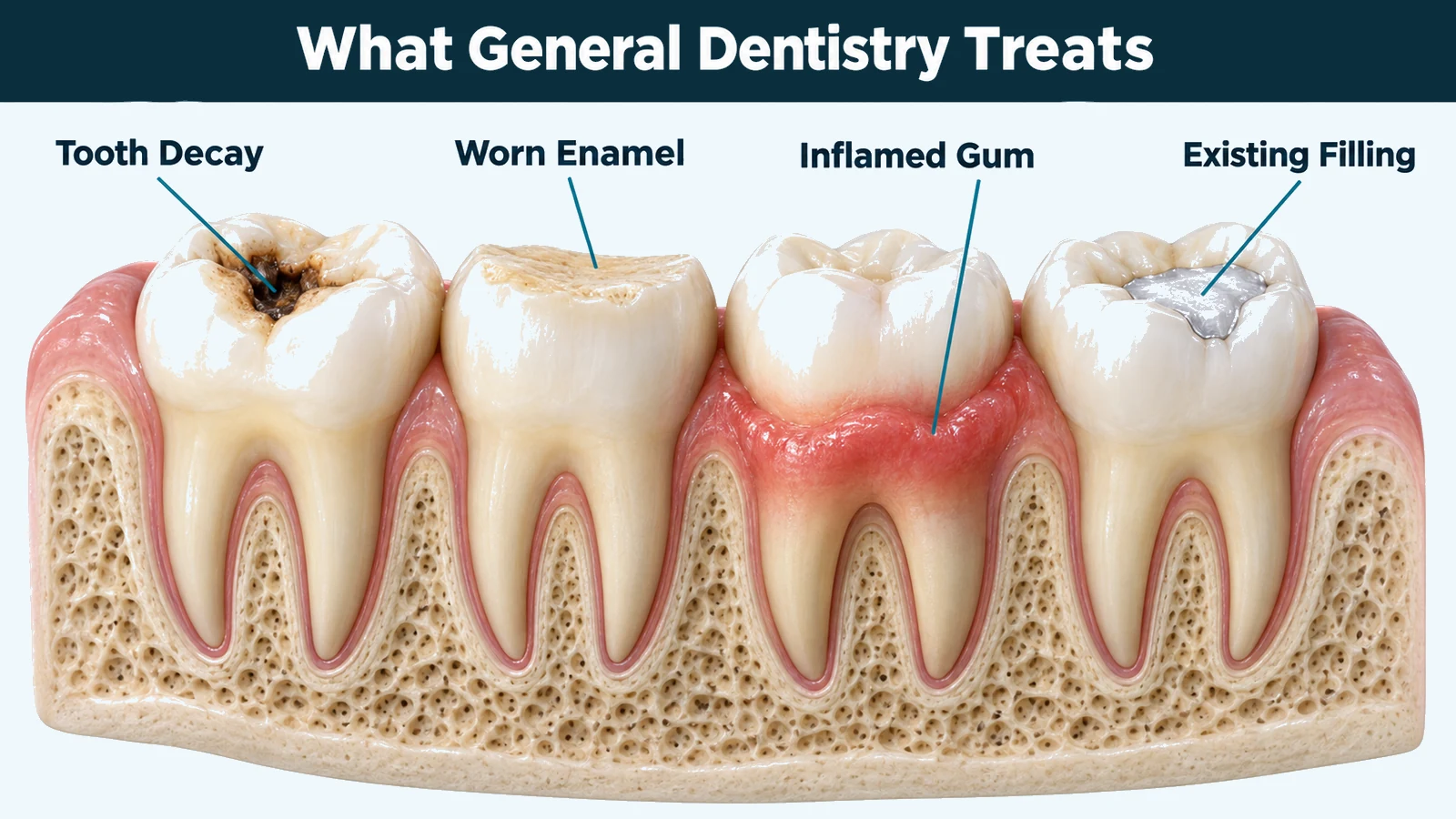
What general dentistry covers
General dentistry is most of what a family needs over the course of a life. Examinations, cleanings, fillings, crowns, root canal treatment and the care that keeps small problems from becoming large ones. General dental care covers the routine half of that, the visits you keep when nothing hurts.
Dentistry on Britannia is a general dental practice. Most of what comes up is dealt with here. Where a case genuinely needs a specialist, we say so and refer.
One general dental office for the whole family. Children, parents and grandparents are seen at the same practice. Same team, one set of records. General family dentistry in Mississauga does not need to be split across three clinics.
Looking for a general dentist in Mississauga? We are on Britannia Road West, with free parking on site and chairs open from 7:00 am Monday to Thursday.
What we do here
Gum care and gum disease
Bleeding gums are the early sign, and they are the one people ignore. Gums that bleed when you brush are inflamed. Healthy gums do not bleed.
Caught early it reverses. Inflammation confined to the gum responds to a cleaning and to better technique at home. Nothing is lost.
Left alone it does not. Once the bone supporting a tooth has gone, it does not grow back. The aim from that point is to stop the loss, not to undo it.
What treatment involves depends on how deep it has gone. A standard cleaning for the early stage. Scaling and root planing, which cleans the root surface below the gum line, where pockets have formed. Surgical treatment, which we refer for, where the pockets are too deep to reach.
The signs worth booking for: gums that bleed when you brush or floss, gums that are swollen, red or sore, bad breath or a bad taste that does not shift, gums shrinking back from the teeth, and teeth that feel loose.
The surgical side of general dentistry
Extractions and wisdom teeth are done here. Where a case needs a specialist, we refer and tell you why.
Gum surgery, where cleaning below the gum line has not been enough. Flap surgery lifts the gum back so the root surface and the bone margin can be cleaned directly. A connective tissue graft covers a root that gum recession has exposed. Both are done here.
Tooth extraction
Where a tooth cannot be saved, or is causing problems where it sits.
Before removal, we explain why the tooth cannot predictably be repaired, what the appointment involves and the options for replacing it if that matters for function or appearance.
Wisdom tooth extraction
Assessment and removal where a wisdom tooth is causing pain, infection or crowding.
We assess its position, the surrounding teeth and the level of infection before deciding whether monitoring, treatment here or specialist referral is the safer choice.
Why regular care is worth it
It is the least costly way to look after a mouth. An examination and a cleaning cost less than the treatment they help you avoid.
The sequence is what matters. A tooth caught early needs a filling. Left longer, the same tooth may need root canal treatment. Later still it may not be savable at all. There is no fixed timetable for that. Delay narrows what is possible.
Most dental problems are painless until they are not. Decay does not hurt until it is well established. Gum disease is largely painless until it is advanced. By the time something hurts, the easy version of the problem has passed.
A conversation, not a plan handed to you. What was found. What the options are. What happens if something is left alone. Where treatment can reasonably wait, we will say so.
What to expect as a new patient
A longer first appointment. There is more to assess. There is more history to take.
No lecture. People stop going to the dentist for all sorts of reasons: cost, a bad experience somewhere in the past, or life getting in the way. None of them is unusual.
A plan, staged. Where there is a lot to do, it is ordered so the most important things happen first.
A written estimate before any treatment begins.
If you are unsure which appointment to request, tell the office what has been happening and we will allow the right amount of time.
How often should you come?
Most people, every six months.
Shorter intervals suit gum disease, a high rate of decay, a dry mouth, smoking or a condition such as diabetes that changes what needs watching.
Longer suits a very stable mouth at low risk.
The interval is a clinical judgement about you. It is not a rule. If you are told six months, it is fair to ask what that is based on in your case.
Cost, insurance and CDCP
We do not publish prices. What treatment costs depends on what you actually need. You get a written estimate before treatment begins. A plan can change once we are underway, because teeth do not always look the same inside as they do on an X-ray. When that happens we stop and talk to you first.
CDCP: we are a Canada Dental Care Plan provider. The plan is open to all ages for eligible Canadian residents; eligibility requires no access to private dental insurance, the required Canadian tax returns, adjusted family net income under $90,000, and Canadian residency for tax purposes. It was built around routine care: examinations, X-rays, cleanings, fillings, root canal treatment, gum treatment and extractions.
Insurance: direct insurance billing is available.
Bring your member card and insurance details so the office can confirm the available coverage before treatment starts.
Dentistry on Britannia is a general dental practice. Our dentists are general dentists, not specialists in any RCDSO-recognised specialty.