
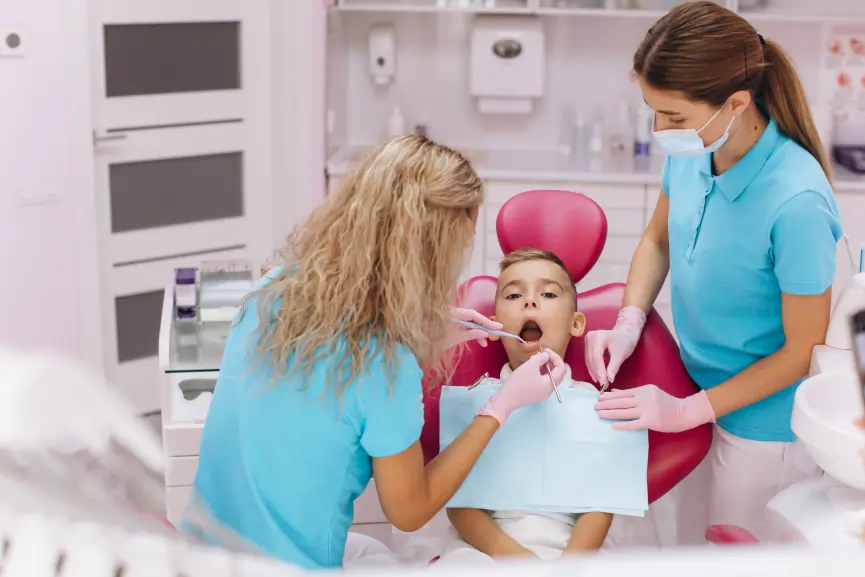
A dental tooth sealant is a thin coating painted into the grooves on the chewing surface of a back tooth. It sets hard and keeps food and bacteria out of pits too narrow for toothbrush bristles to clean well. No needles. No drilling.
Your dentist checks each tooth first and tells you which ones will benefit. You can book dental sealants at our Britannia Road West office in Mississauga.
What are dental sealants?
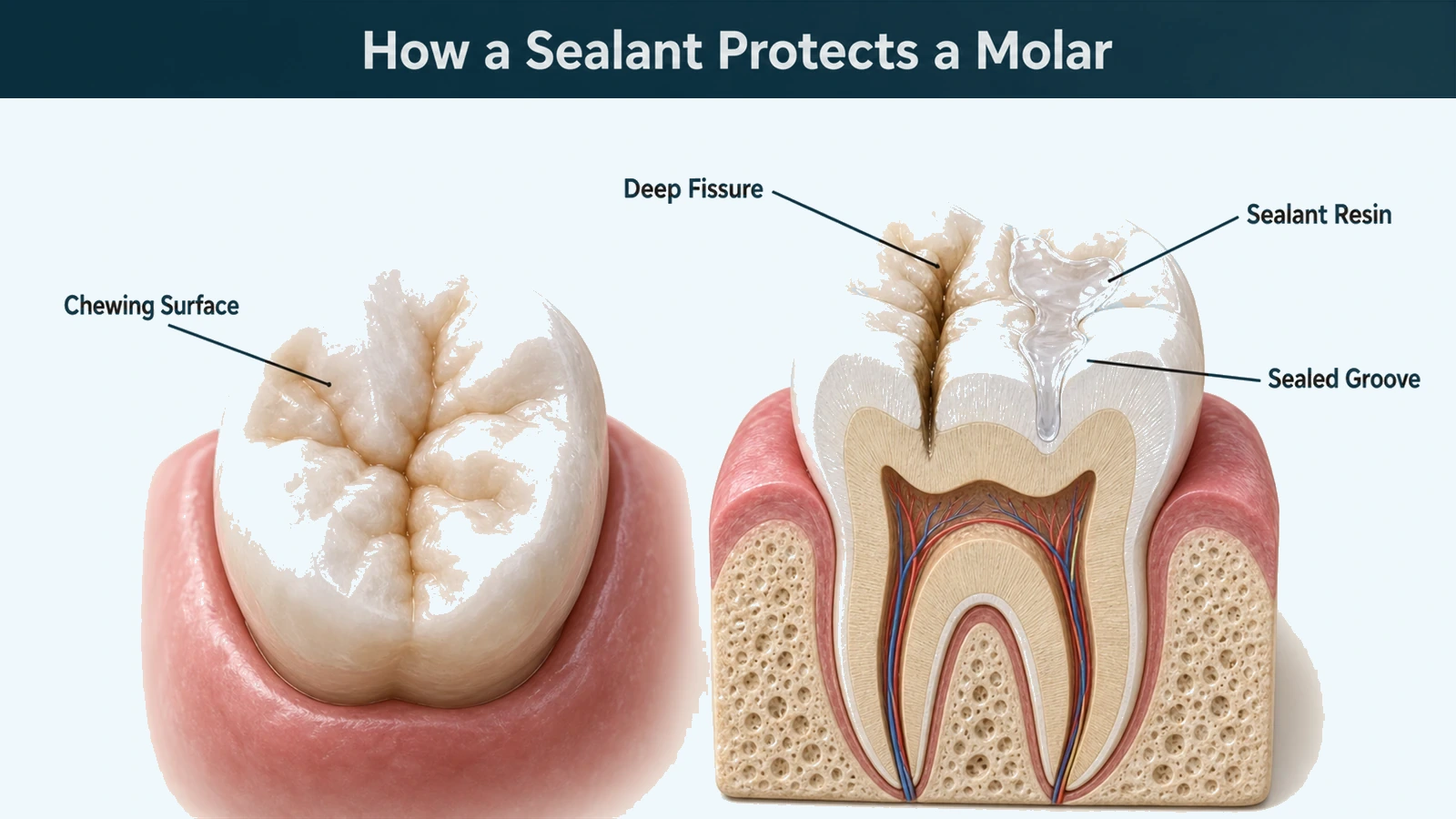
Look at a molar up close. The chewing surface is not flat. It has pits and narrow grooves, called fissures, and some are deeper than a single toothbrush bristle is wide.
Plaque settles at the bottom of those grooves. Bacteria turn sugar into acid there, and decay starts where you cannot brush. The CDC puts it simply: fluoride helps prevent decay in all teeth, and sealants mainly protect the back teeth.
A sealant fills the groove and leaves a smoother surface that is easier to brush clean. Some sealants on teeth are clear and some are tinted.
We use two materials. Resin is our usual choice, and most resin sealants harden under a curing light. Glass ionomer sets through a chemical reaction and is our choice when a tooth cannot be kept fully dry, such as a molar that has only partly come through.
How well do sealants work?
Sealants in dental trials have a strong record in children and teens. A Cochrane review pooled 38 trials with 7,924 children.
- In CDC survey data, low-income children aged 7 to 11 without sealants had almost three times more decayed or filled first molars than children with them
- A Cochrane review of trials in children and teens found resin sealants on permanent molars reduced decay by 11% to 51% at 24 months, compared with no sealant. The review saw a similar benefit up to 48 months
- The ADA reports that in three studies with nearly 2,000 people, sealants on chewing surfaces led to a 73% lower risk of new decay than fluoride varnish alone
Sealants add to fluoride. They do not replace it. Our fluoride treatment page explains how fluoride protects every tooth surface.
Who should get sealants?
The Canadian Dental Association supports sealants chosen tooth by tooth from your risk of decay and an exam by a dentist. We work the same way.
Sealants for kids and teens. The first permanent molars come in around age 6 and the second molars around age 12. Sealing them soon after they come through protects them from the start.
Sealants for adults. Adult teeth with deep, unfilled grooves take sealants too. They make most sense when you have:
- Decay in other back teeth in the past few years
- A dry mouth from medication or a health condition
- Braces or other appliances that trap plaque
- Frequent sugary snacks or drinks
Adult back teeth stay at risk for years after school age. The CDC reports that adults aged 20 to 34 have more untreated cavities in their back teeth than any other age group.
A shallow groove that cleans well does not need one. Sealants for molars and premolars are the common choice. A tooth that already carries a filling or a crown is not sealed, as the Cleveland Clinic sets out. Your dentist tells you which teeth are worth sealing.
Book a sealant check. Call (905) 821-8632 or book online.
The dental sealant procedure for kids and adults
- Your dentist examines the tooth and checks the groove for decay
- The tooth is cleaned and kept dry
- A conditioning gel prepares the enamel so the sealant can grip, then it is rinsed off
- The tooth is dried again, because a sealant needs a dry surface to bond
- Your dentist paints the sealant into the grooves and hardens it with a curing light, or leaves it to set
- Your bite is checked and any high spot is smoothed
This sealing of teeth needs no needle and no drilling, since no tooth is removed.
Does getting a sealant hurt?
There is no needle and no drilling.
You feel air, water and a brush on the tooth, plus light pressure while the surface is cleaned. A sealant sits on enamel, the hard outer layer of the tooth. StatPearls describes mature enamel as not sensitive.
Some young children find it hard to keep still with the mouth open. Tell us if your child is nervous and we will explain each step first. Tell us as well if your bite feels high afterwards, and we will check the sealant. See children's dentistry.
Sealing over early decay
Some grooves show a very early lesion, where the enamel has started to weaken but has no hole yet. A sealant can go over it when your dentist judges it suitable.
A 2016 ADA and American Academy of Pediatric Dentistry guideline found that sealants can slow these early lesions in the molars of children and teens.
A groove with a hole in it is different. A sealant does not treat that tooth, and your dentist plans the repair, such as a dental filling.
How long do sealants last?
Resin sealants hold up well. A 2012 review of retention studies found about 84% of light-cured resin sealants still fully in place after five years. Results varied widely between studies.
Fewer than one in five glass ionomer sealants were fully in place at five years. That is why we keep glass ionomer for teeth that cannot be kept dry.
Chewing wears them down, and a hard bite can chip one. The Cleveland Clinic puts sealant life at up to five years and names extremely hard, sticky or chewy foods as a cause of chipping. A part-lost sealant leaves some of the groove open again. We check yours at every dental exam and repair or replace it when needed.
Sealants vs fillings
| Sealant | Filling | |
|---|---|---|
| Job | Prevents decay in a groove with no hole, and can slow early decay | Repairs a tooth that has a cavity |
| Tooth removed | None | Decayed tooth is removed first |
| Needle | No | Where the tooth needs freezing |
| Area cost | $30 to $60 per tooth | $150 to $498 for a composite filling |
At area prices, the highest sealant price is less than half the lowest composite filling price.
Are sealants safe?
The ADA says resin sealants give off an exceedingly low level of BPA for a few hours after placement. It finds no health concern from that exposure. It puts the amount below what a person takes in from breathing air or handling a receipt. Most daily BPA exposure comes from food and drink.
Tell us before treatment about any allergy to dental materials.
What sealants will not do
- Protect the sides of teeth between them, or the gum line. Cleaning between teeth, fluoride and less sugar help there
- Replace brushing twice a day with fluoride toothpaste
- Fix a cavity that has already formed
- Last forever. Each one needs checks at your visits
Dental sealants cost in Mississauga
| Treatment | Area range |
|---|---|
| Dental sealant, one tooth | $30 to $60 |
Five Ontario clinics that publish a price, two of them in Mississauga, run from $30 to $60 per tooth. These are area ranges and not our fee schedule. Your written estimate is the number that counts.
The total follows the tooth count
Every sealed tooth is its own charge. Four first molars at the area range come to $120 to $240, and all eight first and second molars come to $240 to $480. Adding premolars adds more again. Your estimate names each tooth, so you can decide to start with the ones at highest risk.
Offices in Ontario price with the Ontario Dental Association's annual suggested fee guide in view. The ODA is clear that no dentist is bound by it.
- We offer direct insurance billing. Check how many sealants dental plans like yours cover, and up to what age
- Healthy Smiles Ontario is free for children and youth 17 and under whose families qualify. It covers sealants on permanent molars only. When you book, ask whether we take the program
- The Canadian Dental Care Plan is open to all ages for eligible Canadian residents; eligibility requires no access to private dental insurance, the required Canadian tax returns, adjusted family net income under $90,000, and Canadian residency for tax purposes. Its sealant benefit covers patients aged 17 and under
- CDCP covers the chewing surfaces of permanent molars and premolars, and the inner surface of upper front teeth, where the surface has no filling
- It does not cover wisdom teeth, canines or lower front teeth. The limit is two per eligible tooth over a patient's whole life, counting sealants and preventive resin restorations together
- The plan groups sealants with exams, x-rays, cleaning and fluoride as preventive services. Some services past a frequency limit need preauthorization first
You pay any co-payment and any gap between the dentist fee and the CDCP fee. The co-payment is nothing when adjusted family net income is under $70,000, then 40% of the plan fee up to $79,999 and 60% up to $89,999 (Government of Canada). Full details on dental coverage and the CDCP.
Dentistry on Britannia is a general dental practice. Our dentists are general dentists, not specialists in any RCDSO-recognised specialty.