
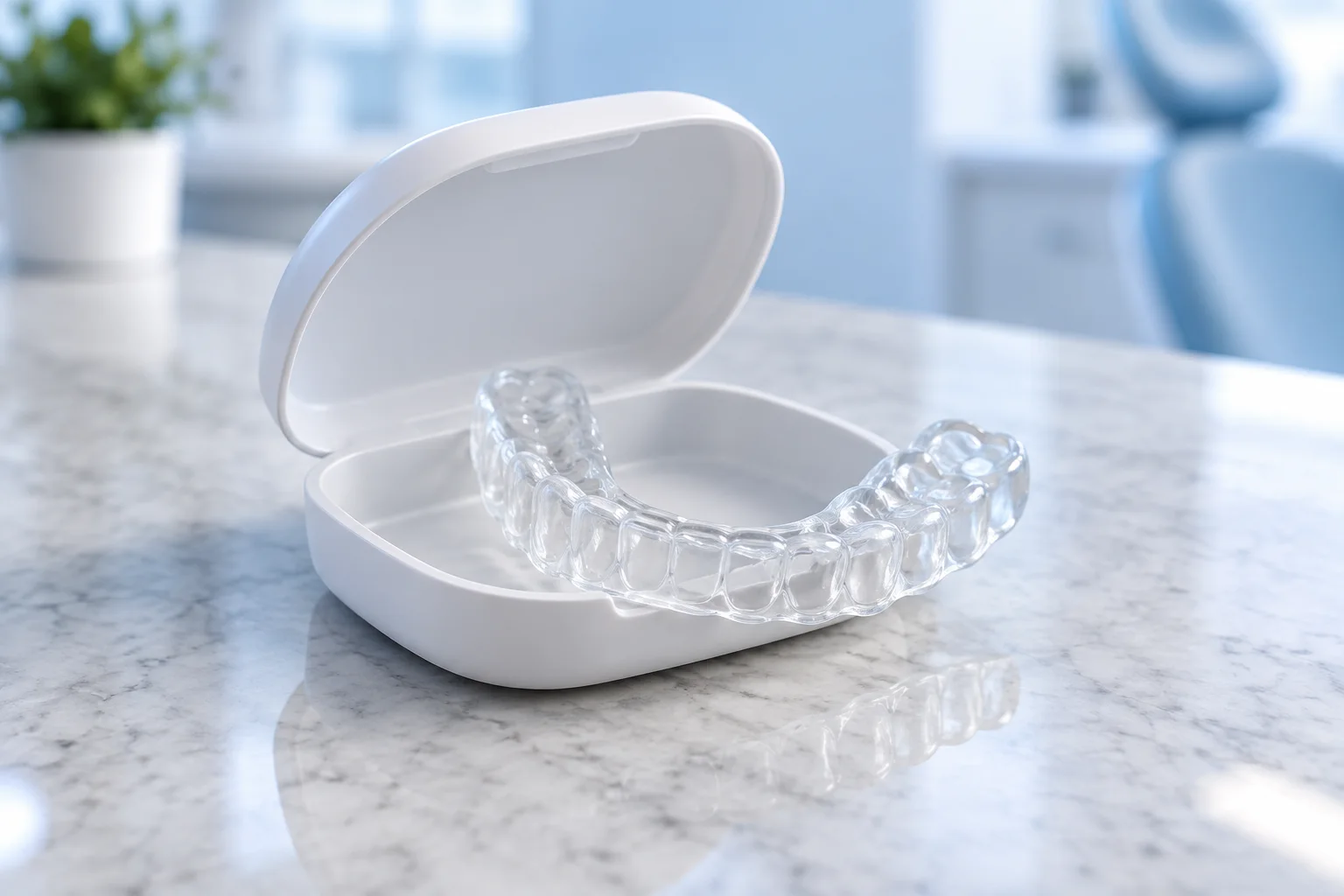
A night guard is an appliance made to fit your own teeth. Worn in bed, it sits between the upper and lower teeth so the grinding lands on the plastic instead of your enamel.
You can have one made at our Britannia Road West office in Mississauga. Plenty of people who need one for teeth grinding found out at a check-up, not in the night. Your insurer may call it a bruxism night guard or an occlusal guard. Same appliance.
What a night guard does
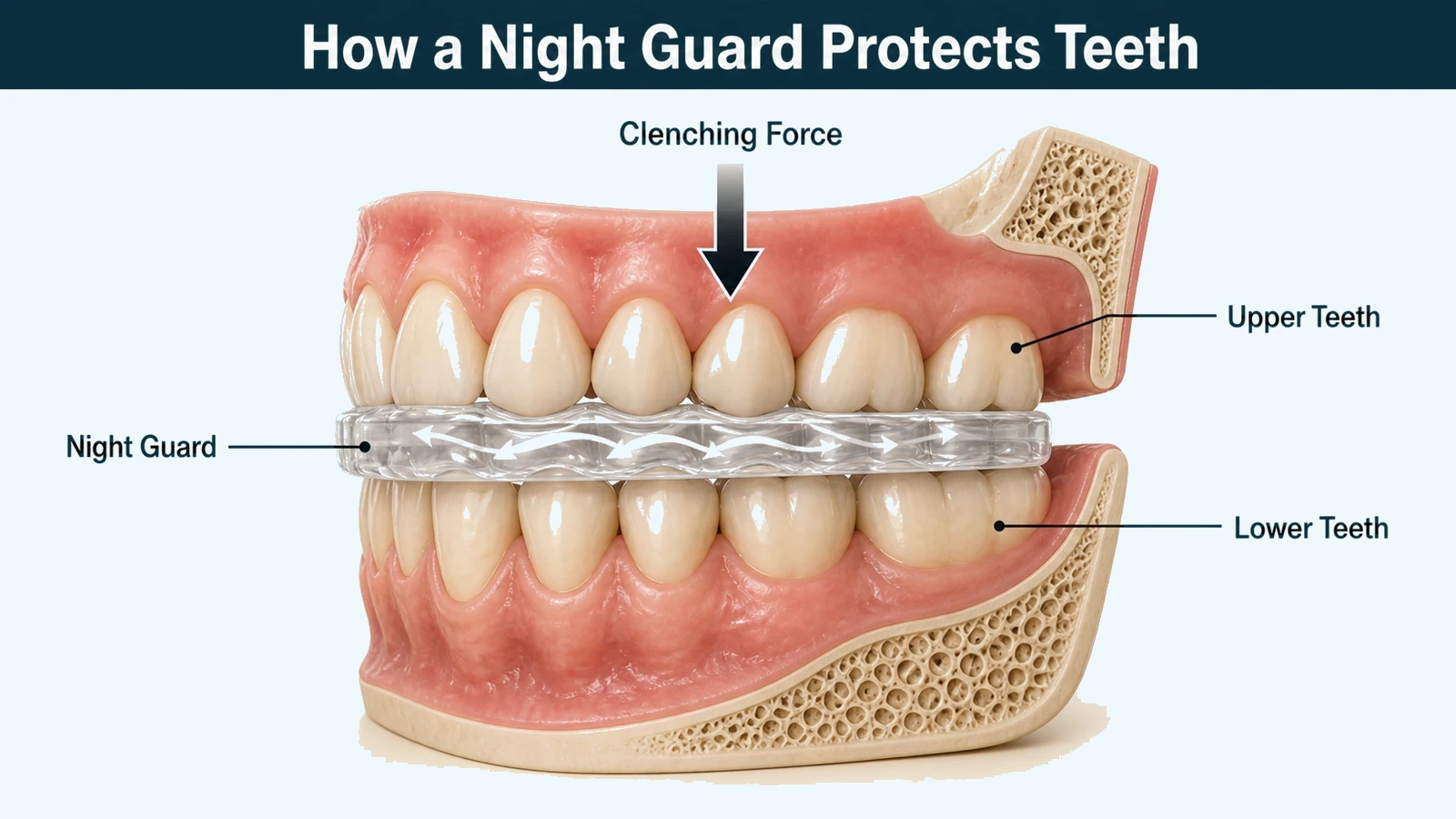
It puts a layer of hard plastic between the upper and lower teeth. The plastic takes the wear, and it spreads the load across the whole arch instead of letting two or three teeth carry it.
The Canadian Dental Association describes a custom guard as something that can help even out the pressure across the jaw and create a physical barrier between the upper and lower teeth to protect them from damage. That is an accurate description of the job.
The grinding carries on underneath it. A guard is armour, not a cure, and knowing that before you buy one is the difference between a realistic expectation and a disappointed one.
Anything sold as stopping the habit itself is overstating what an appliance can do.
Why enamel is the thing being protected
Enamel does not regrow. Whatever grinding wears off is gone for good, and no filling or crown puts back what was there.
The damage builds quietly over years. By the time flattened edges are obvious in a mirror, a good deal of it has already happened.
Clenching loads a tooth far harder than chewing does. The Canadian Dental Association lists cracked or broken teeth, broken crowns and fillings, a higher risk of gum problems, and more stress on the jaw joints and muscles among what prolonged grinding leads to.
If your dental work keeps failing, grinding belongs on the list of reasons alongside decay and the design of the restoration. Learn more about dental crowns.
How would you know
Many people who grind in their sleep have no idea. The Canadian Dental Association describes a partner, spouse or parent being the one who hears it first.
What you can spot yourself:
- Aching teeth or jaws when you first wake up or eat breakfast
- Facial pain or stiffness in the temples after waking
- Headaches
- Earaches
- Teeth sensitive to hot and cold with no cavity to explain it
- The feeling that a tooth has gone loose
What a dentist looks for. Biting edges worn flat, fine cracks in the enamel, ridges along the inside of the cheeks, scalloped edges on the tongue, and restorations that keep breaking.
None of it proves grinding on its own. Acid erosion flattens teeth too, and plenty of people have cheek ridging without grinding at all. These are clues read next to what you tell us.
How common it actually is
Teeth grinding is far more common than most people assume. A 2024 systematic review in the Journal of Clinical Medicine pooled studies published between 2003 and 2023 and put sleep grinding at 21% of people worldwide. Awake clenching came out slightly higher at 23%.
North America had the highest regional rate for sleep grinding in that review, at 31%. Europe was 21% and Asia 19%.
So roughly one person in five grinds at night.
Custom or shop-bought
A custom night guard is made over a model of your own teeth. A shop-bought one is made over nobody's teeth. The difference is fit, and fit here is not a comfort preference. It decides whether the appliance protects you or creates its own problem.
| Custom guard | Boil-and-bite or stock | |
|---|---|---|
| Made from | An impression or scan of your own teeth | A generic shape, softened in hot water |
| Coverage | The full arch, planned | Varies, sometimes only part of the arch |
| Assessed first | Yes, before anything is made | No |
| Adjustable | Yes, and checked at your appointments | No |
| Thickness | Set for how hard you grind | Thins wherever you bite hardest |
| Risk of moving teeth | Lower, and monitored | Higher, particularly with partial coverage |
| Price | $400 to $800 | Drugstore shelf price |
A bulky guard that makes you gag ends up in a drawer, and a guard in a drawer protects nothing. That is the practical case for a custom one.
The clinical case is narrower and more serious. An appliance that covers only some of the teeth lets the uncovered ones keep moving, and over months that changes how your teeth meet. A 2024 review of 15 studies in BMC Oral Health found the effect on jaw muscle activity differs between splint designs, and that possible side effects need weighing case by case.
Stop wearing any guard that causes pain, makes a tooth feel loose, or changes your bite, and get it looked at.
Hard, soft, or a bit of both
Guards are made in several materials and the right one depends on what your teeth are doing.
Soft. Flexible and quick to get used to. It wears through faster under a heavy grinder, and some people find a soft surface invites more chewing.
Hard acrylic. Rigid, longer lasting, and the usual answer for a heavy grinder. It takes a few more nights to settle into.
Dual laminate. Soft against the teeth, hard on the outside. It aims at the comfort of one and the durability of the other.
We make all three. Which one suits you comes out of the examination, not out of a price list. The wear pattern is the thing that settles it.
Top or bottom
Upper is the common answer and it is not the only one.
An upper guard is the usual choice because it covers more tooth surface and stays put. A lower guard is easier to tolerate if you gag, and it is the better option when the upper teeth carry crowns or bridgework that would be awkward to cover.
You only need one.
We decide which arch at the assessment, from your bite and from what your teeth already have on them.
How yours is made
Two visits.
First visit. We go through the symptoms, look at the wear pattern on your teeth, and check the jaw joint and muscles. Anything that needs treating gets dealt with before an impression is taken, because a guard made over a tooth that is about to be restored will not fit afterwards. Then a digital scan of the arch or an impression, both taken here.
Between the visits. A dental laboratory pours a model of your teeth and forms the guard over it. That is where the turnaround time goes.
Second visit. The guard is seated, the bite is checked so it meets evenly, and the edges are adjusted where they press. You leave with it in a ventilated case.
We check it at your regular appointments after that, alongside your teeth.
The first few weeks
Expect to notice it at first.
Extra saliva on the first few nights is common and it settles. Some people get the opposite and wake with a dry mouth. Waking up once or twice having pushed it out is also normal early on.
Wear it every night, for the whole night. A guard worn three nights a week protects you three nights a week.
The Canadian Dental Association puts it plainly: some patients get on with a mouth guard more successfully than others. If yours is still fighting you after a few weeks, bring it back instead of giving up on it so we can adjust it.
What a night guard will not do
It will not stop the grinding. Your jaw does the same thing with the guard in. What changes is where the wear lands.
It will not treat sleep apnoea. An umbrella review in Sleep Medicine in 2026 pooled eight systematic reviews and found that adults with obstructive sleep apnoea do appear more likely to grind, but that nobody has shown which drives which, and the underlying evidence behind even that was mostly weak. If you snore heavily, stop breathing in your sleep, or wake unrefreshed, raise it with a physician. The appliance used for sleep apnoea is a different device and it is not the same thing as a night guard.
It will not fix a jaw joint problem. Clicking, locking, or difficulty opening wide is a separate assessment with a separate answer.
Jaw pain and TMD, briefly. TMD is an umbrella term for problems with the jaw joint, the muscles that move it, or both. They are different conditions with different answers, and telling them apart is most of what an assessment does. What we treat here is assessment, splint therapy, and jaw exercise and self-management guidance. Where the picture points to the joint itself, or where symptoms do not respond, we refer.
Jaw pain with chest pain, shortness of breath, sweating or nausea needs urgent medical attention, because it can be a symptom of a heart problem.
Grinding and TMD overlap for many people and they are not the same thing. One does not always explain the other, which is why the assessment comes before the appliance.
It is not a sports guard. Different material, different thickness, different job. One is built for hours of slow pressure and the other for a single impact. Learn more about sports mouth guards.
Side effects, and what to watch for
A well made guard that fits is uneventful. The problems come from fit, and they are worth knowing.
A bite that feels different after a few weeks is the one to act on. Stop wearing it and book in.
Gum soreness along the edge means the guard is running onto the gum where it should stop at the tooth. Bring it in to have the edge trimmed back, and leave it out until then.
Teeth feeling loose needs looking at, not waiting out.
A guard does not cause gum recession by itself, and one pressing on a gum margin night after night does it no favours either. This is the part people miss about a shop guard: there is nobody checking where its edge sits.
Headaches are the least predictable part of this. Some ease once the load comes off the teeth. Others do not. If yours are not budging after a few weeks, we reassess instead of adjusting the same appliance.
Looking after it
Every morning. Run it under cool water and brush it through with a soft brush and no paste. Toothpaste is abrasive enough to scratch the surface, and a scratched surface holds more.
Drying. Let it dry fully before it goes away. A damp guard in a closed case is where the smell starts.
Never use hot water. It distorts the plastic, and a distorted guard does not fit. The same goes for a dishwasher, a car dashboard, and a windowsill in summer.
Weekly. A soak in a denture cleaning tablet or in equal parts white vinegar and water lifts the film that brushing leaves behind.
Yellowing is mineral build-up from saliva, not dirt. A soak clears most of it. A guard that stays stained and smells after a soak has reached the end of its life.
Bring it with you to your appointments so we check it alongside your teeth.
When to replace it
How long one lasts depends on how hard its owner grinds.
Replace it when it is cracked or worn through, when it no longer seats properly, or when your teeth have changed underneath it. New fillings, a new crown, or orthodontic movement all change the fit.
We assess it at your check-ups rather than replacing it on a schedule.
What else helps
A guard protects your teeth. It does nothing about why you grind, and that part is worth attention.
The Canadian Dental Association names anxiety and stress, interrupted sleep, and crooked or missing teeth among the causes of teeth grinding. It also suggests limiting caffeine and alcohol, finding a way to wind down before bed, and staying physically active.
Daytime clenching is a separate habit and a very common one. Your teeth are not meant to touch when your jaw is at rest. They should sit slightly apart, lips closed. Start noticing whether yours are clamped together at a screen, and you can interrupt it for nothing.
The Canadian Dental Association also notes that getting at the causes can need other health professionals, such as a physiotherapist or a psychologist. A dental appliance is one part of the answer. Learn more about night-time teeth grinding.
What a night guard costs in Mississauga
A custom night guard runs $400 to $800 in this part of Ontario, based on prices published by Ontario dental practices.
What moves the number: which material your case calls for, which arch it goes on, and whether anything needs treating before we take an impression. You get a written estimate before any treatment begins.
Most of what you are paying for is laboratory work and chair time, which is why a fitted guard does not land anywhere near a drugstore price.
We do not spread the cost of treatment over time. Some practices in the area do, so it is worth asking when you compare quotes.
Insurance. Many private plans include night guards under an appliance category with its own frequency limit, separate from preventive care. Coverage differs from plan to plan, so we can send an estimate to your insurer first and get their answer in writing before you commit. We offer direct insurance billing.
The Canadian Dental Care Plan does not cover night guards. The plan's own list of permanent exclusions names bruxism appliances and mouth guards outright. It is open to all ages for eligible Canadian residents; eligibility requires no access to private dental insurance, the required Canadian tax returns, adjusted family net income under $90,000, and Canadian residency for tax purposes, and it covers plenty of other treatment here. This is simply not one of them. Learn more about CDCP coverage at our practice.
Dentistry on Britannia is a general dental practice. Our dentists are general dentists, not specialists in any RCDSO-recognised specialty.