

The common giveaways are waking with a sore or tired jaw, headaches around the temples in the morning, teeth that look worn flat at the edges, and dental work that keeps breaking.
Key takeaways
- You cannot reliably tell on your own. The signs a dentist looks for are wear patterns, small enamel cracks, and sensitivity with no decay to explain it
- Waking with a sore jaw or temple headaches is the commonest thing patients notice themselves
- Enamel does not grow back. Whatever grinding wears away is gone permanently
- If your dental work keeps breaking, grinding is worth ruling in or out alongside decay, the design of the restoration and the bond
- A night guard protects teeth. It does not stop grinding. The appliance takes the wear instead of your enamel
- Daytime clenching is a separate habit and extremely common. At rest your teeth should not be touching
- Snoring or interrupted breathing alongside grinding is worth raising with a physician, not just a dentist
How do I know if I grind my teeth?
You cannot, directly. The signs accumulate, and most people recognise several of these once they are pointed out.
What you might notice yourself
A sore or tired jaw when you wake up. This is the commonest first symptom. The muscles have been working for hours.
Headaches around the temples, particularly in the morning. The muscle that closes your jaw runs up the side of your head and aches like any overworked muscle.
Aching teeth in the morning that settles during the day.
Sensitivity to cold with no cavity to explain it.
A partner mentioning the noise. Not everyone makes a sound. Some do.
What a dentist looks for
None of these proves grinding on its own. Wear can come from acid erosion, and cheek ridging occurs in people who do not grind. They are clues that build a picture, and they are read alongside what you report.
Teeth worn flat at the biting edges. Gradual enough that you can miss it in a mirror you look at every day.
Small cracks in the enamel, visible under a light at an examination.
Ridges on the inside of your cheeks, or scalloped edges on your tongue. These are marks left by teeth pressing against soft tissue.
Dental work that keeps failing. Bonding that chips repeatedly, crowns that come loose, fillings that fracture.
Teeth that have become loose, in more advanced cases.
What grinding actually does
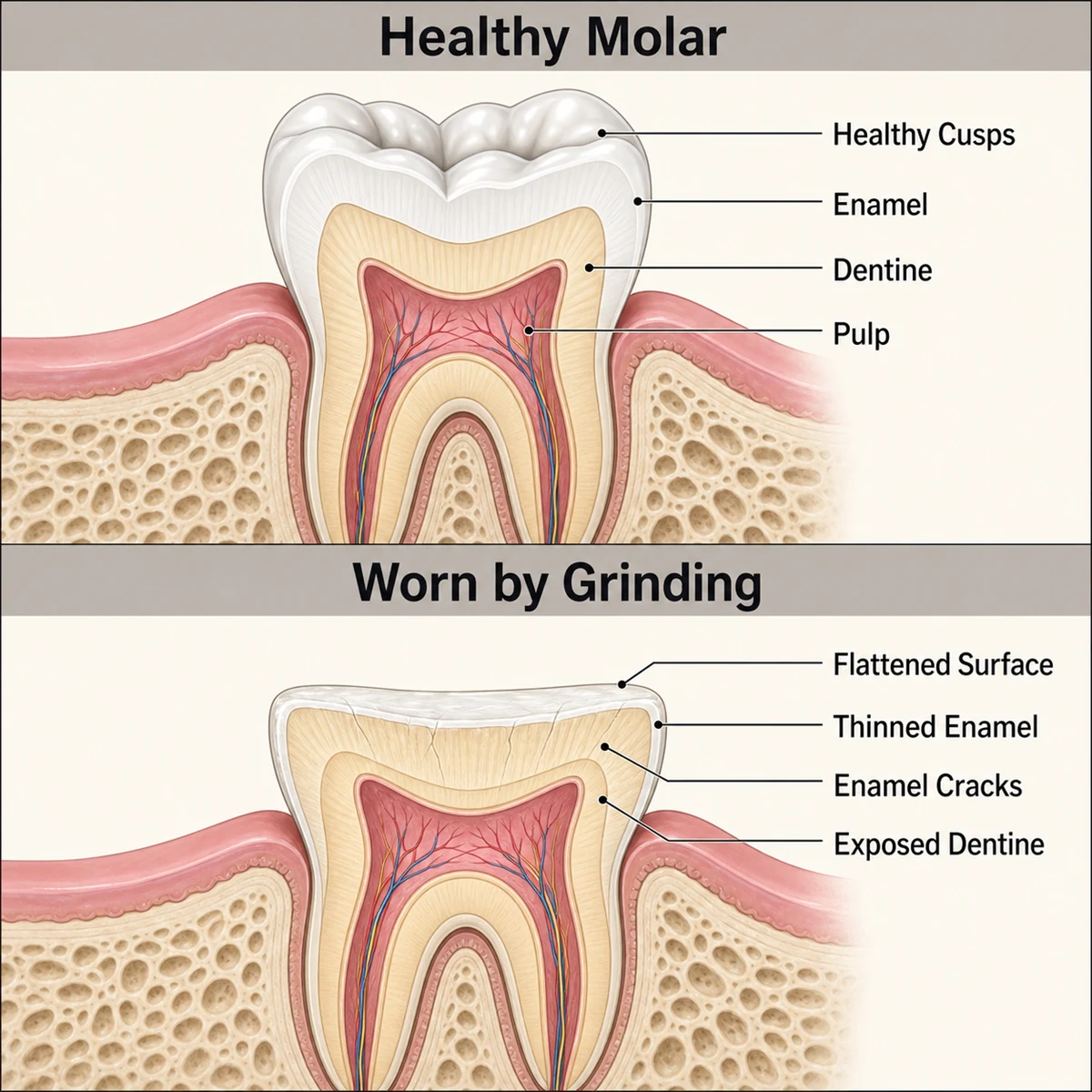
It wears away enamel, permanently
Enamel is the hardest substance your body makes, and it does not regenerate. Whatever is worn off is gone.
It cracks teeth
Clenching and grinding load a tooth far harder than chewing does, and repeat that loading many times in a night. Over time this can contribute to cracked cusps and split teeth, particularly where a tooth is already weakened by a large filling.
It breaks dental work
Crowns, veneers, bonding and fillings are all more likely to chip, fracture or come loose in someone who grinds. Where that is happening, the grinding is worth taking into account when the repair is planned. Replacing like for like ignores the cause. Learn more about dental crowns.
It overworks the jaw muscles and joint
Which can contribute to jaw soreness and to some morning headaches. Both have other possible causes too, so persistent, severe or unusual symptoms are worth raising with a physician as well.
It may play a part in gum recession
Recession and wear at the gumline have several possible causes, brushing technique, gum inflammation and anatomy among them, and grinding is one factor that may contribute. Exposed root is softer, more sensitive and decays faster, so it is worth assessing. Do not assume the cause.
None of this happens quickly, which is exactly why it is worth catching. Grinding damage accumulates over years, and the earlier it is identified the less of it there is.
Why do people grind their teeth?
There is rarely one cause, and knowing which apply to you changes what helps.
Stress and anxiety are the cause cited most, and for many people the pattern is obvious in hindsight.
Daytime clenching. A separate habit from sleep grinding, and one that goes unnoticed for years.
Sleep disturbance. Grinding is associated with disrupted sleep, and that is the part of the picture most people miss.
How your teeth meet. An uneven bite can contribute, though less often as the sole cause than was once thought.
Some medications and stimulants, including caffeine, alcohol and smoking, are associated with more grinding.
Age. Grinding in children follows a different pattern from grinding in adults.
Three of those have a section of their own further down: daytime clenching, sleep, and children.
What actually helps
A custom night guard
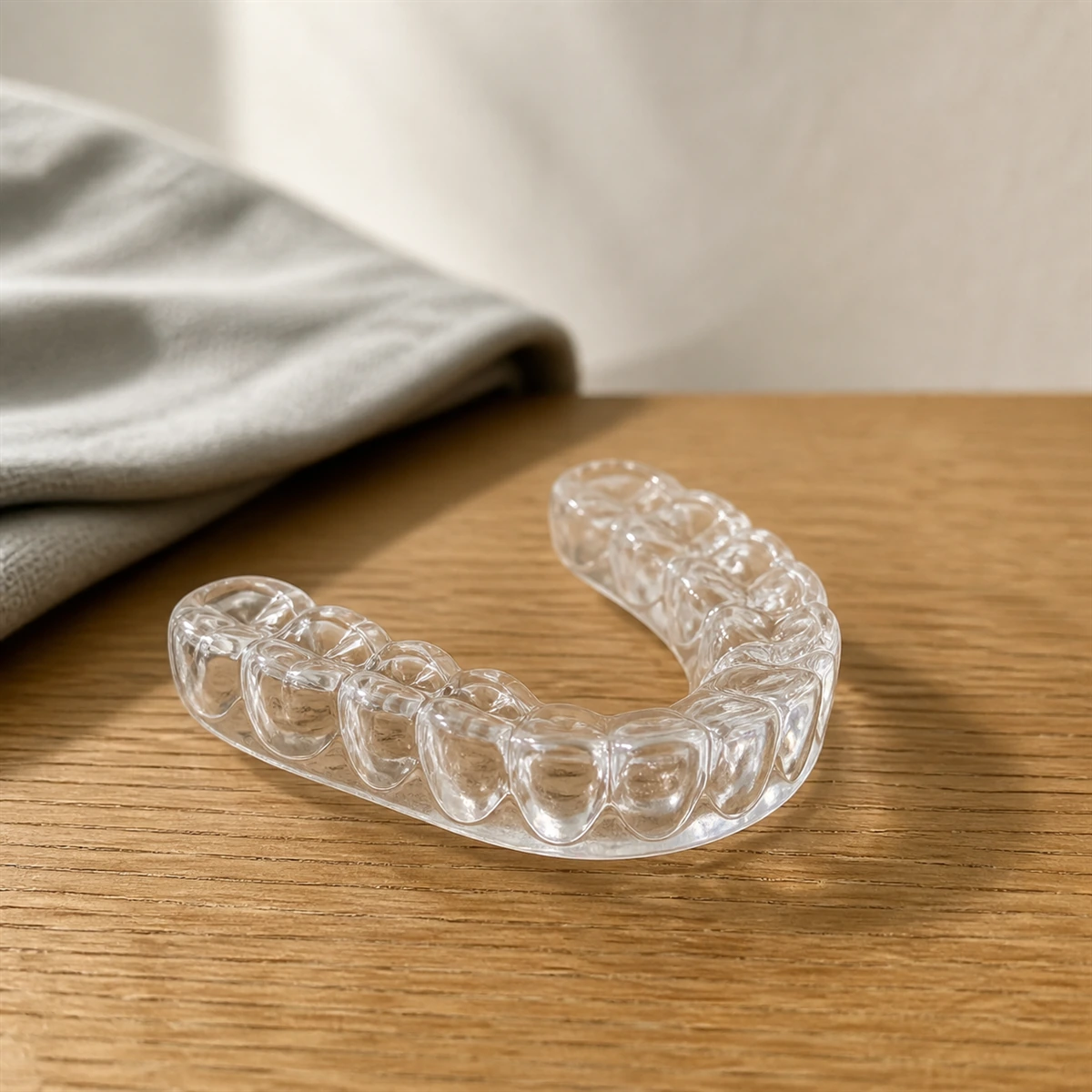
This is the main thing a dental practice offers, and it is worth being precise about what it does.
A night guard is a moulded appliance worn when you sleep. It separates and protects the biting surfaces, so the appliance takes the wear, not your enamel.
The grinding itself carries on. A night guard protects teeth. It is not a cure for bruxism, and that difference is worth knowing before you buy one.
Guards should be reviewed at your check-ups and replaced when wear, damage or a change in fit makes it necessary. Learn more about night guards.
Custom, or from a pharmacy?
You can buy one over the counter. If you use one, stop and get it checked if you develop pain, if a tooth feels loose, or if your bite starts to feel different.
It is worth being assessed first, particularly if you have jaw pain or locking, loose teeth, gum disease, dentures, orthodontic appliances, or snoring and interrupted breathing at night.
The practical difference is fit. A guard that is bulky or makes you gag ends up in a drawer, and a guard in a drawer protects nothing. A custom appliance offers a more controlled fit, and it is adjusted and monitored here.
Appliances that fit poorly, or that cover only some of the teeth, can alter how the teeth meet over time. Any guard causing pain, a change in your bite, or teeth feeling loose should be stopped and assessed.
Noticing daytime clenching
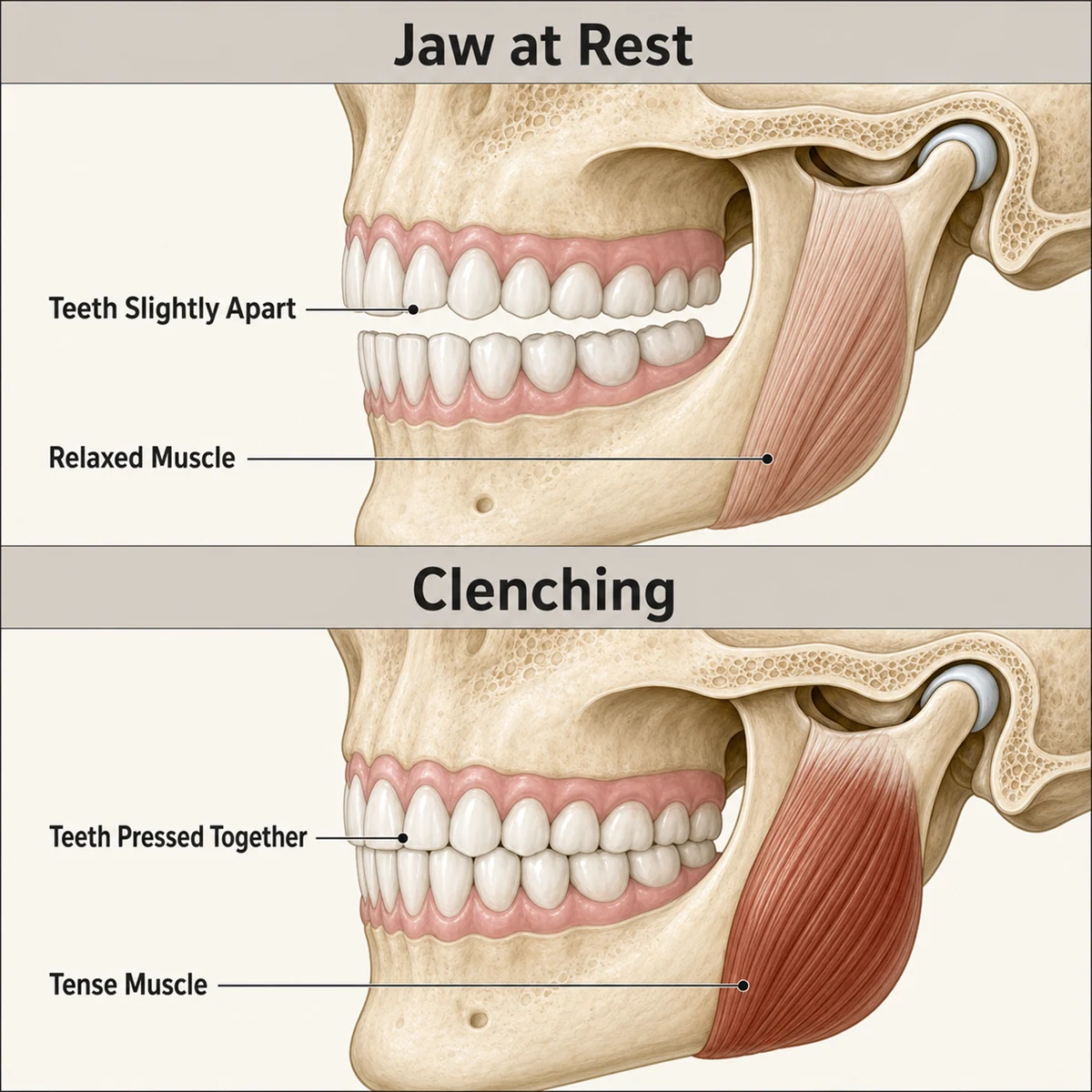
Costs nothing and helps more than people expect.
At rest, your jaw should be relaxed and your teeth slightly apart. They are not meant to be touching. Once you notice that they are, you can interrupt it.
The obvious ones
Caffeine and alcohol later in the day have both been associated with more grinding. General sleep hygiene, including screens at bedtime, is worth attention for sleep quality, though its direct effect on grinding is less well established.
Repairing what has already been damaged
Worn, cracked or sensitive teeth are repairable, but the sequence matters.
Where grinding is the likely cause, it belongs in the plan for the repair. Otherwise the same thing happens again. Whether a guard is recommended, and when, comes out of the assessment.
When it is more than grinding
If the main problem is your jaw and not your teeth, meaning clicking, locking, difficulty opening wide, or pain in the joint itself, that is a different assessment.
We assess it and treat what we can treat here, which means examination and splint or night guard therapy. Where the picture points beyond that, we will say so and help arrange it. We will not fit an appliance and hope.
Clicking on its own, without pain or locking, is common and often needs nothing but monitoring.
Some of this should not wait for a routine appointment
A jaw that has locked open or closed, a marked reduction in how wide you can open, symptoms following an injury, or jaw pain with facial swelling or fever all need prompt assessment, not a booked check-up.
Jaw pain and TMD, Appliances and guards
What happens at the appointment
- Examination, including the wear pattern on your teeth, which tells most of the story
- A conversation about symptoms. Morning soreness, headaches, what your partner has noticed, what your sleep is like
- A discussion of what is likely driving it, and what is worth changing
- An impression or scan, if a guard is the right step
- A fitting appointment, then review. A guard needs at least one adjustment
- Review at your check-ups, so wear is measured early instead of found late
What grinding does to dental work, specifically
Worth its own section, because it is the reason many people find out they grind at all.
Crowns and veneers chip or debond. Porcelain is strong under steady load and less forgiving of the repeated, off-axis force that grinding applies.
Composite bonding on a biting edge has a short life without protection. Bonding a chipped front tooth in someone who grinds, without addressing the grinding, is planning for a repeat.
Fillings fracture, or the tooth around them does. A heavily filled tooth is a shell with a plug in it, and grinding is what finds the weak point.
Implants can be overloaded. An implant does not have the ligament that cushions a natural tooth, so it feels less and takes more.
If your dental work keeps failing, investigate the pattern. Repairing each item in isolation misses it. Replacing like for like without accounting for the force is how people end up doing it twice. Learn more about dental crowns.
Daytime clenching is a separate habit
Separate from sleep grinding, and very common. Most people catch themselves at it within a day of starting to look for it.
At rest, your jaw should be relaxed and your teeth slightly apart. They are not meant to be touching. Lips together, teeth apart, tongue resting on the roof of the mouth.
The situations it happens in are predictable: concentrating at a screen, driving in traffic, lifting something heavy, or during a difficult conversation.
Noticing it is most of the treatment, and it costs nothing. A note on a monitor, or a reminder tied to something you already do, works better than trying to remember.
A night guard does nothing for daytime clenching, because you are not wearing it. That is worth knowing before assuming an appliance covers both.
Grinding and sleep
Grinding is associated with disrupted sleep, and that association is the part most articles on this topic leave out.
Where snoring or interrupted breathing is also present, raise it with a physician. This is not a purely dental matter. A guard fitted without that being considered is the right appliance for the wrong problem.
What is worth mentioning to a physician: loud snoring, pauses in breathing that a partner has noticed, waking unrefreshed however long you slept, and daytime sleepiness.
We are not the right people to assess sleep. We can tell you what your teeth show and flag the pattern. The assessment itself belongs elsewhere, and saying so is part of doing this properly.
Children who grind
It is common in children, and most outgrow it.
Mention it at a check-up so a dentist can look at the teeth. That beats watching it at home and worrying.
The caveats that warrant a physician are the same as for adults: snoring, pauses in breathing, or a child who is persistently unrefreshed by sleep.
Reassurance on its own is not enough. A child who grinds and also snores or sleeps badly needs the sleep looked at too, whatever the teeth show. Learn more about children's dentistry.
What to ask at your appointment
Useful because it turns a vague worry into a specific conversation.
- What does the wear on my teeth actually show? Ask to see it.
- Is this wear from grinding, or could it be erosion? They look different and have different answers.
- Is my dental work failing because of this?
- Would a guard help my symptoms, or only protect my teeth? These are different questions and the honest answer to the first is "we will see".
- What should I do if the guard makes things worse?
- Should I be talking to a physician about my sleep?
Dentistry on Britannia is a general dental practice. Our dentists are general dentists, not specialists in any RCDSO-recognised specialty.