

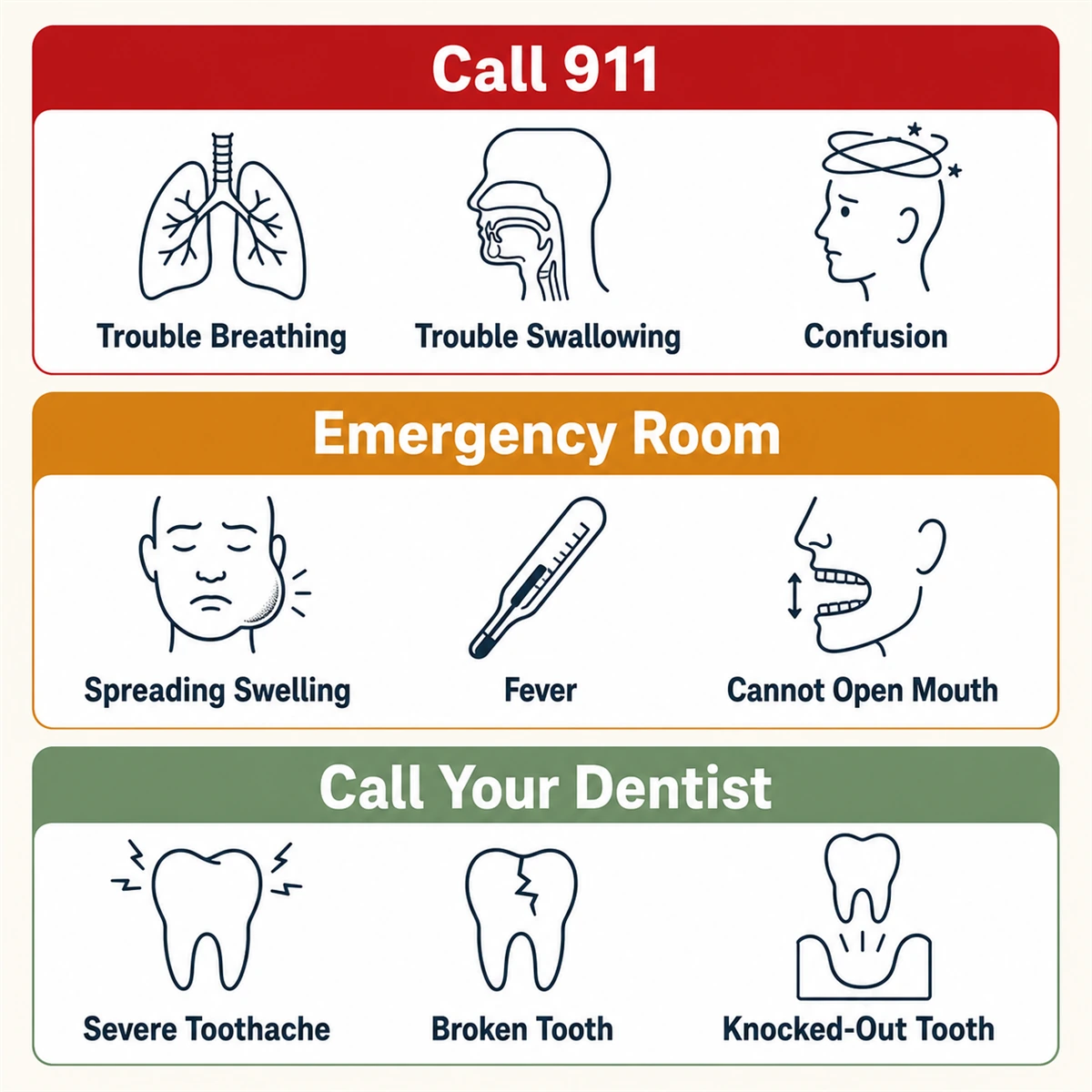
Go to a hospital emergency department if swelling is spreading towards your eye or neck, you have swelling under your tongue, a fever with facial swelling, swelling that is getting worse over hours or you cannot open your mouth properly.
Call us the same day for swelling, pain that stops you sleeping or working, a knocked-out tooth, bleeding that will not stop or an injury to your face or jaw.
Most other dental problems can wait for a normal appointment. Here is how to tell which is which.
Key takeaways
- Airway symptoms are a 911 call and not a dental appointment or a waiting room
- Most hospitals cannot treat the tooth itself. They manage infection, pain and trauma and then send you to a dentist
- Do not wait to see whether facial swelling settles
- A knocked-out adult tooth is time-critical. The best chance is within the hour. Hold it by the crown and keep it moist
- Pain that stops on its own is not reassuring. A nerve that dies stops hurting. The infection does not stop
- We open at 7:00 am Monday to Thursday and on Saturdays. Call and we will tell you the soonest we can see you
- You do not need to be an existing patient or have a referral
Call 911 now if you have any of these
Some problems are beyond what a general dental office can handle. A few are beyond what a waiting room is safe for.
- Difficulty breathing or difficulty swallowing
- Drooling or not being able to manage your own saliva
- A changed, muffled or hoarse voice along with mouth or facial swelling
- Confusion, faintness or unusual drowsiness
- Heavy bleeding you cannot control
- A head injury with loss of consciousness
- Sudden swelling of the lips or tongue with a rash or itching. This can be an allergic reaction and not a dental problem. It is treated as an emergency
A dental infection that spreads into the tissues of the neck or the floor of the mouth can affect the airway. That is a medical emergency and it is why this list sits above everything else on the page.
Go to the emergency department if you have any of these
- Swelling spreading under the jaw, into the neck or towards the eye
- Swelling under the tongue or in the floor of the mouth
- A fever with facial swelling or feeling unwell and shivery
- Swelling that spreads quickly over hours and not days
- Difficulty opening your mouth
- New problems with your vision
- Bleeding that will not stop
- A serious injury to the face or jaw after an accident
Not sure which list you are on? Treat it as the more urgent one. Nobody will think less of you for arriving at hospital with something that turns out to be manageable.
Call us the same day for these
Swelling of the face or gum. An infection that has spread beyond the tooth is a common cause and swelling has other causes too. It needs assessing promptly whatever the cause. Learn more about emergency dental care in Mississauga.
Pain that stops you sleeping, working or concentrating. Severe pain has several possible causes and some of them get worse without treatment. Learn more about emergency dental care in Mississauga.
A knocked-out adult tooth. This is time-critical and the step-by-step guide is below. Learn more about emergency dental care in Mississauga.
A broken tooth with the inside exposed or a break that is bleeding or very painful. Learn more about emergency dental care in Mississauga.
A tooth pushed out of position or loose after an injury.
Bleeding after an extraction that will not settle with continuous pressure.
A dental abscess that has burst. The relief is real, and it is temporary. The abscess has drained. It has not gone.
These can usually wait a few days
A lost filling or crown. Keep the crown, avoid chewing on that side and book within days, not weeks. Learn more about emergency dental care in Mississauga.
A chipped tooth that does not hurt. Enamel has no nerve supply, so a large chip can be completely painless. It is still worth seeing soon.
Sensitivity to hot or cold that stops quickly.
A broken denture unless it is cutting you.
An orthodontic wire rubbing. Cover the end with orthodontic wax and call in the morning.
Gums that bleed when you brush. Not an emergency, and not nothing. Gum inflammation is a common cause and it is easiest to treat early.
If any of these gets worse, call sooner.
Quick triage
| Symptom | Where to go |
|---|---|
| Difficulty breathing or swallowing | 911 |
| Drooling, muffled voice, confusion | 911 |
| Sudden lip or tongue swelling with rash | 911 |
| Swelling towards the eye or neck | Emergency department |
| Fever with facial swelling | Emergency department |
| Cannot open your mouth | Emergency department |
| Facial or gum swelling, otherwise well | Call us today |
| Severe toothache | Call us today |
| Knocked-out adult tooth | Call us now, within the hour |
| Broken tooth, painful | Call us today |
| Lost filling or crown | Call us this week |
| Chipped tooth, no pain | Call us this week |
| Bleeding gums when brushing | Book an assessment |
Not sure where you fit? Call (905) 821-8632 and tell us what is happening.
The one that catches people out
Pain that goes away on its own is not reassuring.
A tooth can hurt badly for days and then stop. It feels like recovery and it may mean the opposite, because one common reason is that the nerve has died. A dead nerve cannot send pain signals, but the problem underneath carries on.
Sudden relief does not mean the problem has gone. Swelling is a common next step.
If you had severe toothache and it stopped without treatment, book anyway.
What to do right now, by problem
If you have a knocked-out adult tooth
If the tooth was lost in an accident, the injury comes first. Call 911 for loss of consciousness, confusion, unusual drowsiness or heavy bleeding you cannot control. Go to the emergency department first for any other head injury, a suspected broken jaw or bleeding that will not stop. Bring the tooth with you.
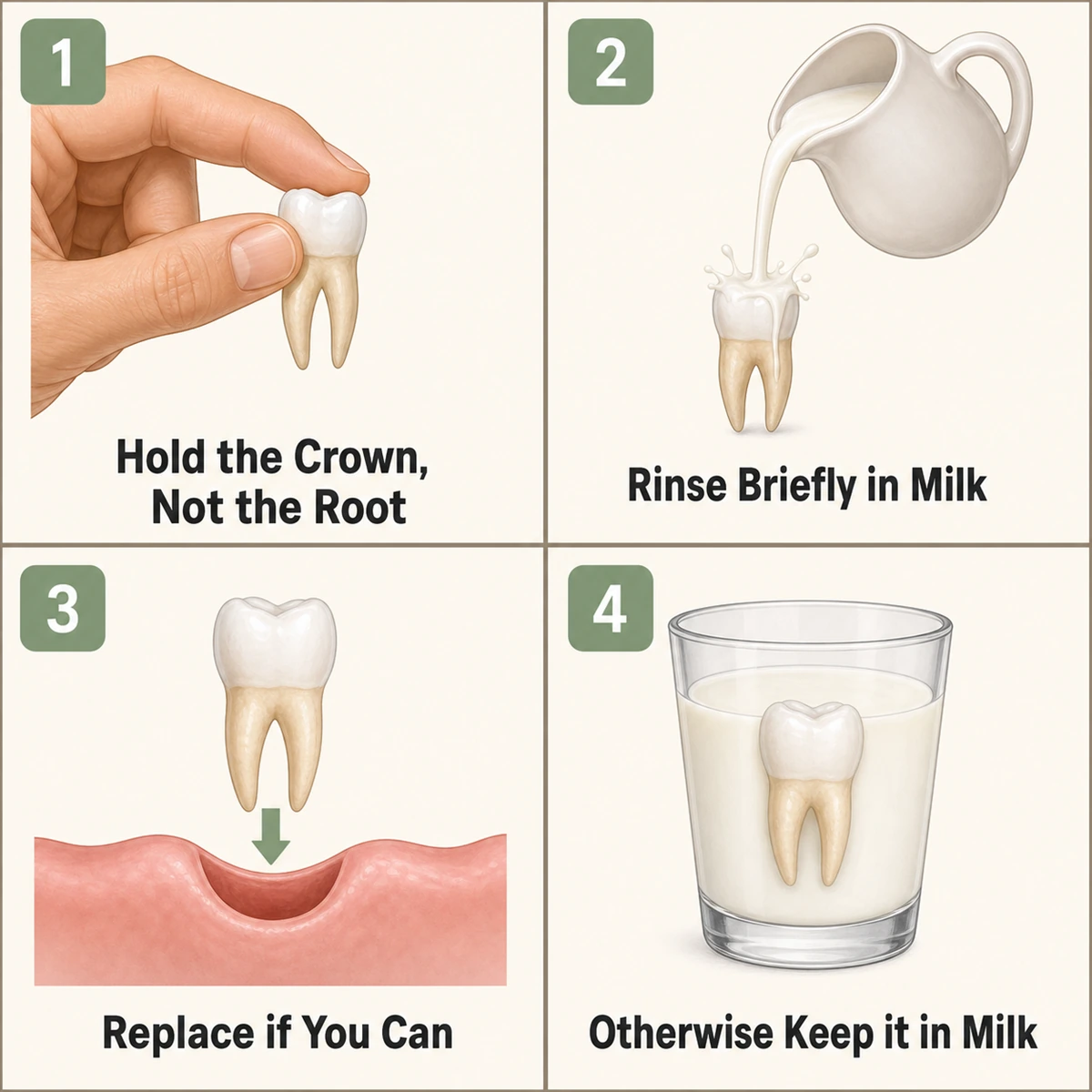
- Pick the tooth up by the crown. That is the white part you normally see in the mouth at the opposite end from the narrow pointed root. Do not touch the root. Living cells on the root surface let the tooth reattach and handling can damage them.
- If it is dirty, rinse it briefly in milk or saline, or very briefly in clean water. A few seconds only.
- Do not scrub or dry it. Do not use soap or disinfectant and do not wrap it in tissue.
- If the injured person is fully alert and able to cooperate, put the tooth back in the socket. Ease it in gently and the right way round without forcing it. Then have them bite on a clean cloth to hold it steady. Putting the tooth straight back gives it the best chance where this is safe and possible.
Do not try this if the person is drowsy, confused, a young child or unable to cooperate, or if there is any chance of the tooth being swallowed or inhaled. Put it in milk instead.
- If you cannot put it back, keep it moist. In order of preference:
- Milk, or a tooth-preservation solution if you have one. Reach for this first - Saline if you have it - The injured person's own saliva held inside their cheek. This is a last resort only for a fully alert, cooperative adult. Never use it for a child or for anyone drowsy or confused, because the tooth can be swallowed or inhaled - Water only if there is nothing else. Plain water damages the root cells but still beats letting the tooth dry out
- Come in immediately and call on the way.
Time out of the mouth matters more here than almost anywhere else in dentistry. The chance of saving the tooth drops the longer it is out of the mouth and falls sharply after the first hour.
Never put a knocked-out baby tooth back. Replanting it can damage the adult tooth developing underneath. If you are not sure whether it is a baby tooth or an adult tooth, do not put it back. Keep it in milk and call us.
If your face is swollen
- Put a cold compress on the outside of the cheek for twenty minutes on and twenty off
- Do not apply heat unless a clinician has told you to
- Keep your head raised at night too
- Do not squeeze or lance it yourself
- Do not use leftover antibiotics. The wrong drug, the wrong dose or an incomplete course all make it harder to treat
- Keep checking yourself against the 911 and hospital lists above
If you have severe toothache
- Take pain relief as directed on the packet before the pain peaks
- Rinse gently with warm salt water made with half a teaspoon in a cup of warm water
- Keep your head raised. Lying flat can make throbbing worse
- Avoid very hot, very cold and very sweet things and chew on the other side
- Do not put an aspirin against the gum. It causes a chemical burn on the tissue and does nothing for the tooth
On pain relief: do not go over the stated maximum and check you are not doubling up on the same ingredient in two products. Ask a pharmacist first if you are pregnant, treating a child, taking blood thinners or managing a stomach, kidney or liver condition.
If a tooth is broken
- Save any pieces in a small container. Depending on the break, a fragment can be bonded back on
- Rinse gently with warm water
- Cover a sharp edge with sugar-free gum or orthodontic wax if it is cutting your tongue
- Do not chew on that side. A cracked tooth can split further under load. A tooth that splits below the gum is much harder to save
If a filling or crown has come out
- Keep the crown. In many cases we can re-cement a crown that comes away cleanly. That is far quicker and cheaper than a remake
- Do not glue it back yourself. Household adhesives are not safe in the mouth and can turn a re-cement into a remake
- Temporary dental cement from a pharmacy is fine for a few days, not weeks, and only if the crown seats easily without force
- Avoid chewing on that side
If you are bleeding after an extraction
Sit upright and place folded gauze or a clean cloth directly over the socket. Bite firmly and continuously for twenty to thirty minutes without lifting it to check. Do not rinse, spit or suck as you do this.
Checking again and again stops the clot forming. Leave it in place. Do not disturb the socket with your tongue.
If it is still bleeding, replace the gauze and repeat once. Call 911 if you feel faint or confused or the bleeding is heavy and you cannot control it. Go to a hospital emergency department if blood is building up quickly. Call us urgently if it continues after a second attempt or if you take blood thinners or have a bleeding disorder, and go to hospital if you cannot reach us.
Blood-stained saliva for a while is normal. Steady active bleeding is not.
Can the hospital help with tooth pain?
Partly. It is worth knowing what "partly" means before you spend a night in a waiting room.
A hospital can:
- manage a spreading infection with intravenous antibiotics if you are seriously unwell
- control bleeding
- manage facial trauma and suspected fractures
- give pain relief
Most hospitals cannot treat the tooth itself because their emergency departments have no dental equipment and no dentist on site. For straightforward dental pain the common outcome is pain relief and advice to see a dentist, with antibiotics in some cases.
So the rule is simple: medical red flags go to hospital and dental problems go to a dentist. The lists at the top of this page are that rule made specific.
The Canadian Dental Association publishes general guidance on dental emergencies and first aid. It is a good second opinion on any of the above.
Why antibiotics alone do not fix an abscess
Antibiotics can control spread and buy time, but they do not remove the cause. An antibiotic cannot clean out a dead nerve, drain an abscess or clear the bacteria living in a deep gum pocket. Symptoms commonly persist or return until the tooth or gum is treated by drainage, root canal treatment, gum treatment or extraction.
That is why "I had antibiotics for this last year" is such a common story.
Why waiting narrows your options
This is the pattern underneath almost every dental emergency.
A tooth treated early may need only a filling. Left longer the same tooth may need root canal treatment. Later still it may not be savable at all. There is no fixed timetable because it depends on the tooth and the diagnosis, but delay narrows what is possible.
A crack gets worse with chewing. Cracks spread. A tooth that splits below the gum is much harder to save than one caught before it does.
Infection spreads. A problem contained inside a tooth is a different situation from one that has moved into the tissue around it.
None of this is a scare tactic. It is why dentists keep saying to call early and why a short phone call is worth making even when you suspect it is nothing.
When can I be seen?

We open at 7:00 am Monday to Thursday and we are open Saturdays. Call (905) 821-8632 about any other day and the office will tell you the soonest appointment, so you do not have to guess from a table.
Same-day availability depends on the day and on what is happening. Call and tell us what is going on and the office will tell you what is free. Appointments depend on clinical triage and on what is available that day.
You do not need to be an existing patient, and you do not need a referral.
If we are closed when you need us
If you have any of the red flags at the top of this page, go to hospital or call 911 as described there.
For dental pain, a broken or knocked-out tooth or a lost filling without those red flags, most hospital emergency departments cannot provide dental treatment. Contact an emergency dental service and call us when we reopen.
A knocked-out adult tooth is the exception where speed matters most. Get dental care immediately wherever you can. Learn more about emergency dental care in Mississauga.
What to bring
- Photo identification
- Your insurance details and your CDCP member card if you have one
- A list of the medications you take, especially blood thinners
- Any pieces of a broken tooth or a crown that has come out
- A knocked-out tooth in milk or back in the socket
What it will cost
We do not publish prices. Treatment costs depend on what you need. Our team will give you a clear estimate before treatment begins.
Insurance plans set their own rules for emergency care. Bring your details and we will confirm what applies before treatment starts. Direct insurance billing is available.
Emergency care can take two appointments. The first settles the immediate problem and the second completes the treatment. That is normal and it is not a delay.
What to have ready when you call
It makes the triage call faster. The person answering the phone is deciding how urgently you need to be seen.
- What happened and when it started
- Whether there is swelling and whether it is spreading
- Whether you have a fever
- What you have already taken for it and when
- Your medications, especially blood thinners
- Any medical conditions, especially diabetes or anything affecting your immune system
Tell us if symptoms are getting worse and not staying the same. That one fact changes the urgency more than almost anything else you can tell us.
Dental emergencies in children
Children present differently and a few things change.
Never put a knocked-out baby tooth back because replanting it can damage the adult tooth developing underneath. If you are not sure whether it is a baby tooth or an adult tooth, do not put it back. Keep it in milk and call.
Never use cheek storage with a child because the tooth can be swallowed or inhaled. Use milk instead.
The head injury comes before the tooth. Call 911 for loss of consciousness, confusion, unusual drowsiness or any severe symptom. Otherwise get urgent medical assessment.
Children are poor at locating dental pain and they can point to the wrong side or to the ear. That is normal. It means the exam does the locating.
A child who is unwell with a fever and facial swelling needs urgent assessment, not a wait-and-see approach. Learn more about children's dentistry.
If you are pregnant
Do not put dental treatment off indefinitely during pregnancy. Infection carries its own risks.
Tell us you are pregnant when you book and say how far along you are. It affects positioning, imaging and what is prescribed, not whether you can be treated.
Gum inflammation is common in pregnancy and it is a reason to keep up with cleanings and not skip them.
For pain relief, ask a pharmacist or your physician instead of assuming your usual pain relief is safe.
What an emergency appointment does and does not do
It deals with the immediate problem. That means relieving pain, controlling infection, stabilising an injury or making a broken tooth safe.
It can stop short of completing the treatment. We can settle a tooth at an emergency visit and treat it fully at a planned appointment afterwards. That is normal and it is not being sent away.
Before you leave, we will tell you which of the two happened and what the next step is.
Dentistry on Britannia is a general dental practice. Our dentists are general dentists, not specialists in any RCDSO-recognised specialty.