
Bone grafting in Mississauga costs $300 to $3,000 per site. Nine Ontario and Canadian practices that publish a figure give that range. Where your own number lands depends on how much bone is missing, which site it is, and whether the graft goes in at the same time as an extraction.
Most people meet the words bone graft for the first time when they are told they need one before an implant. This page explains why the bone went, what a graft can and cannot rebuild, and what the published evidence says about its success.
Been told you need a graft before an implant? Call (905) 821-8632 or book online. We are on Britannia Road West, with free parking on site.
Why bone disappears after a tooth comes out
Bone responds to being loaded. Every time you chew, a tooth root passes force into the bone around it, and the bone maintains itself in answer to that force. Take the root away and the stimulus goes with it.
The ridge then shrinks. This is normal biology and not a complication.
It is faster and larger than most people expect. A pooled analysis of extraction sites measured 3.79 mm of width lost and 1.24 mm of height lost in the first six months. As a proportion that is 29% to 63% of the width and 11% to 22% of the height.
Most of that happens early. The same analysis found rapid loss over the first three to six months, then a slower drift afterwards.
One ranking page in this area tells readers the jaw loses 40% to 60% of its bone "during the following three years". The measured figure is larger and it arrives far sooner. Six months, not three years, is the window that matters.
The practical consequence is simple. The longer a gap has sat empty, the more bone an implant will need built back first.
What a dental bone graft is
A bone graft in the mouth is a procedure that packs material into a site with too little bone, then closes the gum over it.
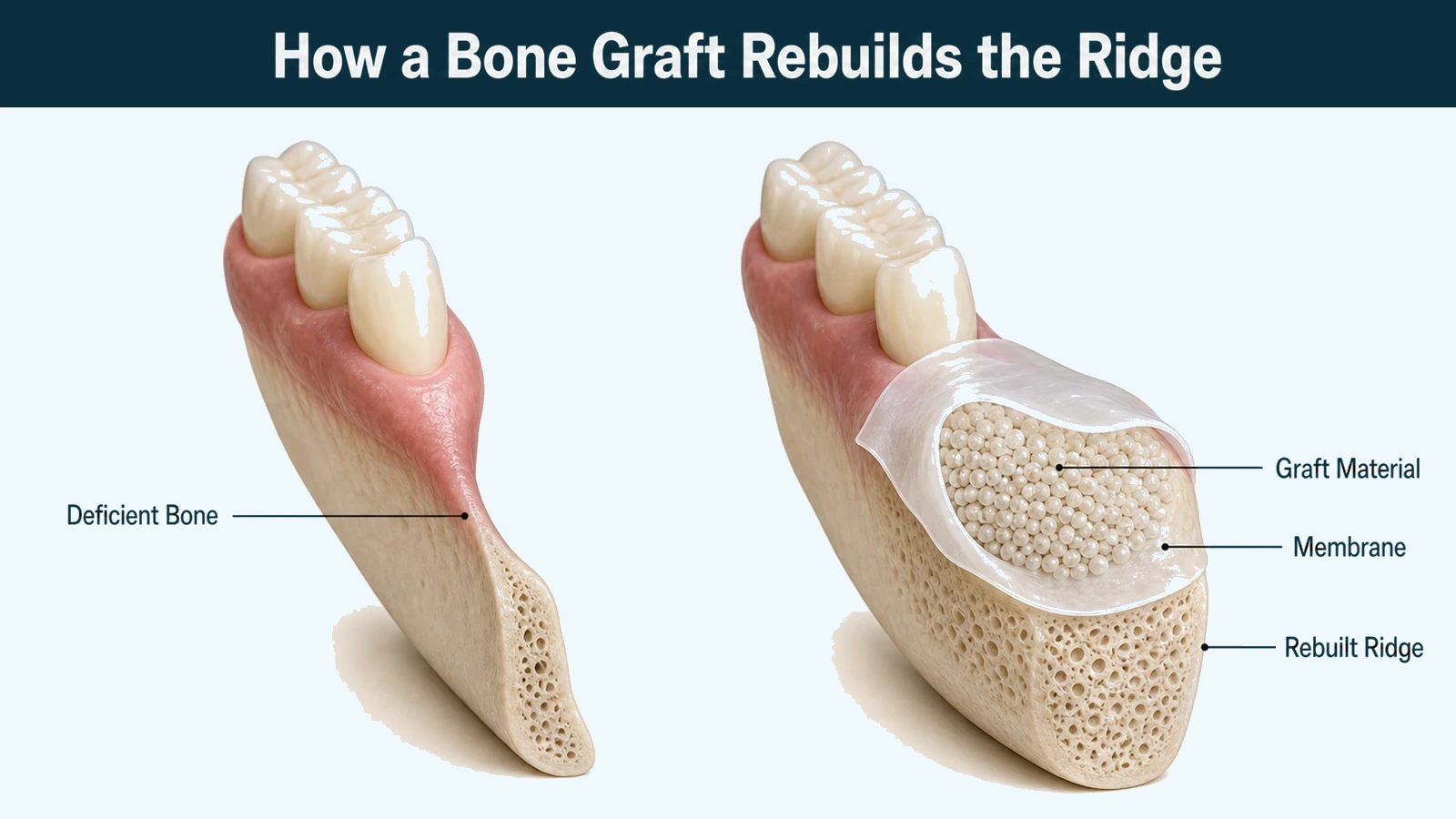
The material does not become your jaw. It holds the space and gives your own bone cells a surface to crawl along. Over months your body lays down new bone through the scaffold and breaks most of the graft down. That process is why the wait exists.
Graft material comes from four places, and the words for them turn up on every consent form:
- Autograft, your own bone, taken from another site
- Allograft, processed human donor bone from a tissue bank
- Xenograft, processed animal bone, most of it bovine
- Alloplast, a synthetic material made in a laboratory, usually a ceramic or a glass
Each behaves differently in the mouth and none is the right answer everywhere. Which one suits your site is a clinical decision taken at the assessment, after imaging. We do not decide it from a web page and neither should you.
A membrane goes over many grafts to keep gum tissue from growing into the space before bone does. That technique is guided bone regeneration, and you may see it written GBR.
The four kinds of oral bone graft
Searchers ask about four procedures. They are different operations with different costs and different waits.
Socket preservation
The graft goes into the empty socket at the same appointment as the extraction. It is the smallest of the four and the cheapest, because the site is already open.
Ridge augmentation
A ridge that has already narrowed gets built back out sideways or upwards. This is a separate procedure months or years after the tooth came out.
Sinus lift
The floor of the sinus above the upper back teeth is gently raised and bone is placed underneath. Upper molars sit close to the sinus. Once they are gone, the bone left between the ridge and the sinus floor is thin.
Block graft
A solid piece of bone is taken from elsewhere in the jaw and fixed to the deficient site with small screws. It is used where a large volume is missing, and it means two surgical sites instead of one.
Which of these applies to you is settled by imaging, not by guesswork. Nothing on this page tells you which one you need.
Does grafting a socket actually help?
This is the question worth asking, and there is a real answer.
A retrospective study of 140 single-tooth sites compared sockets grafted at the time of extraction against sockets left to heal on their own. Implant placement was then planned digitally on each patient's 3D scan. On that planning, extra bone work was judged necessary at 60% of the ungrafted sites and 11.4% of the grafted ones. The odds of not needing a second bone procedure were 17.8 times higher in the grafted group.
The thickness of the bone on the cheek side of the socket mattered enormously. In the same analysis the projected need for augmentation fell 7.7 times for every extra millimetre of it. These were front and premolar sites and not molars.
Now the honest limit. Grafting holds the shape of the ridge. It does not reliably produce more living bone inside that shape.
A 2025 review of 22 randomised trials covering 816 patients found no significant difference in the proportion of new living bone between grafted sockets and sockets left to heal. The authors put it plainly: ridge preservation maintains volume, and histologically it may yield slightly lower proportions of living bone than unassisted healing.
Both findings are true at once. You graft a socket to keep the ridge the right shape for an implant, not to grow better bone than nature would.
What happens at the appointment
The sequence is the same for most grafts.
An assessment comes first, with imaging. A 3D scan shows bone volume in three dimensions where a flat x-ray cannot. The examination and the scan together settle whether you need a graft at all.
On the day, the site is numbed with local anaesthetic. The gum is opened, the site is cleaned, the graft material is placed and shaped, a membrane goes over it where one is needed, and the gum is closed with stitches.
A socket preservation graft adds only minutes to an extraction you were already having. A ridge augmentation or a sinus lift is its own appointment.
You go home the same day. Someone should drive you if you have had anything beyond local anaesthetic.
Does a bone graft hurt?
The procedure itself should not hurt. You are numb.
Afterwards you will feel it. Expect swelling and soreness for several days, worst around day two or three, then easing. A block graft has two sore sites, not one.
Pain relief and written aftercare instructions cover it for most people. Anyone who tells you a bone graft does not hurt at all is describing the appointment and not the week.
Recovery
Expect swelling and soreness for several days. Pain relief and your written aftercare sheet cover it. Follow that sheet closely. The graft is doing delicate work under the gum.
In particular:
- Do not smoke. It materially affects healing
- Do not disturb the site with your tongue or by pulling your lip out to look at it
- Do not rinse vigorously and do not spit forcefully in the first days
- Stick to soft food and chew elsewhere
- Take the first dose of pain relief while the area is still numb, at the dose on the label
After a sinus lift there is more. Do not blow your nose, and sneeze with your mouth open, for as long as you are told. Pressure through the nose pushes on a graft that has not set.
On pain relief: do not go over the stated maximum and check you are not doubling up on the same ingredient in two products. Ask a pharmacist first if you are pregnant, treating a child, taking blood thinners or managing a stomach, kidney or liver condition.
When to get help urgently
Call 911 if you have difficulty breathing or swallowing, are drooling because you cannot manage your saliva, your voice has changed or sounds muffled, or you feel confused or faint.
Go to a hospital emergency department if you have:
- Swelling spreading under the jaw, into the neck or towards the eye
- Swelling under the tongue or in the floor of the mouth
- A fever with facial swelling or feeling unwell and shivery
- Swelling that spreads quickly over hours and not days
- Difficulty opening your mouth
- New problems with your vision
- Bleeding that will not stop
- A serious injury to the face or jaw after an accident
Call us if swelling gets worse after the third day or you have a fever without the signs above. Call us too if bleeding does not settle or material seems to be coming away from the site.
Also call us if you see pus at the site or taste something foul, or if the pain climbs instead of settling after the third day. Both point to infection.
How long before the implant can go in
This is the part most people want a single number for. There is not one.
Soft tissue closes over in about two weeks. The stitches are gone and the site looks healed. The bone underneath is nowhere near ready.
Bone maturation is measured in months. A small socket graft matures faster than a large ridge or sinus graft, and the implant goes in once imaging shows the volume is there. That review appointment is what releases the next step, not a date written down in advance.
Treat bone grafting as the first half of a long project. If someone quotes you a single visit from graft to finished tooth, ask what happens in between.
How often does a bone graft fail?
You will see success rates as high as 100% quoted online, with no source behind the number. The published complication data does not support it.
Here are measured numbers instead.
| Procedure | What was measured | Rate |
|---|---|---|
| Vertical ridge augmentation | Healing complications at the grafted site | 11.0% |
| Vertical ridge augmentation | Patients with a healing complication | 10.8% |
| Horizontal ridge augmentation | Minor wound opening at the site | 9.9% |
| Horizontal ridge augmentation | Patients with a major complication | 1.6% |
| Block graft, donor site | Lasting change in sensation | 7.0% |
| Implants in sinus-grafted bone | Survival at three years | 90.1% (95% CI 86.4 to 92.8) |
Sources: pooled complication rates for vertical augmentation, for horizontal augmentation, and 12,020 implants placed in sinus-grafted sites.
Read the sinus figure carefully. Roughly nine implants in ten were still in place at three years, and 16.6% of patients in that analysis lost at least one implant over the same period. The highest-performing subgroup reached 98.3%, so technique and materials move the number a long way.
A failed graft is a setback and a cost, not a disaster. What happens next depends on why it failed. The options run from grafting the site again to a different plan for the gap.
Smoking, diabetes and healing
Two conditions come up constantly. The evidence treats them very differently.
Smoking is the big one. Across 51 studies and more than 40,000 implants, smokers lost implants at 1.92 times the rate of non-smokers. Smoking also raises the odds of tearing the sinus membrane during a sinus lift, by an odds ratio of 1.58.
Diabetes is treated as a disqualifier far more readily than the data warrants. In that same pooled analysis, diabetes was not significantly associated with implant failure. A separate review of type 2 diabetes found no significant difference in failure either. It did find more bleeding on probing and more bone loss around the implant afterwards.
Controlled diabetes is not a bar to implant treatment. Both reviews measured implants rather than graft healing. The comparable results came from patients whose oral hygiene was kept up under close review.
Head and neck radiotherapy is a genuine risk factor, at more than double the rate of implant loss. Tell the dentist about it.
What a bone graft will not do
It does not replace a tooth. A graft builds the foundation and nothing else.
It does not reverse gum disease. Bone lost to periodontal disease around teeth you still have is a different problem with different treatment.
It does not make every site implantable. Some ridges cannot be rebuilt to a volume that will hold an implant safely, and imaging shows that before anything starts.
It does not last forever on its own. Grafted bone that never receives an implant will slowly resorb, exactly as the original ridge did, because nothing is loading it.
If you would rather not have a graft
Grafting is not compulsory, and the alternatives are real.
A bridge needs no bone at the gap, because the teeth either side carry it. That has its own price, paid in enamel off those teeth.
A denture rests on the ridge, not in it.
A shorter or narrower implant suits some sites where bone is limited but not absent. This is a clinical judgement made from the scan.
Leaving the gap is a legitimate choice for some back teeth with a stable bite, provided the site is reviewed, not forgotten.
Our pages on dental bridges and dentures set out those two routes. The post implant, bridge or denture compared puts all three side by side.
What bone grafting costs in Mississauga
You will not find our own fee on this page. The figures below come from Ontario and Canadian practices that publish theirs. Read them as a scale, not a quote.
| Procedure | Area range |
|---|---|
| Bone graft, per site | $300 to $3,000 |
| Socket preservation with an extraction | $300 to $1,200 |
| Sinus lift | $1,365 to $5,000 |
| 3D scan to plan it | $227 to $500 |
Those numbers describe the area. They are not our price list. Your own number comes from a written estimate after an examination.
The ranges above exist so you can walk into any consultation with a sense of scale.
What moves the price
Volume is the main driver. A single socket takes a fraction of the material a wide ridge defect needs.
The material matters, and on many fee guides the graft material is billed separately from the surgery. Ask whether the material is in the quote.
Site access changes the work. A sinus lift through a window in the side of the jaw is a bigger operation than lifting the sinus floor through the implant site itself.
A block graft is the most involved of the four, because it takes bone from a second site in the same appointment. We found too few published Canadian figures to give you an honest range for it.
Imaging is a separate line. So is the implant that follows, which is the larger cost of the two.
Each year the Ontario Dental Association issues a Suggested Fee Guide. The word suggested carries the meaning: no fee schedule binds an Ontario dentist. Two practices can charge different amounts for the same procedure and both are inside the rules.
The CDCP and bone grafts
Bone grafts are not covered by the Canadian Dental Care Plan. Pre-approval will not change that answer.
The words bone grafts are printed on the plan's permanent exclusion list. That list sits in Appendix E of the CDCP dental benefits guide. The guide says everything named there falls outside the plan at all times and is never eligible.
The exclusion stands on its own. Implants and all implant-related procedures are listed separately, so a graft is not covered even where no implant is planned.
The guide does describe an exception route for services outside the plan's scope. It applies only where a service is outside the scope and is not an exclusion, so it does not reach bone grafts.
Read about dental coverage and CDCP, or see does CDCP cover dental implants?
Private insurance
Private plans each set their own rules. Whether a graft is covered turns on how your policy treats implant-related work. Ask your insurer which section yours falls under.
Ask your insurer for a pre-determination in writing before you commit. That is your insurer's written answer on your specific procedure codes. It is an estimate of coverage and not a promise of payment, and it is the firmest answer you can get before treatment starts.
Dentistry on Britannia is a general dental practice. Our dentists are general dentists, not specialists in any RCDSO-recognised specialty.