
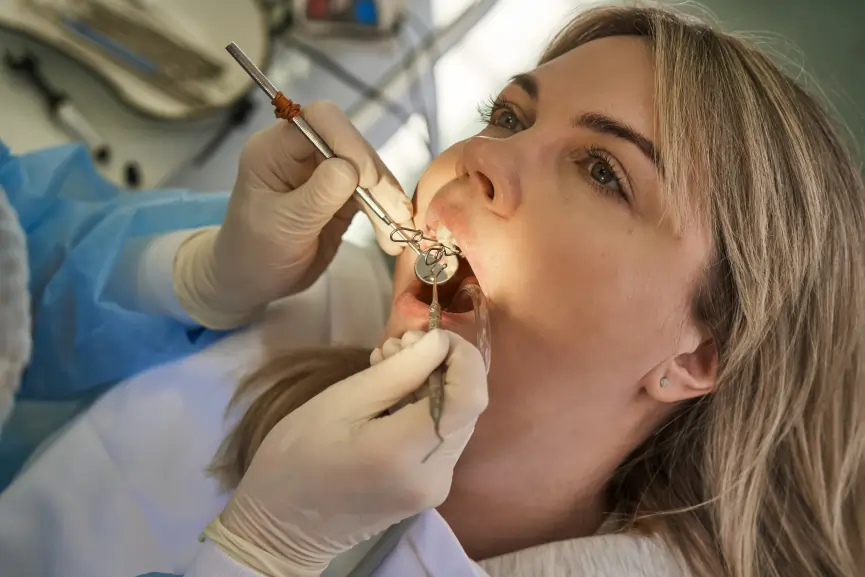
A tooth extraction removes a tooth from its socket in the jawbone. Our dentists do simple and surgical extractions here. A damaged tooth comes out only when saving it is no longer realistic. Crowding and impacted teeth are other reasons.
You get a written estimate first. You also get a plan for the gap before the tooth comes out.
When a tooth needs to come out
Your own tooth is worth keeping. A tooth that fails over and over can cost more than a planned replacement, and we tell you when that is so.
Common reasons for tooth removal:
- Decay or a break that leaves too little sound tooth to repair
- A crack running below the gum into the root
- Advanced gum disease that has destroyed the bone holding the tooth
- Infection that root canal treatment cannot clear, or a retreatment that is not realistic
- An impacted tooth damaging the molar in front of it
- Crowding, as part of an orthodontic plan
Wisdom teeth have their own page: wisdom tooth extraction. Loose teeth? Read about gum disease treatment.
Before the tooth comes out
Bring a list of your medicines. Blood thinners and bisphosphonates change the plan, and so does anything that slows healing or lowers immunity.
The dentist examines the tooth and gum and x-rays the roots and bone. The image shows how many roots there are, their shape and how close they sit to the jaw nerve or the sinus, as StatPearls sets out. You hear the alternatives, keeping the tooth among them, and leave with a written estimate.
Plan the gap now. Some options depend on bone that changes once the root is gone.
Worried about a tooth? Call (905) 821-8632 or book online.
Simple or surgical extraction
A simple extraction is for a tooth fully through the gum that can come out whole. The dentist loosens it with a thin tool called an elevator and lifts it out with forceps.
A surgical extraction is for a tooth broken at the gum line, not fully through it or unable to come out whole with forceps. The dentist opens the gum with a small cut. If the roots need it, a little bone is removed or the tooth is cut into sections.
Got stitches? Ask if they dissolve or come out at a later visit.
Some deeply buried teeth need an oral surgery team in a hospital or surgical clinic. If your tooth is one of them, we tell you at the assessment and explain the referral.
Does a tooth extraction hurt?
The dentist numbs the area first with a local anaesthetic, and the injection pinches for a moment. After that you feel pressure, pushing and rocking.
Feel anything sharp? Tell us straight away. We stop, and we can give you more anaesthetic.
Soreness starts as the numbness wears off and peaks around the second or third day. Cleveland Clinic names acetaminophen and ibuprofen from the pharmacy for this stage. Take pain relief only as your dentist directs, because some medicines and health conditions rule one of them out. Pain that gets worse after the third day is a reason to call us.
Aftercare: protect the clot
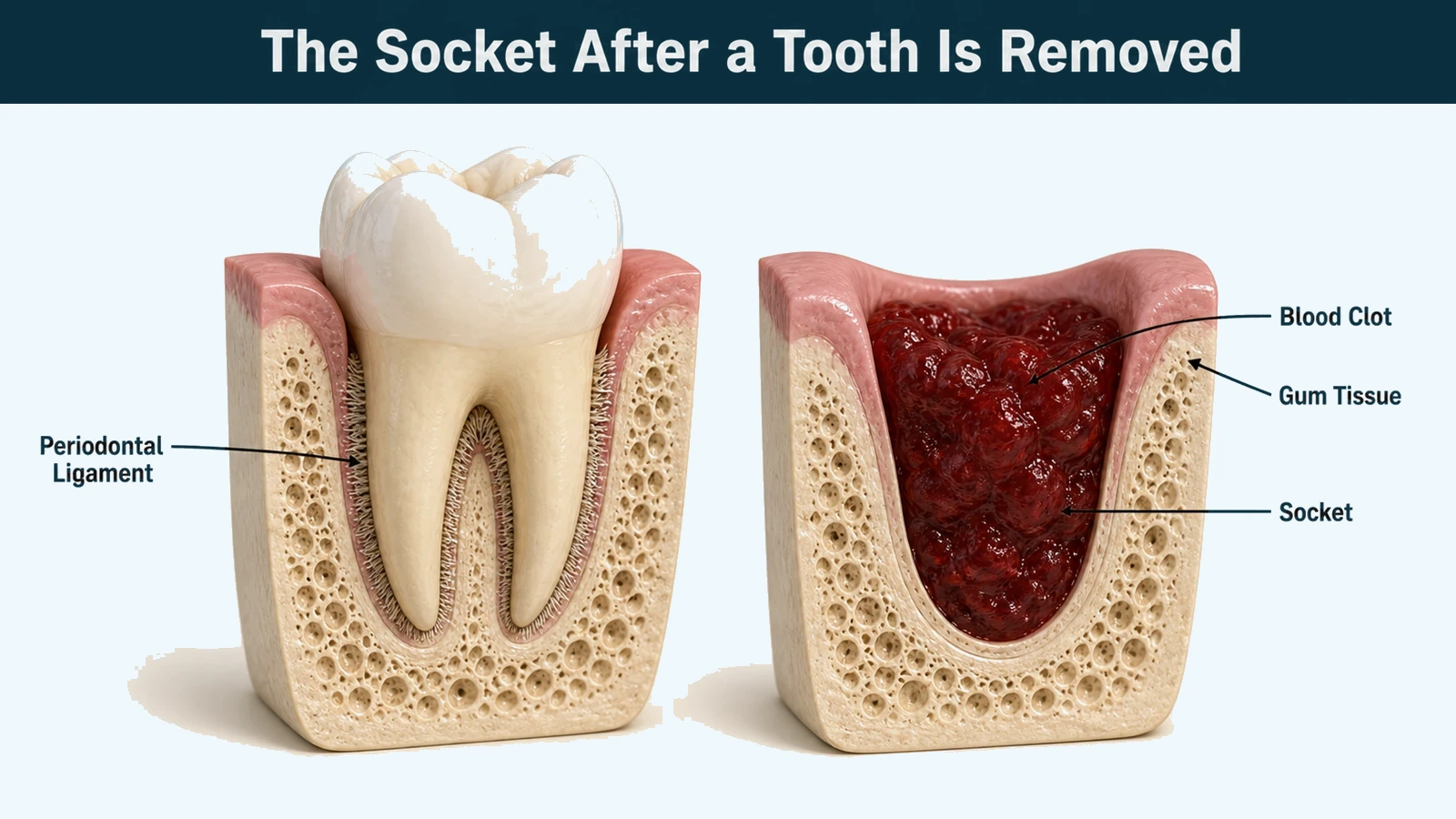
A blood clot fills the socket. It shields the bone as the area heals. Your dentist gives you instructions for your case, and those come first.
In the first day:
- Bite on the gauze you are given, sitting upright
- Do not rinse, do not spit and do not use a straw
- Do not smoke. Avoid alcohol and tobacco for the first two weeks, as the Canadian Dental Association advises
- Hold a cold pack on your cheek for 10 to 20 minutes at a time, wrapped in a cloth
- Rest, skip heavy exercise for a couple of days and keep your head raised on pillows
- Eat soft, cool food such as yogurt, soup that has cooled and mashed potatoes. Skip hot drinks
From the next day, rinse gently with half a teaspoon of salt in a cup of warm water. Let the water fall out of your mouth. Do not swish hard.
What to eat after a tooth extraction
Start with food that needs next to no chewing. Yogurt, applesauce, mashed banana and smooth soup that has cooled all work. MedlinePlus advises soft food until the wound heals.
Move on to soft solids such as scrambled eggs, pasta and rice as chewing gets easier. Chew on the other side of your mouth, as NHS aftercare guidance advises. Keep drinks warm, not hot, so they do not scald the numb area.
If bleeding restarts
Sit upright and place folded gauze or a clean cloth directly over the socket. Bite firmly and continuously for twenty to thirty minutes without lifting it to check. Do not rinse, spit or suck as you do this.
If it is still bleeding, replace the gauze and repeat once. Call 911 if you feel faint or confused or the bleeding is heavy and you cannot control it. Go to a hospital emergency department if blood is building up quickly. Call us urgently if it continues after a second attempt or if you take blood thinners or have a bleeding disorder, and go to hospital if you cannot reach us.
Recovery time and dry socket
Swelling peaks around the second or third day. Some people also bruise on the gum or the outer jaw, and that fades after a few days. Most people are back to their routine within 48 to 72 hours, and back at work or school within a day or two, Cleveland Clinic notes. A physical job can need longer.
The socket takes 1 to 2 weeks to heal, according to MedlinePlus. The jawbone takes several weeks to heal, and up to four months after a large tooth such as a molar, according to Cleveland Clinic.
Dry socket happens when the clot breaks down or falls out. The bone underneath is left bare. Severe pain starts one to three days after the extraction and can spread to the ear. A bad taste or smell is common too.
StatPearls puts the rate under 5% in larger studies and around 30% after lower wisdom tooth extractions. Smokers have more than three times the odds, in a 2022 systematic review.
The dentist cleans the socket and places a medicated dressing. Call us. Do not wait it out.
When to get help urgently
Call 911 if you have difficulty breathing or swallowing, are drooling because you cannot manage your saliva, your voice has changed or sounds muffled, or you feel confused or faint.
Go to a hospital emergency department if you have:
- Swelling spreading under the jaw, into the neck or towards the eye
- Swelling under the tongue or in the floor of the mouth
- A fever with facial swelling or feeling unwell and shivery
- Swelling that spreads quickly over hours and not days
- Difficulty opening your mouth
- New problems with your vision
- Bleeding that will not stop
- A serious injury to the face or jaw after an accident
Call us urgently if you have:
- Bleeding that does not settle after two rounds of firm continuous pressure
- Swelling that is getting worse after the third day
- Severe pain starting a few days later
- Numbness that lasts beyond the expected period
Read about dental swelling and infection and emergency dental care.
Emergency tooth extraction
A tooth snapped at the gum line, a throbbing infected tooth or one hanging loose after a knock needs a dentist soon. Call (905) 821-8632 as early in the day as you can. We see urgent problems during opening hours: 7:00 am to 7:00 pm Monday to Thursday and 8:00 am to 5:00 pm Friday and Saturday.
The dentist examines and x-rays the tooth before anything else. An urgent visit does not always end with the tooth out. Some teeth can be opened and cleaned to take the pain away, which is the first stage of root canal treatment. If the tooth has to go, the dentist decides whether that happens at the same visit.
While you wait, take a pain reliever from the pharmacy as the label directs and hold a cold pack to your cheek. Never put an aspirin against the gum, because it burns the tissue. Swelling near the eye, under the tongue or down the neck is a hospital trip and not a wait for us.
Area prices for an emergency extraction match the simple and surgical ranges below. An emergency exam runs about $50 to $200 in this area. Ask whether the x-rays are in the quote.
Wisdom teeth
Not every wisdom tooth needs removing. One that has come through straight, is cleanable and is causing no trouble can be left alone and watched.
The reasons they do come out: repeated infection around a partly erupted tooth, decay in it or in the tooth in front, persistent pain or swelling traced to it, or a cyst.
Position is what makes it simple or surgical. An upright tooth that has fully erupted comes out like any other. One lying on its side under the bone is a surgical extraction, and that is a longer appointment with a longer recovery.
The nerve in the lower jaw matters. It runs through the bone below the lower wisdom teeth, and how close the roots sit to it is part of what the assessment and the images are for.
Expect swelling and discomfort for several days after a surgical removal, peaking around the second or third day rather than straight away. Feeling fine on the first evening does not mean the worst is over.
What happens to the gap
The bone that held the root shrinks once the root is gone. Teeth on either side can tilt into the space. The tooth above or below can grow down into it. A longer wait can mean a bone graft before an implant.
| Implant | Bridge | Denture | Leave it | |
|---|---|---|---|---|
| Fixed in place | Yes | Yes | No | n/a |
| Surgery | Yes | No | No | No |
| Neighbouring teeth | Left alone | Reshaped for most bridges | Some dentures clasp them | Can drift |
Leaving a back tooth gap is a fair choice for some people. The dentist checks your bite, your chewing and the teeth around the gap first. Make that choice on purpose. Compare dental implants, dental bridges and dentures, or read implant, bridge or denture.
What a tooth extraction costs in Mississauga
We checked what Mississauga clinics publish for tooth removal. The ranges below span their lowest and highest per-tooth prices, in Canadian dollars.
| Extraction | Typical range |
|---|---|
| Simple | $150 to $350 |
| Surgical | $300 to $700 |
The tooth, its roots, a break and any bone removal move you within a range. Ask whether the exam and x-rays are part of the quote. Wisdom teeth are priced on the wisdom tooth extraction page.
Many insurers pay from the Ontario Dental Association's yearly suggested fee guide, and some use an older edition. The ODA treats its figures as a suggestion that dentists can charge above or below. When a practice fee sits above what your plan allows, you pay the balance. Ask which year of the guide your insurer uses before you compare it with your estimate.
Those are local prices, not our fees. Your written estimate is the number that counts.
- Direct insurance billing sends the claim to your insurer for you. Your plan's yearly maximum and deductible still count
- A pre-determination tells you what your insurer expects to pay before the tooth comes out
- Extractions and oral surgery are in the Canadian Dental Care Plan for patients who qualify. Some services need approval from the plan first, such as treatment beyond its frequency limits. Removing a tooth is not marked for approval on the plan's coverage page. Sun Life processes the claims
- CDCP co-payments rise with income. There is none below $70,000 of adjusted family net income, then 40% of the plan fee at $70,000 to $79,999 and 60% at $80,000 to $89,999. Any amount above the plan fee is yours too (Government of Canada)
- Before treatment, ask what you will pay directly. The same Government of Canada page gives that advice
Read how the CDCP works here.
No insurance and no CDCP? OHIP does not pay for dental services in a dentist's office. It covers a medically necessary tooth removal in hospital, and only with OHIP's prior approval.
Adults 65 and over on a low income can apply to the Ontario Seniors Dental Care Program. It covers tooth removal at public health units and partner community health centres.
Dentistry on Britannia is a general dental practice. Our dentists are general dentists, not specialists in any RCDSO-recognised specialty.