
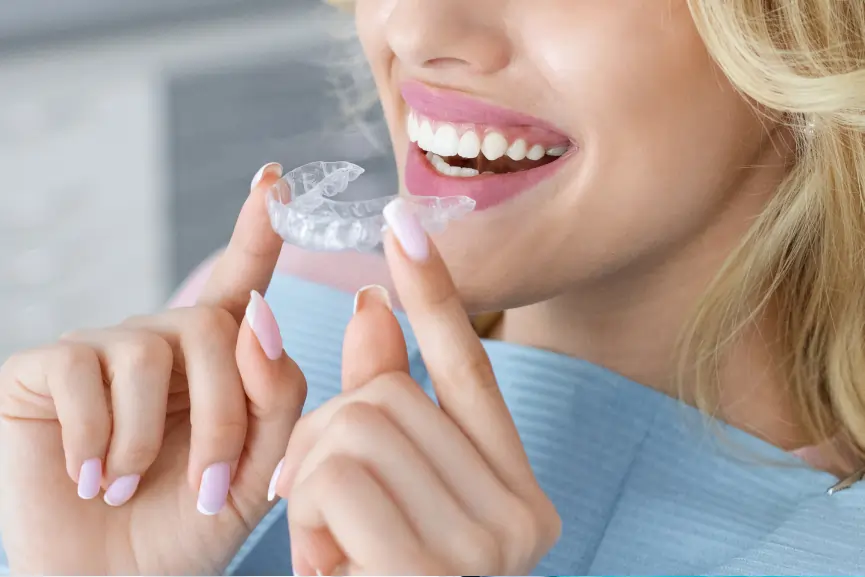
Invisalign costs $2,000 to $9,000. Six practices that publish a figure give that range. The bottom of it is an advertised starting price at one Mississauga practice, not a typical fee. Where your own number sits depends on how far the teeth have to travel and how many sets of aligners that takes.
This page covers the part most Invisalign pages leave out: how accurately the trays actually deliver the movement the software draws, and which movements they struggle with.
Want to know whether your case suits aligners? Call (905) 821-8632 or book online. We are on Britannia Road West in Mississauga, with free parking on site.
What Invisalign is
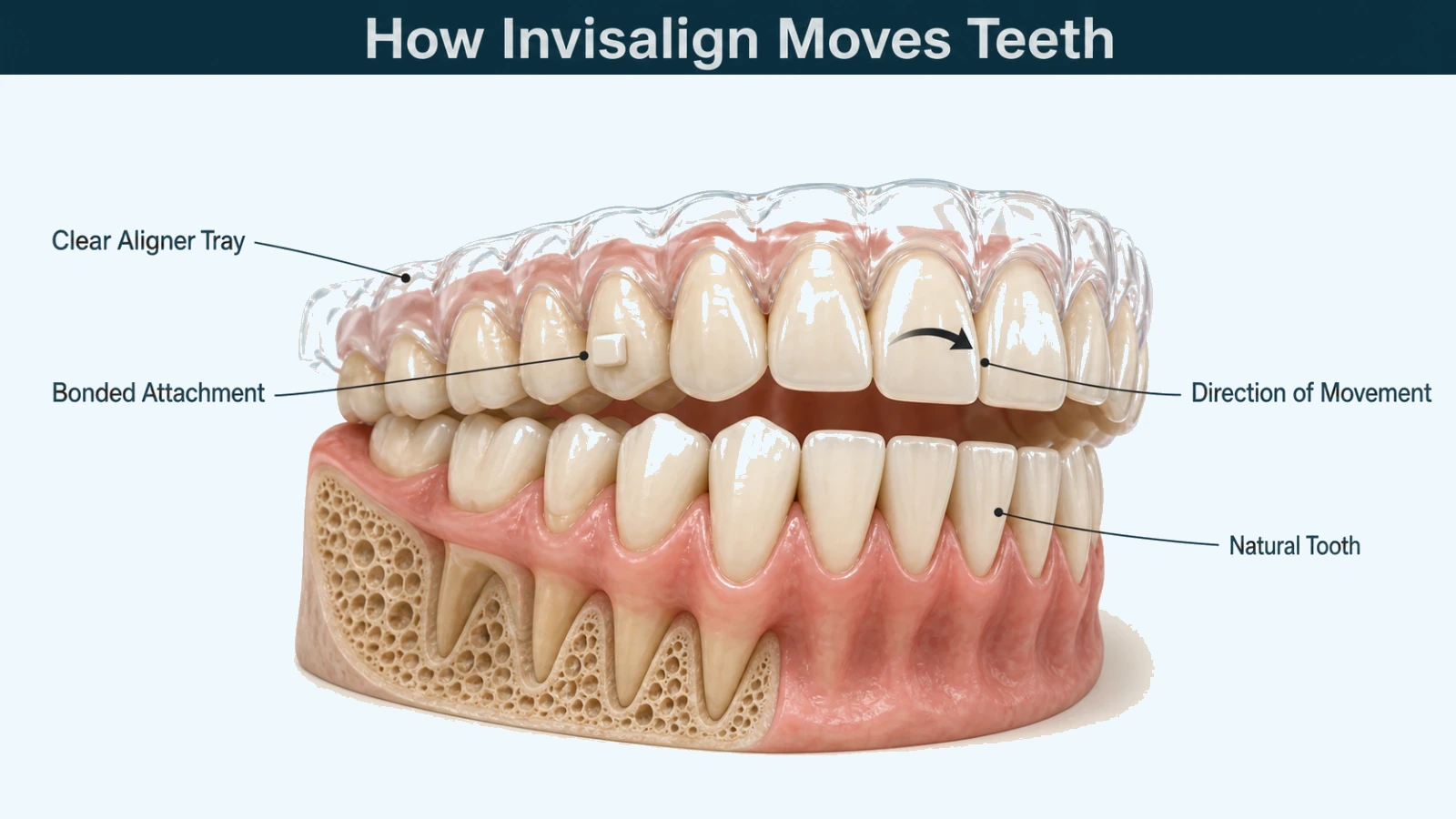
Invisalign is one brand of clear aligner. A scan of your mouth becomes a digital model, a treatment plan is drawn on that model, and a series of trays is manufactured to carry the teeth through it in small steps.
Each tray is a fraction out of line with where your teeth sit that week. The plastic pushes against the mismatch, and the tooth follows. Change the tray, repeat.
The trays are clear and thin, and far less visible than fixed brackets. The attachments described below do show. That is the reason adults ask for them, and it is a fair reason.
What the brand name buys you is the plan, the manufacturing and a very large body of published research on how the system performs. Other aligner systems work the same way. We cover those on our clear aligners page.
How accurately do the trays move teeth?
The movement you see animated on a screen is a prediction, and teeth do not fully obey it.
A 2026 scoping review mapped 119 studies of aligner accuracy against measured outcomes. Early-generation Invisalign studies reported around 50% mean accuracy across all movement types. Newer results are better and still short of the plan.
Broken down by movement, the review found:
| Movement | Accuracy delivered |
|---|---|
| Rotations | about 5 degrees short of plan |
| Torque, the tipping angle of the front teeth | 35% to 58% expressed |
| Opening a deep bite | 28% to 55% achieved |
| Widening the arch | 73% to 88%, and mostly by tipping the teeth outward, not moving them bodily |
| Closing an open bite at the front | 58% to 90% achieved |
| Intruding, or pushing a front tooth up into the bone | 33% to 53% achieved |
Those figures are why aligner plans build in over-correction and ask for more movement than the case needs. The review recommends 50% to 100% over-correction for intrusion. For rotations and torque it recommends 5 to 15 degrees, and for arch widening 1 to 2 mm.
It is also why refinements exist.
Refinements and switching to braces
More than half of aligner cases need a second run of trays. The review above found refinements required in over 50% of cases in the studies that reported them, and 17.2% of cases converted to fixed appliances to finish the job. Both figures rest on a limited set of studies. The review's authors say their estimates should not be used as universal benchmarks.
Nobody enjoys hearing that. It is better to hear it before you start than at month nine.
A refinement is a rescan and a fresh short series of aligners that picks up whatever the first course did not finish. Ask at the consultation whether refinements are inside the quoted fee or billed on top. That single question changes the real cost of treatment more than any advertised discount.
The same review found aligners most reliable for closing an open bite of under 3 mm at the front, and least reliable for bodily movement of back teeth and for large rotations of round teeth.
The attachments nobody mentions in the advert
Aligner trays are smooth. Teeth are smooth. A smooth tray has very little to grip when it needs to rotate a canine or pull a tooth down.
So small tooth-coloured composite bumps get bonded to some teeth. The tray presses on the bump, the bump transfers the force, and the tooth turns. They come off at the end of treatment.
Whether your plan needs them depends on the movements it asks for. Where they are used, they make the trays slightly more visible than the marketing photographs suggest. A 2026 scoping review of 115 attachment studies found laboratory work predominated at 72.1% of the research, and concluded that the clinical effectiveness of attachments remains unclear. Full detail is on our clear aligners page.
What happens at the consultation
The first appointment is an examination, not a sales pitch.
- A look at the teeth, gums and bite. Aligners move teeth through bone. Untreated decay or active gum disease gets sorted first.
- X-rays where they are needed, to see roots and bone that an examination cannot show.
- A digital scan. We have a 3D scanner here, so the model your plan is drawn on is built from a scan rather than a tray of impression material.
- A discussion of what is achievable. Some bites suit aligners. Some suit braces. Some suit either, and then it is your call.
- A written estimate, with the number of aligners, the expected length of treatment and what happens if the case needs refinement.
You leave with a plan and a price, and no obligation to start.
Wearing them: the part you control
Aligners work when they are in your mouth and do nothing in a case on the kitchen counter. Wear is around 20 to 22 hours a day, out for meals and for anything other than water.
That is the honest catch of aligner treatment. Braces work even if you forget them. Aligners do not.
The measured reality: a 2026 review of seven randomised trials covering 266 people found average device compliance of about 77%. The same review found that adding a vibration device under a seven-day tray change schedule improved tracking accuracy, at p = 0.003. The improvement belongs to the device, not to the schedule on its own.
If you know you will not wear them, say so at the consultation. Fixed braces are the better answer for you and there is no shame in it.
Does Invisalign hurt?
There is pressure for the first day or two of each new tray, then it settles. Pooled trial data puts it at the mild end of the scale, and the spread between studies is wide.
A 2026 meta-analysis of 34 studies covering 1,636 people measured aligner pain at an average of 3.06 out of 10 at 24 hours, falling to 1.55 at three days and 1.08 at one week. Variation between studies was high, so treat those as a shape rather than a promise about you.
Compared against fixed braces, aligners hurt less in the early phase of treatment. A 2026 meta-analysis of 28 studies put the difference at a standardised mean of -0.419 in favour of aligners, p below 0.001.
Changing trays at night helps. You sleep through the sharpest part.
How soon will you see a change?
Front teeth move first and visibly. Crowding at the front starts looking different within the first few trays, which for most plans is the first month or two.
The back teeth take much longer, because moving a molar bodily through bone is the hardest thing an aligner is asked to do.
So the early progress is encouraging and it is not the finish line. The last third of treatment fixes details nobody else will notice and you will.
Invisalign against fixed braces
Here they are side by side.
| Invisalign | Fixed braces | |
|---|---|---|
| Visible | barely, plus attachments | yes |
| Comes out to eat | yes | no |
| Depends on you remembering | completely | for elastics and cleaning |
| Cleaning your teeth | normal brushing and flossing | slower, and around brackets |
| Food restrictions | none, trays come out | hard and sticky food is out |
| Complex rotations and bodily movement | limited | stronger |
| Visits | every 6 to 10 weeks | every 4 to 8 weeks for adjustment |
| Published price | $2,000 to $9,000 | $3,000 to $7,000 for metal |
Braces are not the older, worse option. They are the option with more mechanical control, and for some bites they are simply the right tool. Our braces page covers them properly. Clear braces sit between the two on visibility.
Keeping the result
Teeth drift back. This is true after aligners and after braces. It is the single most under-mentioned fact in orthodontic advertising.
Retainers hold the correction. A 2026 network meta-analysis of 18 randomised trials covering 1,471 people found no statistically significant difference between fixed and removable retainers on gum health measures.
The networks behind that comparison were sparse and the certainty of the evidence limited. No difference was measured, and that is not the same as proof the two are equal. The choice comes down to your habits and your bite.
Evidence comparing relapse after aligners with relapse after braces is thin. A 2024 systematic review found only three studies worth including, and one of the three found a difference at three years. Anyone telling you aligner results hold better than brace results is ahead of the evidence.
Ask whether retainers are inside your quote. It is a real cost and it lasts.
Gum health during treatment
Trays come out, so you brush and floss normally. That shows up in the measurements.
A 2026 meta-analysis of 28 studies found people in aligners recorded lower plaque scores, lower gum inflammation scores and shallower gum pockets than people in fixed braces, with all three results at p below 0.001. The authors asked for caution because the studies varied and the pooled effects were small.
It is not a free pass. Trays trap sugar against enamel if you put them back in over an unbrushed mouth. Water only while the trays are in.
What Invisalign costs in Mississauga
We do not publish our own fees. A price on a web page is not a quote, and orthodontic cases differ far too much for one number to mean anything.
What we can give you is what other practices charge. Published pricing for Invisalign runs $2,000 to $9,000, across six practices that publish a figure. The lowest of those is a starting price advertised by a Mississauga practice. The highest is a full comprehensive fee.
What moves your number inside that range:
- How far the teeth have to move, which sets the number of aligner sets
- Whether one arch or both are being treated
- Whether attachments and refinements are included
- Whether retainers are included
- Whether any dental work has to happen first
There is a $500 offer on Invisalign treatment at the moment. Ask whether your case qualifies when you book. It is advertised separately from anything to do with insurance or a government plan.
On insurance
Some dental plans include an orthodontic benefit. Where they do, the plan pays a share up to a total maximum for orthodontics that does not reset each year, unlike the annual maximum on general dentistry.
Ask your insurer for a pre-determination in writing before you commit. They will tell you what they will pay for your specific plan and your specific treatment, in advance.
Two questions worth asking them directly: does the benefit cover adults, and does it cover aligners as well as braces. Some plans cover one and not the other.
On the Canada Dental Care Plan
The CDCP is open to all ages for eligible Canadian residents; eligibility requires no access to private dental insurance, the required Canadian tax returns, adjusted family net income under $90,000, and Canadian residency for tax purposes.
It does not pay for orthodontic treatment. The plan's own coverage page states that orthodontic services are not available. It gives no future date and names no planned expansion.
If you have read elsewhere that CDCP orthodontic cover is arriving on a set date, that is not what the plan publishes. We checked on 21 September 2026.
On Healthy Smiles Ontario
Healthy Smiles Ontario covers children 17 and under in households under an income limit, which as of 1 July 2026 is $29,065 for a household with one child.
It does not pay for braces. The programme names braces alongside teeth whitening as cosmetic dentistry and excludes them. It does not name clear aligners separately.
Dentistry on Britannia is a general dental practice. Our dentists are general dentists, not specialists in any RCDSO-recognised specialty.