
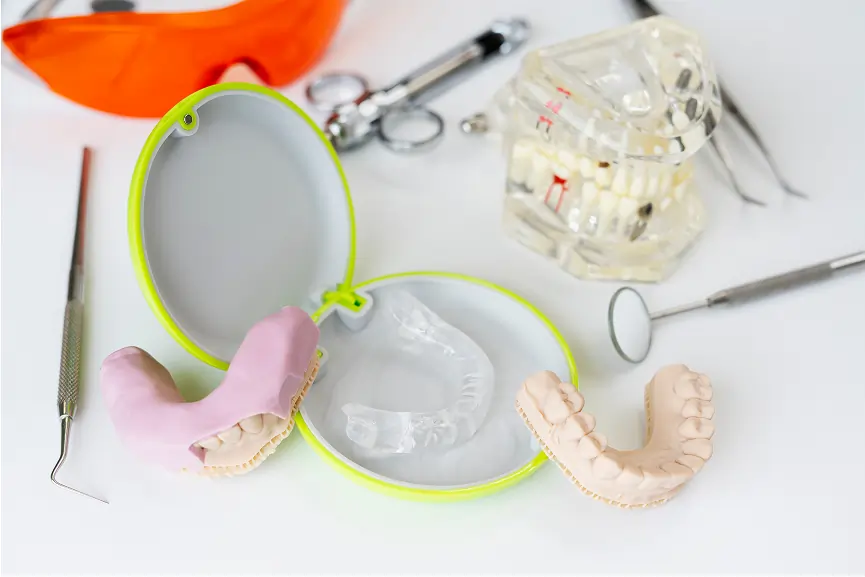
A sport mouth guard is a moulded shield that covers your upper teeth and takes the force of a hit before your teeth do. A custom one is made from an impression of your own mouth, so it sits tight without you biting down to hold it there.
You can have a custom mouth guard made at our Britannia Road West office in Mississauga. For hockey, football, rugby, basketball, lacrosse, martial arts and anything on wheels.
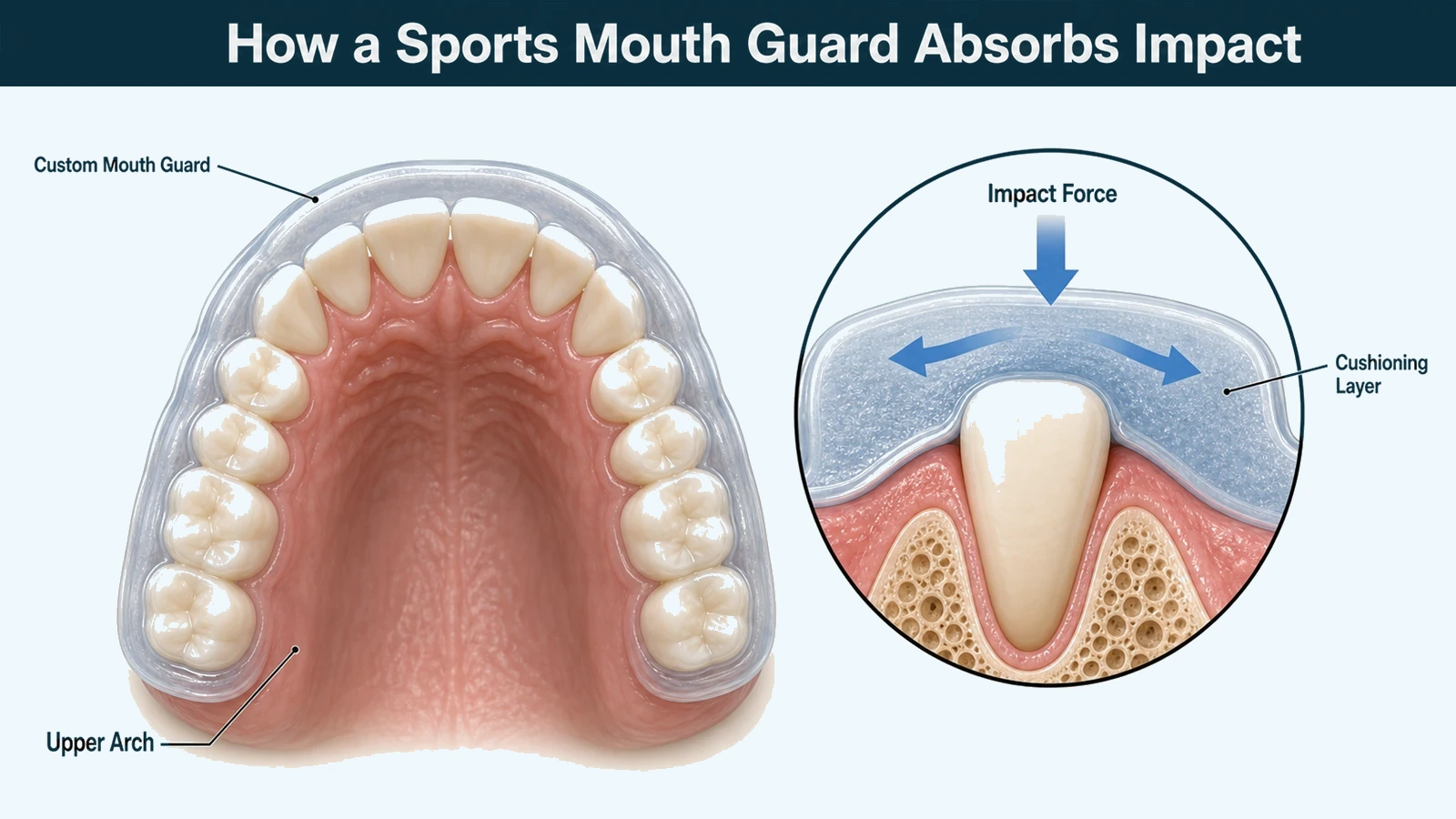
What a mouth guard actually does
It spreads the force of an impact across a wider area instead of letting one tooth absorb all of it. The material compresses so that what reaches the tooth underneath is smaller and slower than whatever hit the guard.
It also holds the upper and lower teeth apart. That matters in a blow to the chin, where the lower jaw is driven up into the upper teeth.
And it keeps your lips and cheeks off your teeth. Soft tissue cut open against your own edges is one of the commonest injuries in contact sport.
The tooth knocked out in sport is nearly always an upper front one. Losing one at fifteen means managing that gap for decades. Learn more about emergency dental care in Mississauga.
How much protection, really
Two numbers are worth knowing before you spend anything.
The American Dental Association summarises a 2019 systematic review that found people who did not use a mouth guard carried more than twice the risk of an orofacial injury. A 2007 meta-analysis it also cites put the risk at 1.6 to 1.9 times higher without one.
That is a real effect and a good reason to wear one. It is not the number you will see on most dental websites.
Two of the Mississauga practices ranking for this search tell you athletes are 60 times more likely to be injured without a guard. We went looking for the study behind that figure and could not find one. It traces back to an uncited attribution and nothing further.
We would rather give you the number that has a paper attached to it.
Which sports, and who decides
Any collision sport. Hockey, football, rugby, boxing, martial arts, lacrosse.
Any sport where a stick, a ball or an elbow arrives at head height. Basketball and soccer produce more dental injuries than people expect, because nobody is wearing anything.
Anything on wheels. Skateboarding, BMX, mountain biking.
Adults too, not only children. Adult recreational leagues generate plenty of broken teeth, and adults wear a guard less than anyone.
Your league may already require one
League rules are what sends most parents looking for a guard, and they are not the same from one association to the next.
The Ontario Minor Hockey Association brought in a mandatory mouth guard policy effective 1 January 2002. Every OMHA registered player must wear one at all OMHA sanctioned events.
The same memo notes that players registered with other Ontario hockey bodies are not bound by the OMHA rule at its tournaments and exhibition games, unless their own organisation requires it. So the answer depends on which association your child is registered with, not on which rink they are standing in.
Check with your own league before the season starts. A custom guard needs laboratory time, so the week of the first game is too late to start.
Custom, boil-and-bite, or stock
The difference is fit. And fit is not about comfort, it is about whether the guard is still in your mouth at the moment of impact.
| Custom-made | Boil-and-bite | Stock | |
|---|---|---|---|
| Made from | An impression of your teeth | Softened in hot water, bitten into shape | Nothing. Bought in sizes |
| Stays in place | Yes, without clenching | Varies | Poorly. Held in by biting |
| Thickness where it is needed | Planned | Thins where you bite hardest | Uneven |
| Breathing and speech | Least affected | Affected | Most affected |
| Works with braces | Made to fit over them | Poor fit over brackets | Needs an orthodontic version |
| Price | $150 to $384 | Roughly $11 to $27 | Under $10 |
| Worn all season | Highest | Middling | Lowest |
A guard you have to hold in by clenching protects you less reliably. The moment you shout, breathe hard or stop concentrating, it moves.
What the shop guards actually cost
Worth knowing, because this is the real decision most parents are making.
At the sporting goods chains a Nike Alpha adult guard runs about $10.97, a Shock Doctor Max AirFlow about $15.00 and an Everlast Evershield double layer about $26.99. All boil-and-bite. Those are September 2026 figures and they move.
A shop guard worn every game beats a custom guard left in a bag. We will say that plainly. The argument for the custom one is that people keep it in, because it does not need holding there.
How your custom guard is made
Two visits.
First visit. Your teeth and bite are checked, and anything that needs treating is dealt with before an impression is taken. You talk through the sport because a hockey guard and a basketball guard are not built the same. Then an impression of your upper teeth.
Second visit. One to two weeks is the general laboratory figure for a custom sports guard. Ask for your own date when the impression is taken. The guard is seated and the bite adjusted, and you check that you can breathe and speak with it in before you leave with it in a ventilated case.
Between those two visits the laboratory pours a stone model of your teeth and forms a thermoplastic sheet over it under heat and pressure, then trims and smooths the edges so nothing digs into your gums.
Say when you book if you are in orthodontic treatment. The guard is built differently.
Thickness, material and colour
Custom sports guards are made from EVA, ethylene vinyl acetate. It is a thermoplastic that compresses under load and returns to shape.
The National Athletic Trainers' Association position statement sets out the thicknesses a guard should finish at: roughly 2 to 3 mm over the front of the teeth, roughly 3 mm on the biting surfaces, and roughly 2 mm on the palate side. Thicker is not automatically better, because a guard nobody can breathe around comes out.
Your dentist decides the final thickness from your sport and your bite. A goalie and a midfielder are not asking for the same thing.
Colour is up to you. Laboratories make these in team colours and in patterns at no clinical cost, and a guard a fourteen year old actually likes is a guard that stays in.
A mouthguard for braces is a different build
Fixed braces make a guard more necessary and harder to make. A blow to the mouth drives brackets into the lip, and the cuts are worse than they would be without them.
A guard made over braces has to leave room for the brackets and for teeth that are still moving. It needs remaking partway through treatment, and more than once in a long case.
Tell us at booking. A guard made from an impression taken before the braces went on will not fit over them. Learn more about metal braces.
Breathing and speech
You will notice it for the first few sessions. Most people stop noticing after that.
A custom guard interferes least, because it is thin where thickness buys nothing and it does not need to be gripped. If you find yourself taking it out to talk on the bench, that is a fit problem worth bringing back to us.
What a mouth guard will not do
It will not prevent concussion. The National Athletic Trainers' Association is direct about this: mouth guards are not recommended for preventing mild traumatic brain injury or sport related concussion, because no quality evidence supports any guard or material for that purpose.
Some dental sites in this area say otherwise. Google's own AI answer for "custom mouth guard Mississauga" puts concussion protection on the list of reasons to buy one. That is not what the evidence says, and we will not repeat it to sell you a guard.
Wear the guard for your teeth. Wear the helmet for your head.
It will not make a tooth impossible to break either. It lowers the risk substantially. Nothing removes it.
And a night guard is not a sports guard. Different material, different thickness, different forces. A night guard is built for the slow grinding of a whole night and a sports guard is built for one sudden hit. Learn more about night guards.
Looking after it
Rinse it in cold water after every use. Brush it occasionally with a soft brush and no toothpaste, because toothpaste is abrasive enough to scratch the surface.
Let it dry before it goes in the case. Use a ventilated case rather than a kit bag.
Keep it out of hot cars and off radiators. Heat distorts EVA, and a distorted guard does not fit.
Bring it to your appointments so we can check it alongside your teeth.
When to replace it
Replace it when it no longer seats properly, when it is torn or chewed through, or when your mouth has changed.
A child's guard is the one that changes fastest. Teeth come and go through those years, and a guard that fitted last season may not fit this one. Bring it to every check-up.
An adult guard that is looked after and not chewed will see out several seasons. We check it at your appointments instead of replacing it on a calendar. How long one lasts depends on how hard its owner is on it.
If a tooth gets knocked out anyway
A knocked-out adult tooth is time critical. Hold it by the crown and never the root. If the injured person is alert and able to cooperate, ease the tooth straight back into the socket the right way round and have them bite on a clean cloth.
Do not try this if the person is drowsy, confused or a young child. Put it in milk instead.
Never put a knocked-out baby tooth back. Replanting it can damage the adult tooth developing underneath. If you are not sure whether it is a baby tooth or an adult tooth, do not put it back. Keep it in milk and call us.
Do not use cheek storage with a child, because the tooth can be swallowed or inhaled.
If you cannot put it back, keep it moist in milk. Get to a dentist immediately. Minutes matter.
If there was a head injury, loss of consciousness, a suspected broken jaw, or bleeding that will not stop, go to the emergency department first. The head injury comes before the tooth.
We see dental emergencies during our opening hours. Learn more about emergency dental care in Mississauga.
What a custom guard costs in Mississauga
A custom sports guard runs $150 to $384 in this part of Ontario, based on prices published by Ontario dental practices. The lower end is a straightforward single arch guard. The upper end is a published fee that separates the appliance from the laboratory charge.
Published prices are hard to find locally, which is why that range comes from Ontario practices that do publish one.
What moves the number: whether the guard has to fit over braces, the thickness your sport calls for, and whether anything needs treating before we take an impression. You get a written estimate before any treatment begins.
Insurance. Some plans cover custom sports guards under a separate appliance category, not under preventive care. Confirm the details with your insurer before the appointment. Ask whether the laboratory fee sits inside the quote.
We offer direct insurance billing.
The Canadian Dental Care Plan is open to all ages for eligible Canadian residents; eligibility requires no access to private dental insurance, the required Canadian tax returns, adjusted family net income under $90,000, and Canadian residency for tax purposes. It does not cover sports guards. Mouth guards sit on the plan's permanent exclusion list, in Appendix E of the CDCP dental benefits guide, under "mouth guards". The guide describes everything on that list as always outside the scope of coverage. Learn more about CDCP coverage at our practice.
Dentistry on Britannia is a general dental practice. Our dentists are general dentists, not specialists in any RCDSO-recognised specialty.