
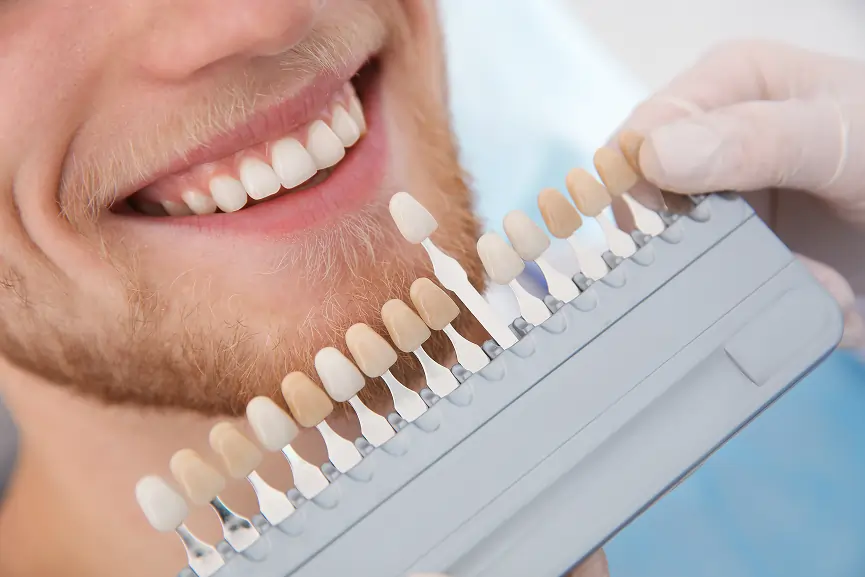
Getting them involves a trade. To fit a conventional veneer, a layer of enamel comes off the tooth first and that enamel does not grow back.
We will tell you when a veneer is the right answer and when whitening, bonding or straightening would get you closer to what you want for less. Call (905) 821-8632 or book online to start with an assessment.
Understand this before anything else
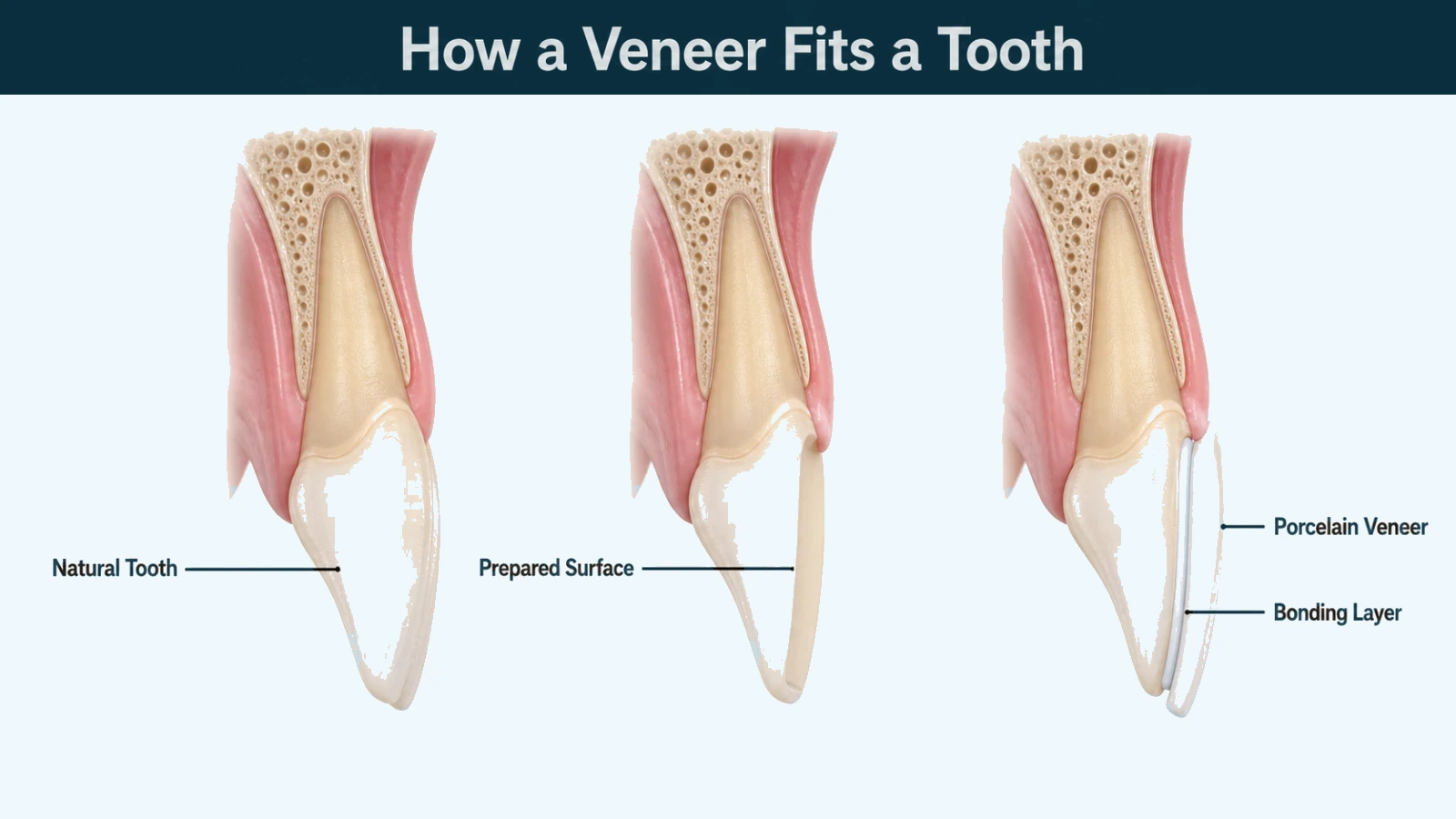
A conventional veneer needs room that your dentist makes by taking a layer of enamel off the front of the tooth.
Enamel is the only part of a tooth that cannot repair itself, so once it is gone it is gone and the tooth underneath is softer and more sensitive. From that point the tooth needs a veneer or a crown on it for the rest of your life.
There is not much of it to spend. A study that scanned 324 front teeth in living patients measured the enamel on the front of an upper central incisor at 0.58 mm near the gum line and 0.99 mm further up the tooth. That is the whole budget a preparation works inside.
This is not a reason to avoid veneers. It is a reason to be sure before you start.
We put it first because it is the one decision you cannot walk back.
Porcelain or composite
Two materials do this job, and they are not close substitutes.
Porcelain is made in a lab and bonded on at a second appointment. It holds colour and it lasts. A study of 318 porcelain veneers in the Journal of Prosthetic Dentistry put survival at 94.4% after five years, 93.5% at ten years and 82.9% at twenty.
Composite is a tooth-coloured resin shaped straight onto the tooth in one appointment. It costs less and it needs far less enamel removed. Some composite work needs no enamel removed at all.
The trade shows up in how long each lasts. A practice-based study in Dental Materials followed 1,459 veneers on 341 patients for ten years and found composite veneers failing at about four times the rate of ceramic ones.
So composite is the cheaper entry and the shorter commitment. Porcelain is the bigger commitment and the longer result. Neither is the right answer for everyone.
What veneers do well
- Teeth that stay dark after whitening, including tetracycline staining and single dark teeth
- Chips and worn edges on front teeth
- Small gaps between front teeth
- Teeth that are narrow, short or an odd shape
- One or two teeth sitting slightly out of line
That last one has a limit. A veneer hides a small rotation but it does not move a tooth.
When something else is the better answer
Plenty of people who ask about veneers do not need them.
Your teeth are healthy and just yellow. Whitening is cheaper, takes nothing off the tooth and you can repeat it. See teeth whitening.
One chipped corner. Dental bonding repairs a chip in a single appointment for a fraction of the cost, and almost nothing comes off the tooth.
Crooked or crowded teeth. Moving teeth fixes the position. A veneer covers it. Orthodontics or Invisalign keeps your enamel.
A tooth that is cracked, heavily filled or root treated. A veneer covers the front and leaves the rest of the tooth unprotected. That tooth gets assessed on its own and the answer is often a dental crown.
You grind at night. Grinding is the single biggest risk to a veneer. The 20-year study found a grinding habit carried 7.7 times the risk of failure. A night guard comes first.
We would rather send you to the cheaper option that works than sell you the expensive one that does not.
The honest limits
Veneers fail. Not at the rate people fear, and the numbers are published.
A meta-analysis in the International Journal of Prosthodontics pooled thirteen studies with a median follow-up of nine years. Across that group:
| What happened | How common |
|---|---|
| The veneer came unbonded | 2% |
| The veneer fractured or chipped | 4% |
| Decay started at the edge | 1% |
| Bad staining along the margin | 2% |
| The tooth needed root treatment | 2% |
Six other things belong on this list.
Decay still happens. A veneer covers the front and the join at the gum line is a real edge that collects plaque like any other edge.
Colour is fixed on the day. Porcelain does not whiten and the veneer gets matched to whatever shade you land on, so whiten your natural teeth first if you plan to.
Matching one veneer is hard. A single shell beside natural teeth has to match colour, translucency and surface texture, and six matched to each other is an easier job.
They get replaced. A veneer is a restoration and at some point it comes off and a new one goes on, with each replacement taking a little more tooth. A veneer that fails badly cannot always be replaced with another veneer, and the answer is then a crown.
The nerve can react. Preparing a tooth exposes dentin in places and that can irritate the nerve underneath, which is why a small number of prepared teeth need root treatment later.
Gums react too. The edge of a veneer sits at the gum line. That gum can stay sore or inflamed, and it can recede over the years and show the join.
What has to be sorted out first
No veneer goes on an unhealthy mouth because a veneer laid over an untreated problem seals that problem in.
Before we prepare anything, decay gets treated, gum disease gets treated and a grinding habit gets a plan. Old fillings on the teeth being veneered are replaced first where they are failing. If your bite is driving the wear, the bite gets addressed before the cosmetics.
This adds appointments and it adds cost. It also decides whether the result lasts.
Your dental veneers consultation in Mississauga
Teeth veneer treatment starts with an assessment, not a drill.
We look at the teeth you are unhappy with and the ones beside them, and we check your gums, your bite and whether you grind. An x-ray shows what is hiding under an existing filling. Then we tell you what veneers would achieve on your teeth, and what they would not. That is the appointment where you find out whether you are a candidate at all.
Ask for a written estimate listing every tooth and every step. Nothing is prepared until you have seen that estimate and agreed to it.
Ask us anything at this appointment. Ask what happens if you say no. Ask what the cheaper option would look like. Ask whether you will see a mock-up of the shape and the shade before any enamel comes off.
Saying no is a real answer. Teeth that are healthy but not the shape you wanted stay healthy if you leave them alone, and waiting does not make veneers harder to do later.
What treatment involves
Composite is shaped onto the tooth, cured and polished in the chair.
Porcelain takes more than one visit, in which the tooth is prepared, an impression or scan is taken and the lab makes the veneer. You wear a temporary in between where the preparation needs one. A prepared tooth is smaller and rougher than it was and the temporary will not look like the finished veneer.
At the next visit the fit, the shade and the edges get checked before anything is bonded down. Speak up here if the colour or the shape is not what you agreed. Once porcelain is bonded, changing it means cutting the veneer off and starting again.
How many appointments you need depends on how many teeth are involved. Your estimate will say.
Living with veneers
Brush and floss normally and do not skip the gum line, because it matters more now than it did before.
Do not open packaging with your front teeth and do not chew ice or pens. Wear your night guard if you have one. It lowers the risk of a fracture and it does not remove it. Coffee, tea, red wine and smoking stain the natural tooth and the bonding line even when the porcelain holds its colour.
Keep your regular checkups because catching a lifting edge early is what gives a repair a chance.
How much do veneers cost in Mississauga?
Cosmetic veneers are elective, so the price question comes first for most people. Porcelain veneers in Mississauga sit at the top of the range and composite bonding at the bottom.
| What you are buying | Area price range | What moves it |
|---|---|---|
| Porcelain veneer, per tooth | $950 to $2,500 | Material, lab, how many teeth |
| Composite bonding, per tooth | $250 to $800 | Size of the area being built up |
Those are ranges published by clinics and dental sources across the Mississauga area and they are a starting point for the conversation, not our fee.
Three things affect the cost. The number of teeth, because a matched set of six is a different job from one tooth. The material. And whatever has to be fixed first, which is the item people forget.
Ask whether the consultation, the x-rays, the temporaries and any preparatory treatment are in the quote.
Coverage. Veneers are cosmetic, and cosmetic work sits outside almost every dental plan. The Canadian Dental Care Plan is open to all ages for eligible Canadian residents; eligibility requires no access to private dental insurance, the required Canadian tax returns, adjusted family net income under $90,000, and Canadian residency for tax purposes, and it pays for treatment you need, not treatment you want. Its published exclusion list names veneers in composite or ceramic.
Where a tooth needs restoring for a health reason, that part of the treatment is a different question. Bring your plan details to the assessment and we will tell you what we find.
Your written estimate is the number that counts.
Dentistry on Britannia is a general dental practice. Our dentists are general dentists, not specialists in any RCDSO-recognised specialty.