
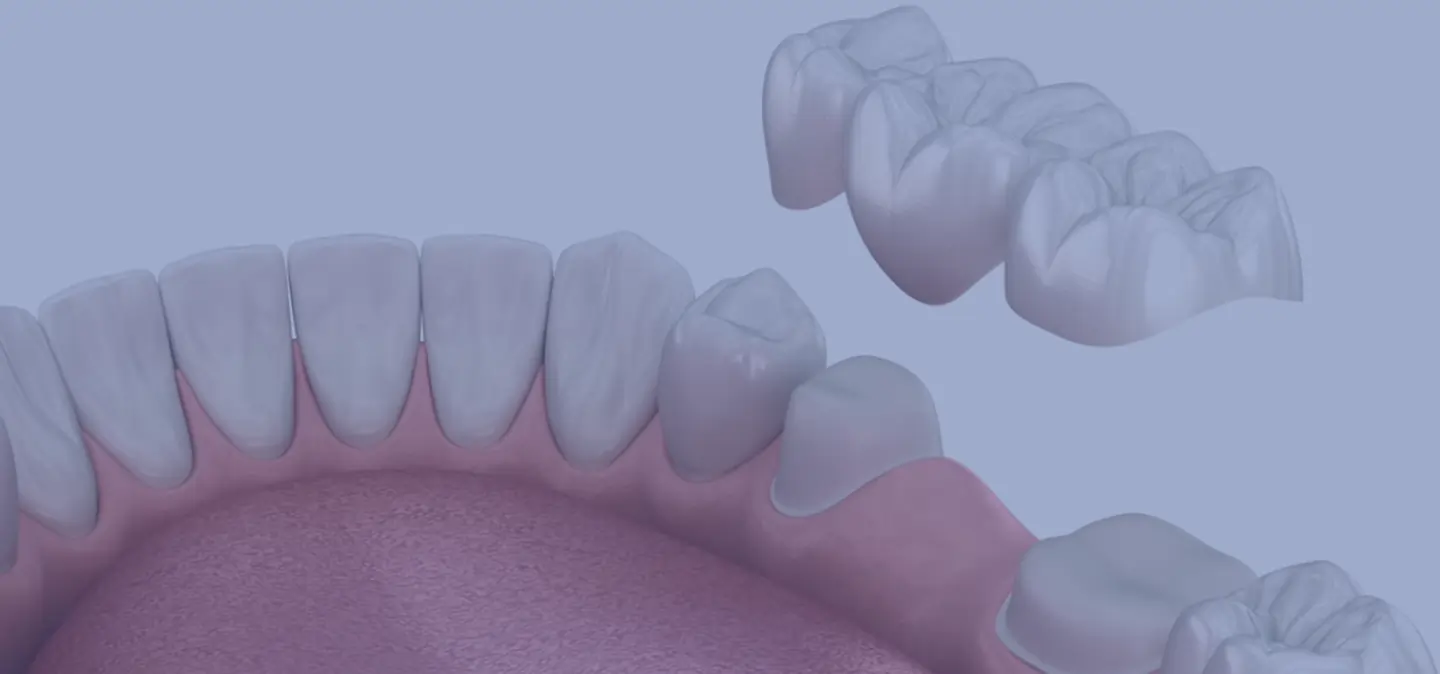
With a tooth-supported bridge nothing goes into the bone and that is the trade. No surgery, and the two neighbouring teeth pay for it.
A dental bridge in Mississauga runs about $2,300 to $5,000 for a standard three-unit bridge. That figure comes from seven Ontario and Canadian sources that publish one. Your own number depends on how many units the bridge spans, the material, and whether the supporting teeth need work first. The written estimate is the number that counts.
Missing a tooth and weighing your options? Call (905) 821-8632 or book online. We are on Britannia Road West, with free parking on site.
The four kinds of dental bridge
Four designs exist and they are not interchangeable. Which one suits you is decided by the teeth that are missing and the state of the teeth around them.
Traditional bridge
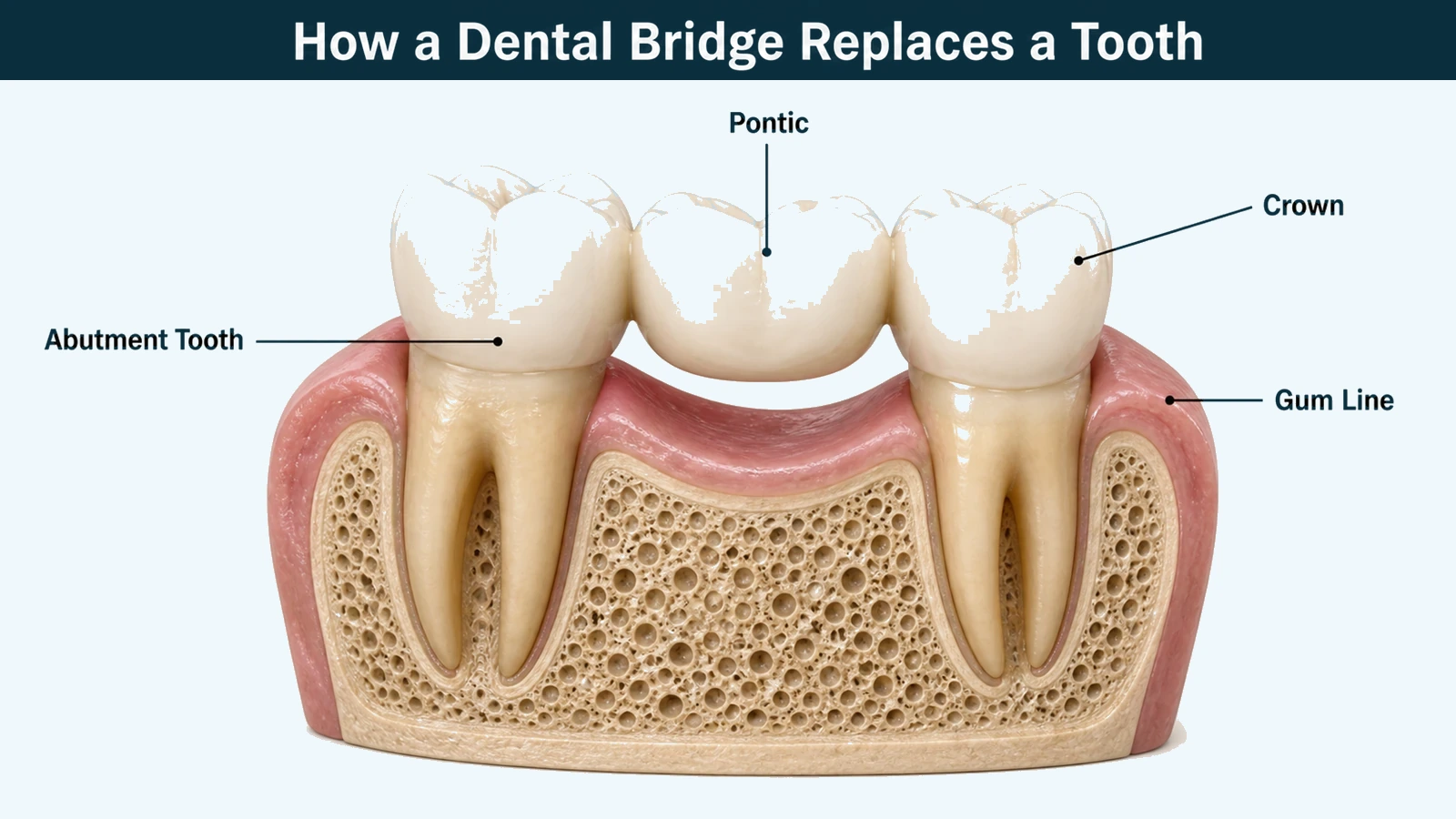
A crown on the tooth in front. A crown on the tooth behind. The pontic joined between them.
This is what most people mean by a tooth bridge in Mississauga and it is the design behind the $2,300 to $5,000 figure. It needs healthy well-rooted teeth on both sides.
Cantilever bridge
Anchored on one side only. Used where there is a tooth on one side of the gap and nothing usable on the other.
It works but it asks more of the single supporting tooth, because that tooth takes a sideways twist every time you chew. Cantilevers survive at 91.4% at five years and 80.3% at ten. That is measurably below a two-sided bridge.
Maryland bridge, also called resin-bonded
A pontic with one or two thin metal or ceramic wings that bond to the backs of the neighbouring teeth. Almost no enamel is removed.
It is mainly a front-tooth solution and the gentlest design on the teeth beside the gap. Across 2,300 resin-bonded bridges the five-year survival rate is 91.4% and the ten-year rate is 82.9%. Single-wing designs outlasted two-wing designs in that analysis. The usual failure is a wing coming unstuck and rebonding it is a short appointment.
Implant-supported bridge
The bridge sits on implants placed in the bone instead of on your own teeth, so nothing is filed down.
It costs the most and takes the longest. It is also the only design that leaves the neighbouring teeth untouched. Implant-supported bridges run about 95.2% at five years and 86.7% at ten.
What a bridge takes from the teeth beside the gap
This is the part most pages skip. Of the ten Mississauga pages ranking for bridge terms, three describe filing the supporting teeth at all. Not one says the change is for good.
To fit a traditional bridge, enamel is cut from the two teeth beside the gap so crowns can sit over them. How much comes off depends on the tooth and on the bridge material. Enamel does not regenerate and those two teeth will need a crown for the rest of their lives, with or without the bridge.
There is a second cost and it is measurable. In cantilever bridges followed over ten years, 32.6% of abutment teeth lost the living nerve inside them and 9.1% developed decay at the abutment. A tooth whose nerve dies needs root canal treatment. Across conventional bridges, the ten-year risk of losing the whole bridge to decay is 2.6%.
None of that makes a bridge a bad choice. It means the choice has a price the invoice does not show. You should hear it before you agree.
If the teeth either side are already crowned or heavily filled, the argument for a bridge gets stronger, because the enamel is already gone.
Who a bridge suits, and who it does not
A bridge suits you if one tooth is missing, or two in a row. The teeth on both sides need to be sound and well rooted. Your gums need to be healthy and the bone around the supporting teeth stable.
The case gets stronger when the teeth beside the gap already carry large fillings or crowns. It gets stronger again if you want the gap closed without surgery.
A bridge is the harder argument in five situations. If the neighbouring teeth are untouched and healthy, an implant leaves them alone. Active gum disease has to be treated first. A long gap loads the abutments heavily, because a bridge spanning three or more missing teeth asks a great deal of the two teeth holding it.
The last tooth in the arch has nothing behind it to anchor to. Grinding your teeth hard shortens the life of any fixed work.
This is settled at an assessment with an examination and x-rays. Which bridge designs this practice fits is worth asking us directly.
Bridge dental treatment in Mississauga, appointment by appointment
Preparation and fitting are two visits over two to three weeks. The assessment comes before them and a short review after.
- Assessment. Examination, x-rays of the supporting teeth and the bone around them, and a discussion of bridge against implant against denture. You get an itemised written estimate here.
- Preparation. The abutment teeth are numbed and shaped. A scan or impression goes to the laboratory with the shade. A temporary bridge goes on at the same visit, so you do not leave with a gap.
- The laboratory stage. Two to three weeks for most bridges. The bridge is built to the impression.
- Fitting. The temporary comes off and the new bridge is tried in. The bite is checked and adjusted, and when it sits right it is cemented.
- Review. A short follow-up to check the gums around the margins and how you are cleaning under the pontic.
A porcelain dental bridge in Mississauga is built from porcelain fused to metal, all-ceramic or zirconia. Across implant-supported multiple-unit bridges metal-ceramic reached 98.7% survival at five years against 93.0% for zirconia-ceramic. Front teeth favour ceramic for appearance and back teeth favour strength.
Living with the temporary bridge
The temporary is made of acrylic and cemented lightly, because it has to come off cleanly. Treat it gently.
No hard crusts. No toffee. No chewing ice on that side.
If it comes loose, keep it and call us. Prepared teeth drift within days and then the finished bridge will not seat.
Need the gap looked at? Call (905) 821-8632 or book online.
Does getting a bridge hurt?
The preparation appointment is done under local anaesthetic. Expect pressure and movement. Say so if you feel anything sharp and more anaesthetic goes in before the work carries on.
Afterwards the prepared teeth are sensitive to cold for a few days. For some people it runs to a couple of weeks, and over-the-counter pain relief handles it. Sensitivity that gets worse instead of better after ten days is worth a call, because it can mean the nerve in an abutment tooth is struggling.
The gums around a new margin are tender for the first week. That settles as they heal against the new edge.
Cleaning under a bridge
A bridge is one solid piece and floss will not pass between the units. The space under the pontic has to be cleaned another way, and this is where bridges are lost.
- A floss threader or superfloss to pull floss under the pontic and slide it along the gum. Once a day.
- Interdental brushes sized to the gaps at each end of the bridge.
- A water flosser, which many people find easier under a long span and which is a fair substitute when threading is awkward.
- Normal brushing twice a day with a fluoride toothpaste, paying attention to the margins where crown meets tooth.
The margins are where decay starts, because the abutment tooth underneath is still a real tooth and it can still decay. By the time it hurts, the bridge has to come off.
Signs to call about
Call us the same day for severe pain, swelling of the gum, or a fever. Go to an emergency department instead if the swelling reaches your eye or under your tongue, if it is spreading down your neck, or if you have trouble breathing or swallowing.
Call us soon, and it is not urgent, for:
- A bridge that feels loose or clicks
- A bad taste or smell that will not brush away
- Gum that bleeds around one end of the bridge
- Sensitivity to cold that keeps getting worse
- Food packing under the pontic every time you eat
How long a dental bridge lasts
Here are the measured figures instead of a round number.
| Bridge type | Survival at 5 years | Survival at 10 years |
|---|---|---|
| Conventional, tooth-supported | 93.8% | 89.2% |
| Cantilever | 91.4% | 80.3% |
| Maryland or resin-bonded | 91.4% | 82.9% |
| Implant-supported | 95.2% | 86.7% |
Source: pooled survival analysis of fixed dental prostheses, and resin-bonded bridge survival across 2,300 units.
Survival and success are different things. A bridge that is still in your mouth has survived. A bridge that has had no problem at all has succeeded.
At ten years, 71.1% of bridges were free of every complication in a second pooled analysis. Roughly one bridge in five is still doing its job and has needed something done to it along the way.
The ten-year risks behind that number, from the same analysis:
- Loss of retention, meaning the bridge comes loose: 6.4%
- Decay at an abutment costing the bridge: 2.6%
- A porcelain chip or fracture: 3.2%
- An abutment tooth fracturing: 2.1%
- Gum disease taking a supporting tooth: 0.7%
What moves your own odds: how well you clean under the pontic, whether you grind, and the state of the supporting teeth on the day it was fitted.
Bridge, implant or denture?
| Bridge | Implant | Partial denture | |
|---|---|---|---|
| Surgery | No | Yes | No |
| Neighbouring teeth filed | Yes for a conventional bridge, and for good | No | No |
| Fixed or removable | Fixed | Fixed | Removable |
| Treatment time | 2 to 3 weeks | 3 to 9 months | 3 to 6 weeks |
| Survival at 10 years | 89.2% | 86.7% | varies |
| Bone under the gap | Shrinks | May hold around the implant | Shrinks |
| Typical area cost | $2,300 to $5,000 | higher | lower |
| CDCP | No | No | May help, conditions apply |
A bridge does not stop the bone under the gap from shrinking, because nothing is transmitting chewing force into it. Over years the gum under the pontic can hollow slightly. An implant is the only option here that loads the bone.
Read more on dental implants and dentures.
What a dental bridge costs in Mississauga
We do not publish our own fee. These are area ranges, collected from Ontario and Canadian sources that publish a figure, so you can see roughly where you stand before you sit down.
| Bridge type | Area range |
|---|---|
| Traditional three-unit | $2,300 to $5,000 |
| Maryland or resin-bonded | $1,500 to $3,700 |
| Cantilever | $1,800 to $3,900 |
| Implant-supported | $5,200 to $13,300 |
Those are area ranges, not our price list. Your own number comes in a written estimate after an examination.
What moves the price
Five things move the number. A bridge is priced per unit, so a three-unit bridge is two crowns plus one pontic. A four-unit bridge costs more than a three.
The material matters and porcelain fused to metal sits below all-ceramic and zirconia. A supporting tooth that needs a filling, root canal treatment or gum treatment before it can carry a bridge adds its own cost.
Front teeth carry a shade-matching cost that back teeth do not. Bridges are made by hand in a lab and lab fees vary.
The Ontario Dental Association publishes a Suggested Fee Guide each year. It is a guide and not a binding schedule. No fee schedule binds an Ontario dentist, so fees differ between practices for the same procedure.
The CDCP and fixed bridges
The Canadian Dental Care Plan does not cover fixed bridges. This is not a case of needing pre-approval. Bridges appear on the plan's permanent exclusion list, in Appendix E of the CDCP dental benefits guide, under "fixed prosthodontics (bridges and all bridge related procedures)". The guide describes the items on that list as always outside the scope of coverage.
The plan's exception route does not reach bridges either. It applies only to services that are outside the scope and are not on the exclusion list.
What the CDCP can help with, if you qualify:
- Examinations and x-rays
- Cleanings
- Fillings
- Extractions
- Root canal treatment
- Eligible dentures
Co-payments start once household income passes $70,000. The rate is 40% from $70,000 to $79,999 and 60% from $80,000 to $89,999. Any fee above the CDCP rate is added on top (Government of Canada). Our CDCP page covers eligibility in full.
Private insurance
Bridges fall under major restorative work on an employer plan. That category is reimbursed at a lower percentage than fillings and cleanings and it counts against an annual maximum. A bridge can use most of a year's maximum on its own.
Two things are worth doing before you commit. Ask your plan what percentage it pays for major restorative work and what your annual maximum is. Then ask for a pre-determination, which gets your insurer's answer in writing before treatment starts.
When you compare quotes, ask whether the examination, the x-rays, the temporary bridge and the laboratory fee are inside the number you have been given, because they are not in every quote.
When a bridge is the wrong answer
It happens, and we would say so at the assessment.
Filing two healthy teeth to replace a third is a poor exchange when an implant is possible. Pristine teeth either side argue against a bridge. A gap at the back with nothing behind it gives nothing to anchor the far end to.
Active gum disease rules a bridge out for now, because a bridge on teeth losing bone support will fail and it will take the supporting teeth with it. Gum treatment comes first.
Past two or three units the load on the abutments climbs sharply and a partial denture or implants make more sense. Supporting teeth with short or curved roots may not take the extra load.
If a bridge comes loose or fails
Loss of retention is the single most common problem, at 6.4% over ten years. A bridge that lifts, clicks or packs food underneath is telling you something.
Do not wait it out. Saliva gets under a loose bridge and decay starts on the abutment underneath. A bridge that could have been recemented in one visit becomes a bridge that has to be cut off.
A bridge that cannot be lifted off intact has to be cut off, and cutting destroys it.
What happens next depends on what we find. A sound abutment under a loose bridge is recemented. An abutment with decay at the margin needs the decay removed and the tooth rebuilt, then a new bridge. An abutment that has fractured below the gum may have to come out, and the plan changes to an implant or a partial denture.
If your bridge comes out whole, keep it somewhere safe and call us. Do not try to glue it back.
Dentistry on Britannia is a general dental practice. Our dentists are general dentists, not specialists in any RCDSO-recognised specialty.