

That is the part that separates an implant from every other option. A bridge leans on the teeth either side. A denture rests on the gums. An implant is anchored in bone, so nothing else in your mouth carries the load.
A single dental implant in Mississauga runs about $2,900 to $6,500. That range comes from seven Canadian sources that publish a figure, two of them Mississauga practices. The bottom of it is one local practice's advertised flat fee and most quotes land above it.
Four of those seven say the figure covers the post, the abutment and the crown. Three do not say, which makes it the first thing to ask about any quote. Your own number depends on the state of the bone and on what has to happen before the post goes in.
Missing a tooth and wondering whether an implant is possible? Call (905) 821-8632 or book online. We are on Britannia Road West, with free parking on site.
What a dental implant actually is
Three separate parts, made and fitted at different times. Knowing which is which makes every quote easier to read.
The implant. A threaded titanium post, roughly the size of a tooth root, placed into the jawbone. Titanium is used because bone will grow directly onto it.
The abutment. A connector that screws into the post and sits just above the gum line. It is what the crown attaches to.
The crown. The visible tooth, made in a laboratory to match the teeth beside it.
Some quotes price all three together and some price them separately. Ask which you are looking at, because a number covering only the post is not comparable to one covering the finished tooth.
Osseointegration, and why it takes months
The bone does not simply hold the post in place by friction. Living bone grows onto the titanium surface and locks it there. That process is called osseointegration and it is what makes an implant different from anything else in dentistry.
It cannot be hurried. The post is placed, the gum is closed over or around it and the bone is left to do its work for several months before the crown goes on. The exact wait depends on where in the mouth the implant sits and how dense the bone is there.
Across studies with a mean follow-up of 13.4 years, the mean bone loss around the implant was 1.3 mm. Bone settles a little around an implant. It is not supposed to keep going.
Who an implant suits, and who it does not
An implant needs three things: enough bone to hold it, healthy gums around it and healing that works normally. An assessment checks all three.
Enough bone
The post has to be surrounded by bone on every side. Where a tooth has been missing for years the ridge narrows. An infection at the time the tooth came out takes height off the bone as well.
Where there is not enough, bone grafting can build it back before the implant goes in. That adds months and cost. It is a separate procedure with its own consent. Our bone grafting page sets out what that involves.
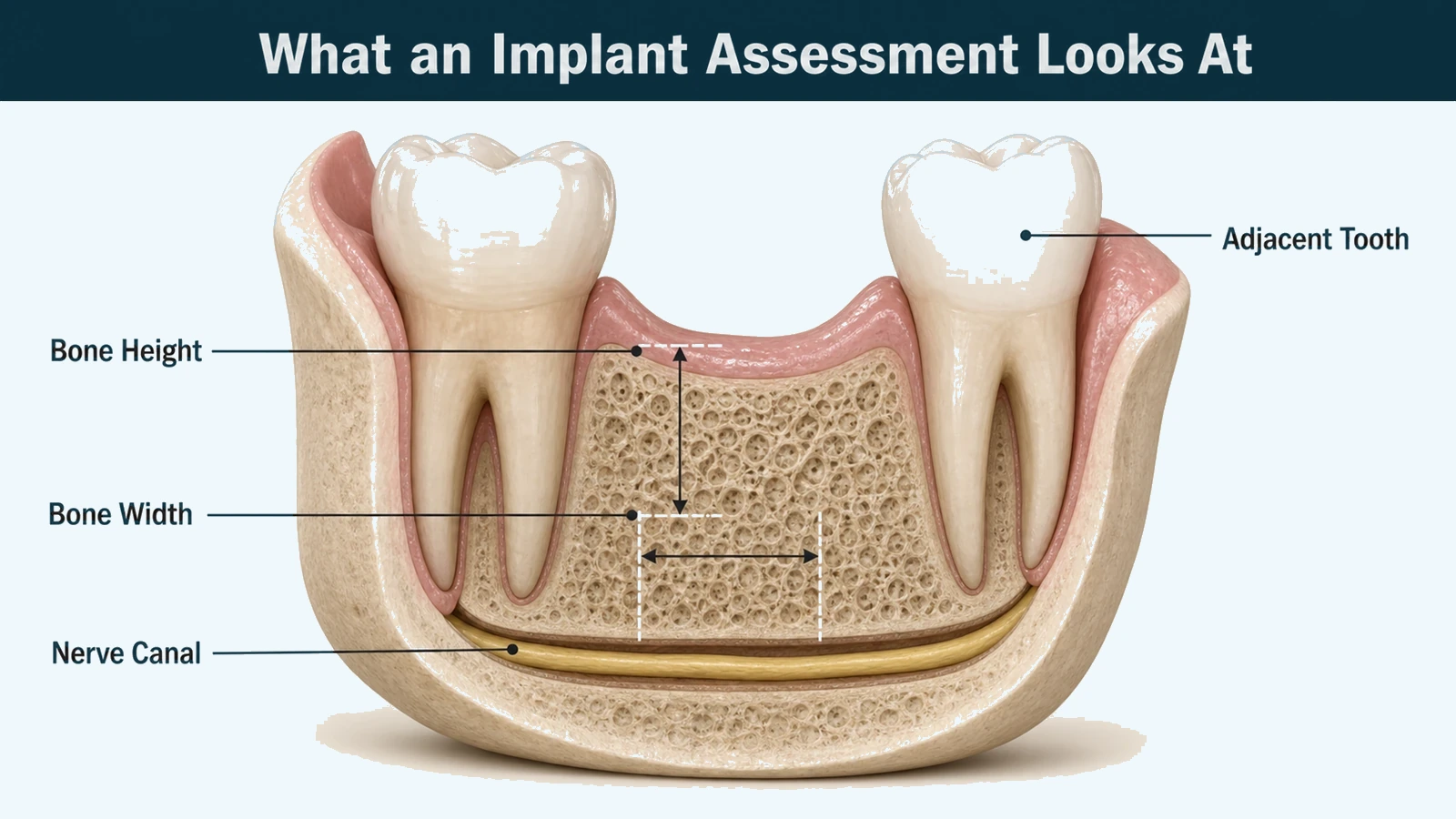
Where the answer is not obvious from an x-ray, a CBCT scan settles it. We have the scanner here, so that scan is taken at your appointment and not booked somewhere else. Height, width and the position of the nerve are measured off it, not estimated by eye.
Healthy gums
Gum disease has to be treated and stable before an implant is placed. The bacteria that destroy bone around natural teeth do the same thing around an implant. If your gums bleed when you brush, that comes first. Gum disease treatment and a cleaning are the starting point, not a delay tactic.
Smoking
Smoking is the single largest modifiable risk to an implant, and most pages about implants do not mention it at all.
Across 107 studies, 6.35% of implants placed in smokers failed against 3.18% in non-smokers. The same analysis found higher rates of infection after surgery and more bone loss around the implant over time.
That does not rule out an implant. It does mean you should hear the number before you decide.
Diabetes
Both types of diabetes raise the risk of infection around an implant, and not by the same amount.
In a Swedish register study of 18,975 people, peri-implantitis affected 21.1% of those with type 1 diabetes against 15.2% without it. For type 2 the prevalence gap was smaller, 20.5% against 18.2%, and was not statistically significant.
Counting new cases over time changed that. On that measure type 2 diabetes did carry a raised risk, with a hazard ratio of 1.36. The authors concluded that both types are associated with a higher risk of peri-implantitis.
Well-controlled diabetes is not a barrier to an implant. Uncontrolled blood sugar is a reason to get that settled first.
Age
There is no upper age limit. Age moves the odds a little and it is not a barrier, which is set out with the figures under Am I too old for a dental implant? below.
The limit is at the other end. An implant does not move as the jaw grows, so implants are not placed in people whose jaws are still developing. That is judged on growth, not on a birthday.
What the consultation covers
An implant consultation exists to find out whether an implant is possible, and to say so plainly either way.
- An examination of the gap, the teeth either side and the bite.
- X-rays, and a CBCT scan where the case needs one. Both are taken here. Imaging shows bone height and width, the nerve that runs through the lower jaw, and the floor of the sinus above the upper back teeth. Planning is built around those two structures, because an implant placed into either one causes a problem.
- A medical history, including every medicine you take, so bring the list. Drugs that act on bone, such as bisphosphonates and denosumab, change how the jaw heals after surgery. So can blood thinners, steroids and treatment that suppresses the immune system.
- A discussion of what is realistic, including the options if an implant is not.
- A written estimate, itemised, before anything is booked.
You will leave knowing whether the bone is there, roughly how long the whole thing would take and what it would cost. If the answer is that an implant is not the right move, you get that answer at the consultation and not after the money is spent.
Getting a dental implant, stage by stage
The order is fixed, and the gaps between the stages are where most of the time goes. Every stage below happens in this office. The surgical appointment is not referred to another practice, and you are not passed between two sets of records.
Preparation. Anything that has to happen first happens first. A tooth that is still in place is removed and gum disease is treated.
A graft, if one is needed, is placed and left to heal.
Placement. The post is put into the bone under local anaesthetic, through a small opening in the gum. It is a surgical appointment and most people describe it as easier than the extraction that came before it.
Healing. The bone grows onto the post over several months. You are seen during this period to check it. You can wear a temporary tooth for that time if the gap shows when you smile.
The abutment. Once the implant is solid, the connector is fitted. This is done at placement or as a small second appointment.
Impressions. A digital scan is taken with the 3D scanner here, so the laboratory can make a crown that fits your bite and matches your other teeth.
Fitting. The crown is attached, the bite is checked and adjusted and the tooth is finished.
Plan for the whole thing to run across months, not weeks. Your own timeline is set at the assessment, because the bone decides it.
Living with the gap while you heal
This is the part nobody asks about until they are in it.
For a back tooth, most people simply chew on the other side. For a front tooth a temporary is usually made. It is either removable or bonded to the neighbouring teeth.
Eat softly in the first week after surgery and keep away from the site until it closes. Your own instructions come from the person who placed it. They beat anything written on a web page.
Does getting an implant hurt?
The placement itself is done under local anaesthetic, so you feel pressure rather than pain.
Afterwards expect soreness and some swelling for a few days, of the kind that follows an extraction. Ordinary painkillers handle it for most people. Swelling peaks around the second day and then settles.
Pain that is getting worse after the third day is not the normal pattern. That is a phone call, not something to wait out.
When to get help urgently
Call 911 if you have difficulty breathing or swallowing, are drooling because you cannot manage your saliva, your voice has changed or sounds muffled, or you feel confused or faint.
Go to a hospital emergency department if you have:
- Swelling spreading under the jaw, into the neck or towards the eye
- Swelling under the tongue or in the floor of the mouth
- A fever with facial swelling or feeling unwell and shivery
- Swelling that spreads quickly over hours and not days
- Difficulty opening your mouth
- New problems with your vision
- Bleeding that will not stop
Call us if numbness or tingling in the lip, chin or tongue is still there once the anaesthetic has fully worn off. The nerve in the lower jaw runs close to the implant site and altered sensation needs to be assessed early.
Call us if an upper back implant is followed by air or fluid passing between the mouth and the nose, a blocked or bleeding nose on that side, or pain over the cheekbone. The floor of the sinus sits above those roots.
Call us too if swelling gets worse after the third day, if you have a fever without the signs above, if bleeding does not settle, or if you see pus at the site or taste something foul. All of those point to infection.
How long a dental implant lasts
Implants have been followed in research for decades and the survival figures are good. The honest version of those figures has a range in it.
A review of 18 studies put ten-year survival at 96.4% at implant level. The same authors then ran the numbers again, filling in the patients the studies had lost track of instead of assuming those implants did as well as the ones still being followed. On that reading the figure fell to 93.2%. Both numbers come from the same analysis and the lower one is the more cautious read.
A separate review following 7,711 implants for a mean of 13.4 years found 94.6% still in place.
Survival is not the same as untroubled. An implant still firm in the bone may have needed a screw tightened, a crown remade or gum treatment along the way. Those are repairs and not failures, and they are common enough to budget for.
Nothing in dentistry is fitted and forgotten. An implant that is cleaned and checked lasts a long time, and one that is neglected does not.
Cleaning around an implant
An implant cannot decay. The gum and bone holding it can still be lost. That is what ends most implants that do end.
Brush it like a tooth, twice a day. Clean between it and its neighbours every day with floss, an interdental brush or a water flosser. Use whichever you will actually keep up. The area right at the gum line is the part that matters.
Keep the check-up and cleaning appointments. Bone loss around an implant causes no pain in its early stages and shows on an x-ray long before you would notice it.
Peri-implantitis
This is the condition to know the name of. It is inflammation around an implant that has gone past the gum and started taking bone with it.
It is common. Pooled across studies, peri-implant mucositis affects about 43% of people with implants and peri-implantitis about 22%. Neither figure is precise. The pooled estimates carry confidence intervals of 32% to 54% and 14% to 30%.
Mucositis is the earlier stage. It is reversible and confined to the gum. Peri-implantitis is the stage where bone is being lost, and prevalence rises the longer an implant has been in function.
Caught early it is treatable. Caught late the implant may not be savable, which is the whole argument for regular checks.
Signs to call about
- Gums around the implant bleeding when you brush
- Redness or swelling at the gum line that does not settle
- A bad taste or a smell coming from the area
- Any movement in the crown or the implant
- Pain on biting that was not there before
Implant, bridge or denture?
Three ways to replace a missing tooth. Each differs in cost, in how long it takes and in what it does to the teeth around the gap.
| Implant | Bridge | Denture | |
|---|---|---|---|
| Area cost | $2,900 to $6,500 per tooth | $2,300 to $5,000 for three units | $900 to $3,300 per arch |
| Teeth either side | Untouched | Filed down for crowns | Untouched |
| Time to finish | Several months | Two to three weeks | Weeks |
| Surgery | Yes | No | No |
| Removable | No | No | Yes |
| Cleaning | Brush and clean between, like a tooth | Clean under the pontic with threaders or a water flosser | Taken out and cleaned |
An implant costs the most and asks the most of you in time. It is the only one of the three that replaces the root of the tooth, which is what keeps the load on the bone.
A bridge is quicker and cheaper. It is paid for in enamel taken off two healthy teeth. A denture is the least invasive and the least stable. Our blog piece on choosing between an implant, a bridge and a denture works through the trade in more detail.
What happens if you leave the gap
Doing nothing is a real option. Its consequences are worth hearing before you choose it.
The teeth either side of a gap tilt towards it over time. The tooth opposite drifts down or up into the space. That changes the bite, and a changed bite puts uneven load on teeth that were fine before.
The bone that used to hold the root is no longer being loaded. Ridge bone narrows where a tooth is missing. That is the reason a gap left for years can need grafting before an implant becomes possible.
One claim needs care here. Implants are widely described as preventing that bone loss. A 2023 review comparing implant-supported and conventional prostheses found no clear advantage for the implant on alveolar bone resorption, and judged the evidence insufficient.
An implant replaces the root. Whether it protects the ridge the way it is commonly said to has not been shown.
What a dental implant costs in Mississauga
We do not publish our own fee. The figures below are area ranges collected from Canadian practices that publish one, so you can see where you stand before you sit down.
| What | Area range |
|---|---|
| Single implant, including the abutment and the crown | $2,900 to $6,500 |
Seven sources publish a single-implant figure and two of them are Mississauga practices. The $2,900 at the bottom is one local practice's advertised flat fee, not a typical price. Six of the seven sources sit above it.
Four of the seven say what the figure includes, and all four count the post, the abutment and the crown. Three do not say. Your own number comes in a written estimate after an examination.
What moves the price
Whether a tooth still has to come out, and whether the socket needs anything doing after it does.
Whether bone grafting is needed. Four of the seven sources that publish an implant price say grafting adds cost without saying how much.
The crown material, and whether the tooth is at the front where shade matching is harder. The imaging, because a CBCT scan is not part of every quote.
The Ontario Dental Association publishes a Suggested Fee Guide each year. It is a guide and not a binding schedule. No fee schedule binds an Ontario dentist, so fees differ between practices for the same work.
We do not spread the cost of treatment over time. Some practices in the area do, so it is worth asking when you compare quotes.
The CDCP and dental implants
The Canadian Dental Care Plan does not cover dental implants. This is not a matter of getting pre-approval first.
Implants sit on the plan's permanent exclusion list. The CDCP dental benefits guide lists "implants and all implant-related procedures" as an exclusion, and lists bone grafts and ridge augmentation separately as others. Exclusions are not eligible for reconsideration.
The plan's exception route does not reach implants either. It applies to services that fall outside the scope of coverage and are not on the exclusion list, and the guide describes coverage of exceptions as expected to be extremely rare.
What the CDCP can help with, if you qualify:
- Examinations and x-rays
- Cleanings
- Fillings
- Extractions
- Root canal treatment
- Eligible dentures
Co-payments start once adjusted family net income passes $70,000. The rate is 40% from $70,000 to $79,999 and 60% from $80,000 to $89,999. Any fee above the CDCP rate is added on top (Government of Canada). Our CDCP page covers eligibility in full.
The one Ontario programme that does fund implants
You will read on a lot of pages that no public plan in Ontario pays for implants. That is nearly right and it is stated too strongly.
Ontario runs the Oral and Maxillofacial Rehabilitation Program. It provides funding for patients who require implants to retain a removable, highly specialized prosthetic device to restore the ability to chew, swallow and speak when no other treatment alternative exists.
That is a narrow door. It is aimed at people rebuilding after cancer surgery or major facial trauma, not at replacing a single missing tooth. Most people reading this page will not qualify, and the few who might should know the name of it.
Private insurance
Plans treat implants differently. A fair number exclude them outright as a category.
Where a plan does contribute, implants fall under major restorative work. That is reimbursed at a lower percentage than fillings and cleanings. It also counts against an annual maximum that a single implant can use most of.
Two things are worth doing before you commit. Ask your plan in plain terms whether implants are covered at all and what your annual maximum is. Then ask for a pre-determination, which gets the insurer's answer in writing before treatment starts.
When an implant is the wrong answer
There are cases where it is, and you should hear that at the assessment.
Not enough bone and no appetite for grafting. Active gum disease that has not been dealt with. A medical picture that makes healing unreliable. A budget that an implant would swallow when a bridge or a denture would solve the same problem.
If an implant is not right for you, we will say so and set out what is.
Dentistry on Britannia is a general dental practice. Our dentists are general dentists, not specialists in any RCDSO-recognised specialty.