
That last part is what separates it from a veneer. You can add to bonding later, repair it or have it taken off, so the tooth is not committed to being covered for the rest of your life.
We will also tell you when bonding is the wrong answer for your tooth. Call (905) 821-8632 or book online.
What happens in the chair
The appointment is short and nothing is sent to a lab.
- We look at the tooth first, because a chip can hide a fracture line and a worn edge often points to grinding.
- We pick a shade against the teeth beside it, in daylight where we can.
- We roughen the surface slightly and apply a conditioning liquid so the resin grips.
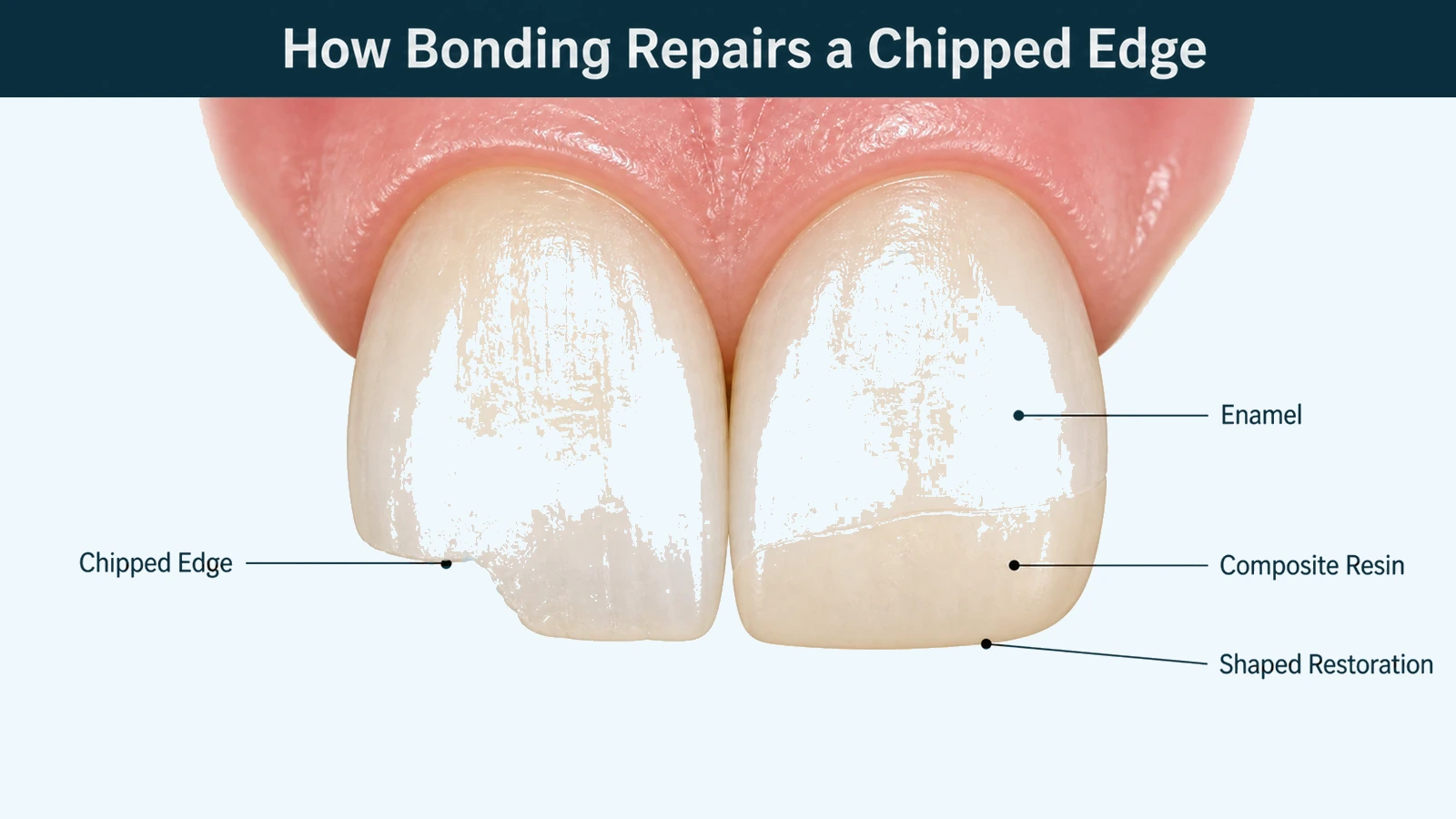
- We build the composite up in layers and shape it by hand.
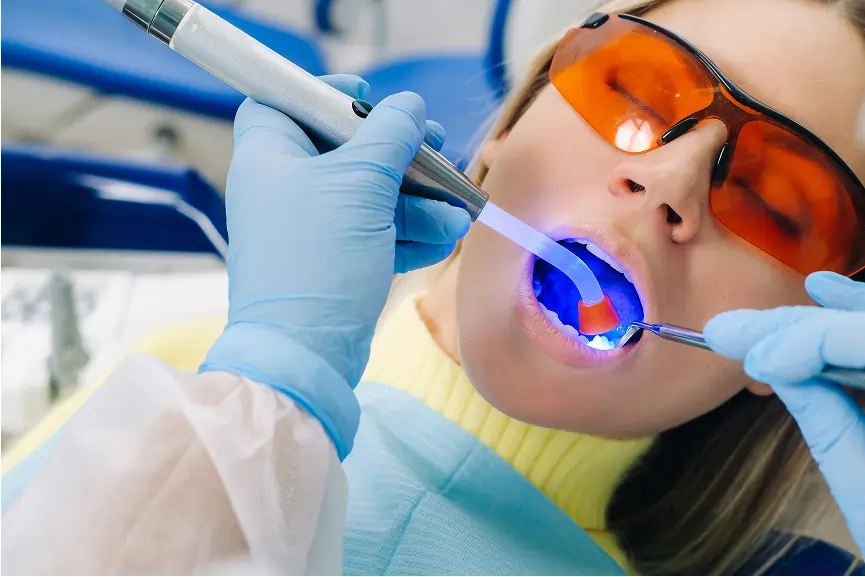
- A curing light sets each layer hard in seconds.
- We adjust your bite, then smooth and polish the finished repair.
Freezing is often unnecessary because a straightforward repair removes no tooth. We use it when there is decay to clear out first or when the repair reaches a sensitive root surface.
Check the shape in a mirror before you leave. Say so on the day if anything feels high or catches your lip, because it is far easier to adjust before you leave.
What tooth bonding fixes well
- A chipped or cracked corner on a front tooth
- A small gap between two teeth
- A tooth that sits slightly short, or has an uneven edge
- A patch of discolouration that whitening will not shift, the case most people mean by cosmetic dental bonding
- An exposed root surface where the gum has receded and the area is sensitive
- An old silver filling on a tooth that shows
The common thread is that all of these are small, and composite resin is shaped onto the tooth in one visit.
What bonding will not do
Enamel and porcelain are both harder than composite, so bonding chips under load sooner than either.
It picks up stain over the years and the worst of it shows along the edges where the resin meets the tooth. Coffee, tea, red wine and smoking speed that up.
It wears faster than porcelain, and the wear shows first on biting edges and in people who grind.
It will not rebuild a badly broken tooth. Past a certain point the tooth needs covering rather than adding to, and that means a dental crown.
Matching a single front tooth is the hardest version of this job. A match that looks right today can drift, because composite ages differently from natural enamel.
How long does composite bonding last?
Two published studies answer this better than any estimate we could give you.
The Journal of Dental Research published a practice-based study that followed 72,196 composite repairs on front teeth in 29,855 patients. Forty-seven general dentists placed them over fifteen years. It measured a mean annual failure rate of 4.6% at five years and roughly one repair in twenty needs attention in any given year.
That rate ran from 2% to 11% depending on which dentist placed the repair. Who places it matters.
Dental Materials published a separate review of seventeen studies covering 1,821 repairs, and the most common reason for failure was the tooth or the repair fracturing.
That review also found something worth knowing before you book. Repairs placed to improve appearance failed on appearance more often than repairs placed to fix damage. Colour drifts. The shape flattens and the surface picks up stain.
Bonding done for looks is judged by how it looks. That is a harder standard to hold for a decade.
So plan on touch-ups. Bonding is a repair that gets refreshed. It is not a one-time fix, and a polish or a small addition costs less than starting again.
Does insurance or the CDCP cover dental bonding?
This is the question nobody in this market answers, and the answer is more useful than a simple yes or no.
Bonding is not one procedure to a dental plan. It is two, and they are treated differently.
Bonding that restores a tooth. Resin used to repair decay or a broken corner is a filling and the Canadian Dental Care Plan lists composite restorations on permanent teeth as an eligible service. Its published rule is once per tooth surface in any 24-month period.
Bonding that improves how a tooth looks. The CDCP publishes a list of treatments it never pays for at any time. Cosmetic treatment is named on it. So are veneers in composite or ceramic and restorations for wear on the biting edges of teeth.
Closing a gap you dislike or masking a stain falls on that side of the line. So does building up front teeth that have worn short.
The same resin in the same appointment counts as an eligible restoration or as cosmetic treatment that is excluded. The reason for the treatment is what decides it.
Private plans draw a similar line in their own words. Where a plan pays a share of a restorative repair, reported out-of-pocket costs across Ontario sit around $60 to $120 per tooth. That figure describes other people's plans. Yours sets its own rules.
Ask us which of the two your treatment is before you commit. What your plan then pays is between you and your plan. Read more about dental coverage and the CDCP.
How much does dental bonding cost in Mississauga?
Composite bonding across the Mississauga area runs about $300 to $600 per tooth. Practices publishing figures locally land inside that range with very little spread.
Three things move your own number. How many teeth are involved. How large an area is being built up, since a whole front surface is a different job from a corner. And whether anything needs treating before the cosmetic work starts.
Covering the entire face of a tooth stops being a chip repair and starts being a composite veneer, which is priced accordingly. Dental veneers sets out that comparison.
Ask whether the exam, any x-rays and any preparatory treatment are included in the quote.
Your written estimate is the number that counts, so ask for it before you agree to anything.
When we will suggest something else
The tooth is badly broken. It needs covering, not adding to.
The problem is position, not shape. Orthodontic treatment moves the tooth. Bonding only disguises it, and hiding a real misalignment means bulking the tooth out until it looks bulked out.
The colour bothers you across every tooth. Teeth whitening deals with that. Bonding one tooth to match unwhitened teeth solves the wrong problem, and in the wrong order.
There is decay, a crack or gum disease. Those get treated first, because resin laid over an untreated problem seals the problem in.
You grind heavily and will not wear a guard. We will say so plainly. Bonding on a biting edge does not survive long in someone who grinds without protection. Our custom night guards page explains how they are made.
Bonding, a veneer or a crown
| Bonding | Porcelain veneer | Crown | |
|---|---|---|---|
| Appointments | Usually one | Usually two | Usually two |
| Made where | In your mouth | In a lab | In a lab |
| Tooth removed | Little or none | A layer of enamel, for good | More, all around |
| Reversible | Largely | No | No |
| Cost per tooth | $300 to $600 | Higher | Highest |
| Stain resistance | Lowest | High | High |
| Wrong choice for | A large repair, or heavy grinding with no guard | A problem small enough for bonding | A tooth that does not need full coverage |
Start with bonding when the only problem is one small chip. It costs less than the alternatives. It takes little or no enamel. A veneer is still open to you afterwards.
The reverse order does not work. Enamel removed for a veneer never grows back.
Not sure which one your tooth needs? Book an exam and we will look at it with you. Call (905) 821-8632.
The first two days, then the years after
Composite takes up stain most readily when it has just been placed and polished.
So for the first 48 hours go easy on coffee, tea, red wine, dark sauces and tobacco. After that the surface has settled and normal habits matter more than any single day.
From then on, four things decide how long it lasts.
Do not bite hard objects with a bonded edge. Fingernails, ice, pens and bottle caps are what chip it.
A mouthful of water after coffee, tea or red wine helps if colour matters to you.
Skip abrasive whitening toothpaste, because it dulls the polish and dull composite picks up stain faster.
Mention your bonding at every checkup so we can look at the edges and polish or repair it before it needs redoing.
Dentistry on Britannia is a general dental practice. Our dentists are general dentists, not specialists in any RCDSO-recognised specialty.