
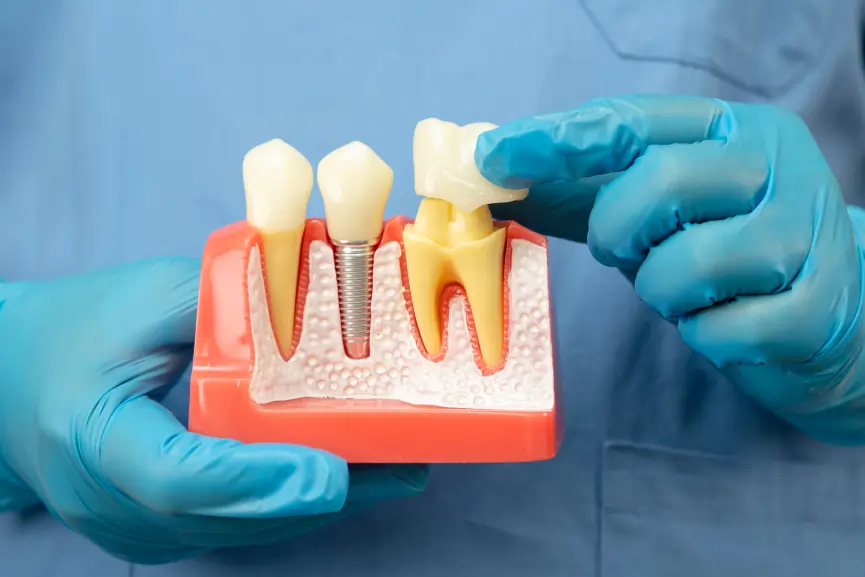
A dental crown is a shell that covers a tooth and spreads the chewing load across it. It is one answer for a tooth that is cracked, heavily filled or weakened. How much sound tooth is left decides whether it is the right one.
Two appointments with a temporary crown in between. No referral step here and no need to be on our books already.
When do you actually need a crown?
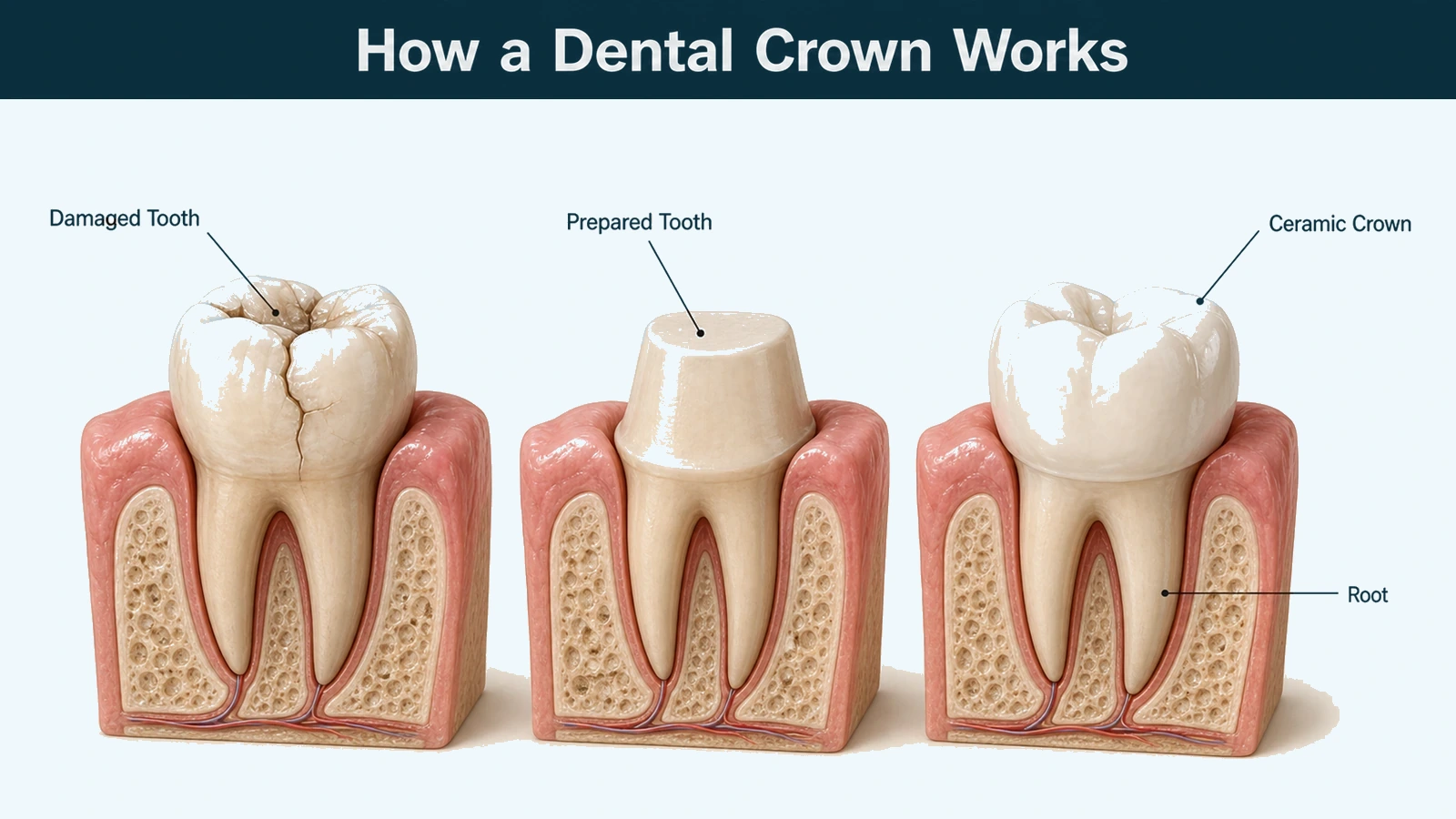
A tooth needs covering when too little sound tooth remains to hold a filling, or when what remains would crack under load.
That happens when a large filling fails and too little tooth is left for another. When a cusp breaks off. After root canal treatment on a back tooth, where covering the cusps stops it splitting. And after a crack is found, once we know how deep it goes.
Cosmetic reasons count too and a dark, badly shaped or worn tooth can take one for appearance alone.
But a crown is not a small thing. Healthy tooth has to be reduced on every surface to make room and that cannot be undone. Read about dental fillings first if a filling would still hold.
Crown, filling, or something else?
It comes down to how much tooth is left.
Enough sound tooth to grip a filling? A filling is less work, less cost and keeps more of your tooth.
Not enough left and the nerve healthy? A crown or an onlay, chosen on what is left.
Nerve infected or dying? Root canal treatment first. Whether the tooth can carry a crown gets checked before that starts.
Tooth split below the gum? The answer here can be extraction. How deep the split runs decides it and an x-ray tells us.
The two appointments
First visit. We numb the tooth and shape it so old filling material and decay come out and anything missing is built back up. Then an impression, the shade agreed, and a temporary fitted.
In between. Your crown gets made at the laboratory. You leave with a tooth that is covered, not a stump.
Second visit. Off comes the temporary and on goes the new crown. We check the fit, the bite and the contact with the next tooth before cementing it.
Every crown here is made in a laboratory. That is what the two visits and the temporary are for. Other treatment is different: if the job is small the dentist will often do it the same day, and that call gets made after looking.
Ready to get it looked at? Call (905) 821-8632 or book online.
Living with a temporary crown
Temporaries are held with provisional cement meant to come away at the next visit, so one can loosen. Chew on the other side and skip anything sticky.
Comes off? Keep it and phone us. That tooth is shaped and sensitive, and teeth drift once it is off, which stops the finished crown fitting.
Does it hurt, and what about afterwards?
We numb the tooth for the preparation so what you feel is pressure and vibration. Tell us if anything feels sharp.
Afterwards the gum around a freshly prepared tooth stays tender for a few days. A tooth with a live nerve in it can react to cold with the temporary on and that brief sensitivity settles. Pain that lingers, or starts on its own, needs checking before the crown is cemented.
Once the finished crown is on, Cleveland Clinic says twinges from hot and cold drinks are normal for up to a couple of weeks. For sore gums it names acetaminophen or ibuprofen. Take one you already know is safe for you and stick to the dose on the label.
Two things need a call. A bite that feels high on the new crown, because it aches and takes little to fix. And pain that builds instead of fading, which can mean the nerve has not tolerated the work.
Ring the same day for swelling, a rising temperature or a taste that will not clear. Call 911 if you have difficulty breathing or swallowing, are drooling because you cannot manage your saliva, your voice has changed or sounds muffled, or you feel confused or faint.
What crowns are made of
Ask which material suits your tooth. It depends on where it sits, how hard you bite and what shows when you smile.
All-ceramic and porcelain are the tooth-coloured options and appearance is where they earn their place. With no metal in them they also suit people with a metal allergy (Cleveland Clinic).
Zirconia is strong, and comes in formulations trading strength against how natural it looks.
Porcelain bonded to metal has decades behind it. The porcelain can chip and a dark line can show if the gum recedes.
Gold is gentle on the tooth biting against it and needs the least thickness, so the least tooth comes off. Gold crowns have a page of their own.
We place all of them: zirconia, porcelain, ceramic, PFM and gold. The choice is clinical, not a stock question.
Clearance is part of it. Ceramic and zirconia need more room than gold, and the gold crowns page sets out its figures and alloys.
How long does a crown last?
Five to 15 years is the average span Cleveland Clinic gives and good care stretches it further. There is no way to predict yours. The research gives real numbers. Pooled survival data puts metal-ceramic crowns near 97% at five years and monolithic zirconia close behind, with zirconia around 86% still in service at ten.
Several things decide it. The margin, because that join collects plaque. Your bite, whether you grind and the health of the tooth under it.
Where the tooth sits matters too, because molars take the heaviest chewing load. In a review of 37 studies 8.1% of all-ceramic molar crowns fractured within five years against 3.0% on premolars.
The crown cannot decay but the tooth underneath can. So a crowned tooth needs the same brushing and flossing and the same check-ups as the rest of your mouth.
Cleveland Clinic tells crown wearers to steer clear of ice cubes and very hard nuts, popcorn kernels and sticky sweets like toffee and caramel. Ask about a custom mouth guard if you grind or clench at night.
If your crown comes off
Keep it. Put it somewhere safe and bring it, because an undamaged one can go back on.
Do not use superglue because it is not safe in the mouth and it fills the fitting surface. A crown that would have gone back on has to be remade.
Until you are seen keep it clean and chew on the other side. Tell us when you call if the tooth is sharp or sore, or if the crown came off with a piece of tooth attached.
Severe pain, swelling or a fever needs us the same day. If you swallowed or breathed in the crown and are coughing or short of breath, treat it as an emergency and get medical help.
What a dental crown costs in Mississauga
The material sets most of it. These are the ranges in this area, in Canadian dollars.
| Crown | Typical range |
|---|---|
| Porcelain bonded to metal | $875 to $1,800 |
| All-porcelain or ceramic | $800 to $3,000 |
| Zirconia | $1,200 to $2,500 |
| Gold or metal alloy | $800 to $2,500 |
Practices in the area publish crown prices from $500 to $4,000 across every material. Gold sits where it does because the laboratory bills for the metal at market rate.
What moves you inside a range: which tooth, what material, whether the tooth needs building up first and whether anything else has to be treated first.
Those are area ranges, not our price list. A crown is not one item either, so read your written estimate line by line and ask what it covers.
No fee schedule binds an Ontario dentist. The Ontario Dental Association publishes a suggested fee guide and says fees can vary above and below it.
The lab fee and what else to ask about
Two charges make up the crown itself. Ask what the dentist's fee takes in: preparing the tooth, the impression, the temporary and the fitting. The laboratory charges for making the crown. The Ontario Dental Association says that charge is passed on at exactly what the lab billed, and you can ask for a lab fee estimate before you start.
Some teeth need work first. A core build-up replaces lost tooth so the crown has something to hold. A post and core does that job in a root-treated tooth. If you need root canal treatment first, ask whether it is in the quote.
Ask for each one to be named on your estimate. The same question goes for the exam and any x-rays taken before the crown.
Insurance plans set a yearly maximum. A crown can use most of it, so check what is left on yours before you book. Many carriers work from the ODA fee guide and some use an older year of it that pays less than a current fee.
Here is what you can do before committing.
- Ask for a written estimate, which you get before treatment begins
- Ask us to send a pre-determination so your insurer states in writing what it will cover
- Use direct insurance billing
- Use the Canadian Dental Care Plan if it covers you. Age is no longer the barrier, income is. Some treatment needs approval first, and approval is not payment
On the CDCP your co-payment follows adjusted family net income. Under $70,000 there is none. The rate is 40% of the CDCP fee for incomes of $70,000 to $79,999 and rises to 60% for $80,000 to $89,999. A dentist fee above the CDCP fee is added on top (Government of Canada).
Crowns are on the CDCP list of major services along with the cores and posts that support them, crown repairs and re-bonding. A crown needs preauthorization and so do its core and post. Your dentist recommends the work and the plan confirms whether it will pay.
That request goes in with dated x-rays taken within the last 12 months (CDCP preauthorization rules). Not every request is approved.
Read about coverage and the CDCP.
Dentistry on Britannia is a general dental practice. Our dentists are general dentists, not specialists in any RCDSO-recognised specialty.