
Not all recession needs treating
Start here. Recession that is stable needs nothing but monitoring.
Treatment is considered when there is a reason:
- Sensitivity that does not settle with other measures
- Decay on the exposed root surface, which is softer than enamel and decays faster
- Recession that is progressing, measured over time and not guessed at
- Too little firm gum left to stay healthy
- Appearance, where the recession is visible and it bothers you
Stable recession that causes no symptoms is monitored and not grafted. If nobody can tell you why you need it, that is a reason to ask.
What causes recession
Which cause applies to you decides whether a graft will hold.
Brushing technique. Brushing too hard, at the wrong angle or with a brush that is too stiff. This is a common cause and it is one you can change.
Gum disease, which destroys the supporting tissue.
Anatomy. Thin gum tissue or a tooth positioned with little bone over its root. You were born with both.
Grinding and clenching, which load teeth in ways that can contribute.
Orthodontic movement, where a tooth has been moved through a thin area of bone.
Piercings, where jewellery rubs against the gum.
Treating the cause comes first. Grafting a site where hard brushing continues is a repair with an expiry date.
Read about gum disease treatment and night guards.
What the procedure involves
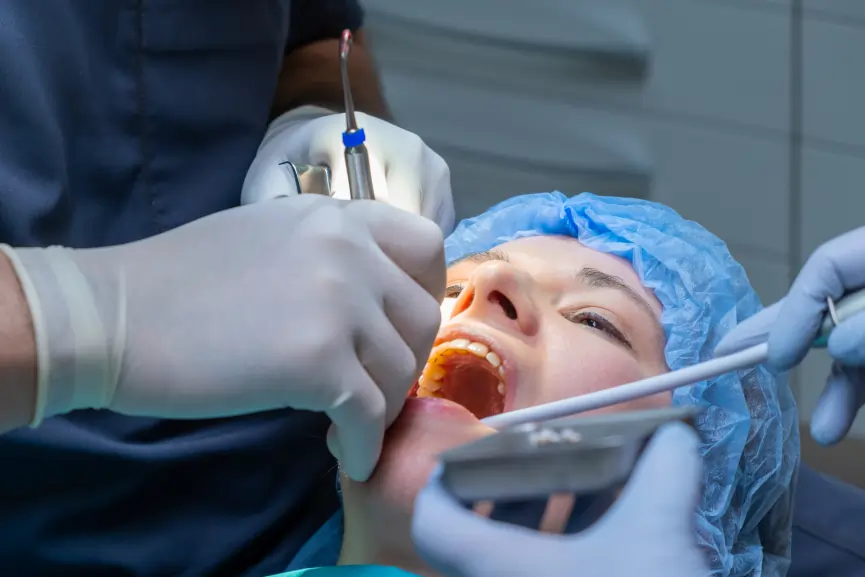
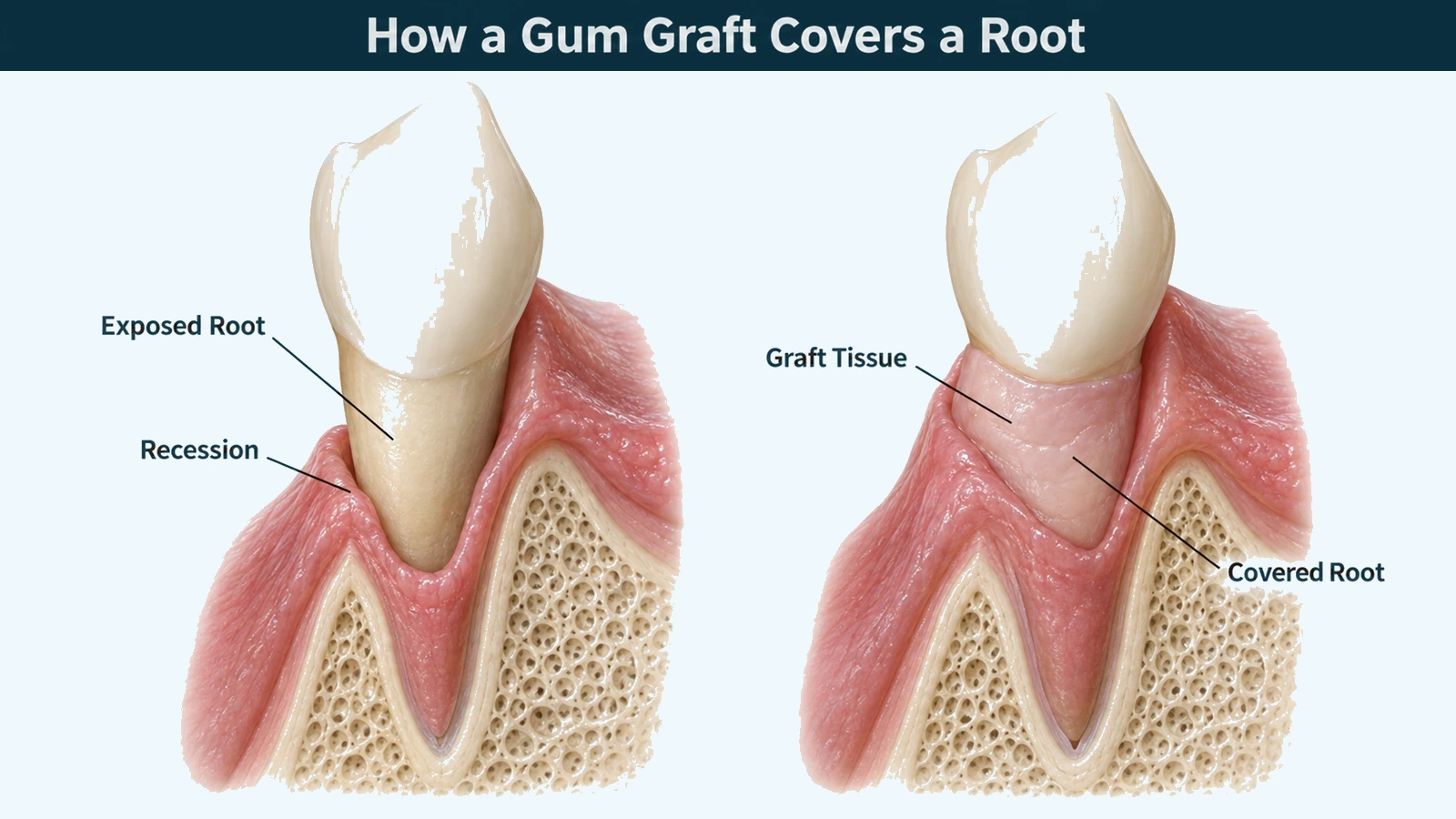
Tissue is taken from elsewhere in your mouth such as the palate. It is placed at the site of recession to rebuild the gum and cover the exposed root.
- Local anaesthetic at both the donor site and the recipient site.
- The graft is taken.
- It is positioned over the area of recession and secured.
- Both sites are dressed or stitched.
There are two healing sites and not one. You may notice the donor site more in the first days, and that is worth knowing in advance.
Gums receding? Book an assessment or call (905) 821-8632.
What it cannot promise
Full root coverage cannot be promised. How much gum you regain depends on the bone between the teeth, the amount of recession, the tissue available and the site.
That is assessed before treatment and not promised. A site with bone loss between the teeth behaves very differently from one where the bone is intact. No honest assessment offers a percentage before looking.
It does not stop recession coming back if the cause is still active. Hard brushing, untreated gum disease and grinding can all undo it.
Colour and texture may differ slightly from the surrounding gum.
Recovery
Expect discomfort for several days at both sites, managed with pain relief and the aftercare instructions you are given. Follow those instructions closely.
In particular:
- Do not brush either site until you are told to. Clean the rest of your mouth normally
- Use the rinse you are given
- Eat soft and cool food. Nothing hot, nothing hard and nothing with sharp edges
- Do not smoke. It materially affects graft survival
- Do not pull your lip out to look at it because that disturbs the graft
- Avoid strenuous exercise for the period you are told
On pain relief: do not go over the stated maximum and check you are not doubling up on the same ingredient in two products. Ask a pharmacist first if you are pregnant, treating a child, taking blood thinners or managing a stomach, kidney or liver condition.
When to get help urgently
Call 911 if you have difficulty breathing or swallowing, are drooling because you cannot manage your saliva, your voice has changed or sounds muffled, or you feel confused or faint.
Go to a hospital emergency department if you have:
- Swelling spreading under the jaw, into the neck or towards the eye
- Swelling under the tongue or in the floor of the mouth
- A fever with facial swelling or feeling unwell and shivery
- Swelling that spreads quickly over hours and not days
- Difficulty opening your mouth
- New problems with your vision
- Bleeding that will not stop
- A serious injury to the face or jaw after an accident
Call us if bleeding does not settle with gentle pressure or swelling gets worse after the third day. Call us too if you have a fever without the signs above or the graft feels loose.
What happens afterwards
We review the site at intervals to check the graft and the tissue around it.
The cause has to stay addressed. If it was brushing technique, that change is for good. If it was grinding, the guard is not optional.
Sensitivity usually improves where the root is covered and it can take time.
When it is the wrong answer
When the recession is stable and causing no symptoms. Monitoring is a legitimate plan.
When the cause has not been dealt with. Grafting into an active problem is a repair with an expiry date.
When gum disease is active, which is treated first.
When the tooth's outlook is poor regardless.
When the case needs a specialist. Where that is so, we refer.
What affects the cost?
We do not publish prices. The cost depends on how many sites are treated and how complex the case is. You get a written estimate before treatment begins.
Coverage: grafting done for appearance is generally treated as cosmetic and excluded. Grafting done for a clinical reason may be treated differently. Which applies depends on the reason for treatment and we will tell you before you commit. Ask us to submit a pre-determination. Learn more about CDCP coverage at our practice.
Dentistry on Britannia is a general dental practice. Our dentists are general dentists, not specialists in any RCDSO-recognised specialty.