

Two quite different reasons for it
For health. The gum covers more of a tooth than it should and the margin cannot be kept clean, or a restoration needs sound tooth structure above the gum to be built on. That second one is called crown lengthening, and it is a functional procedure and not a cosmetic one.
For appearance. The gumline is uneven, or more gum shows than you would like when you smile.
They are assessed differently, and the coverage question is different too.
What has to be established first
Not every gummy smile is a gum problem.
More gum showing can come from:
- The gum position itself, which is what contouring addresses
- The length of the teeth, where they are naturally short or worn down
- How much your lip lifts when you smile, which is muscle and not gum
- The position of the upper jaw, which is skeletal
Contouring only addresses the first of these. Reshaping gum will not fix a smile whose cause is lip movement or jaw position, and doing it anyway removes tissue for no benefit.
The assessment tells you which one you have. If nobody has explained which applies to you, that is the question to ask.
Unsure what is causing it? Book a consultation or call (905) 821-8632.
Not for people with active gum disease
That is treated first, always.
Reshaping the gumline in a mouth where the supporting tissue is being lost treats appearance and leaves the actual problem going. It also produces a result that will not hold.
Recession is also assessed first. Removing tissue from a site where the gum has already receded is the wrong direction.
What the procedure involves
- Assessment, including where the bone sits relative to the gum. That matters more than the gum itself.
- A talk about what is achievable for your smile.
- Local anaesthetic.
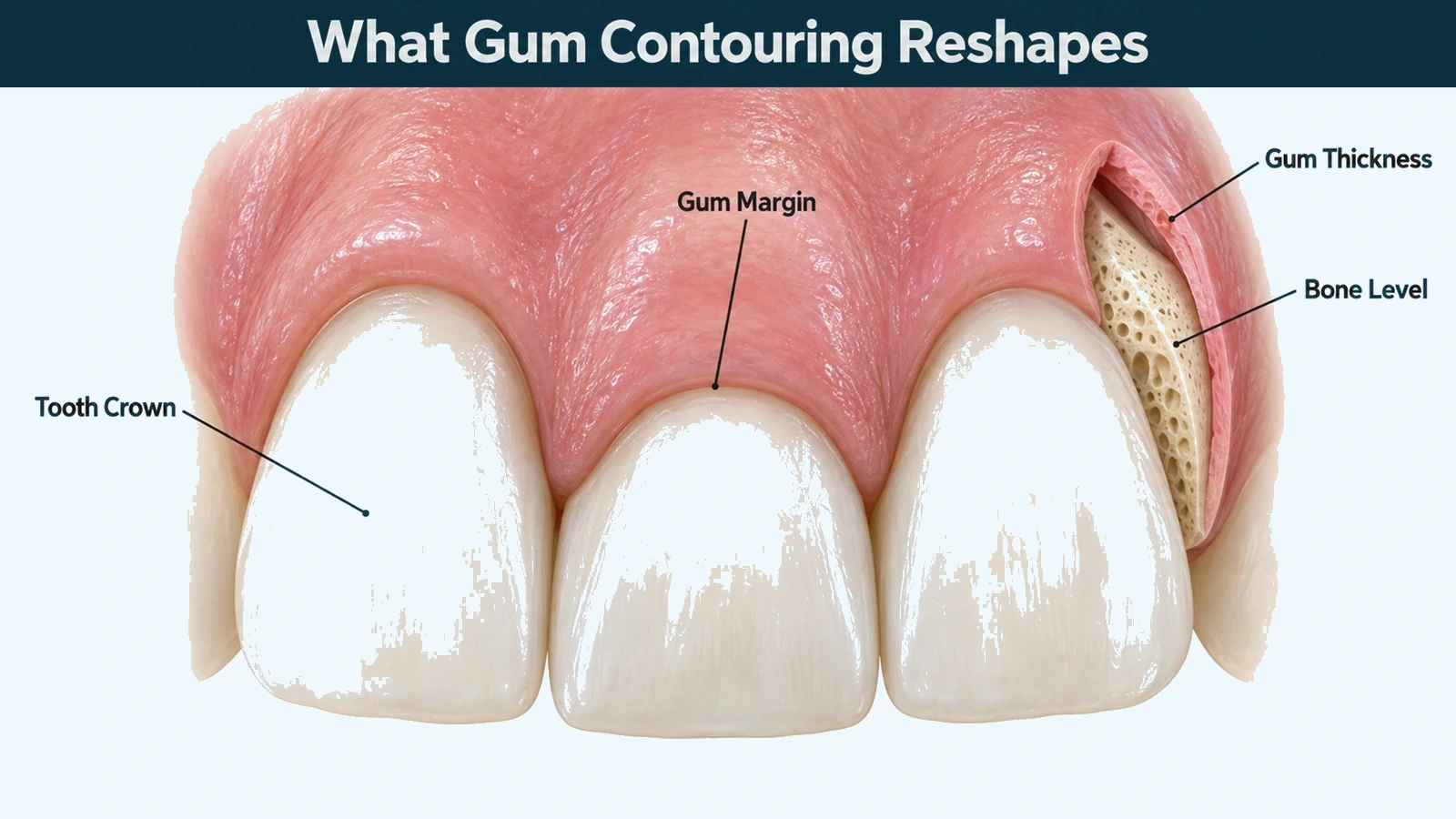
- Reshaping the gum, and the bone underneath where needed, so the result is stable.
- Healing.
Where the bone has to be reshaped too, the procedure is more involved. That step is what makes the difference between a result that holds and one that rebounds.
Healing takes longer than the visible part
Healing takes weeks, and settling takes months. The gum margin keeps maturing after the visible healing is done, so the final appearance is not the appearance at two weeks.
That matters if you are planning around a date. If you are booking this before a wedding, know the timeline properly, because it is longer than people assume.
Sensitivity is common in the early weeks and usually settles.
The honest limits
Results are not guaranteed.
Some tissue rebound is possible, especially where the bone was not addressed.
It does not change the length or shape of the teeth themselves. If the teeth are short or worn, the gum is not the whole answer and the plan can include bonding or veneers.
Read about dental bonding and dental veneers.
It does not fix a gummy smile caused by lip movement or jaw position.
Where recession is the real issue, contouring is the wrong direction entirely.
If it is being done for a restoration
Crown lengthening exposes more tooth structure so a crown or filling has something sound to be built on.
This is functional and not cosmetic, and it is planned as part of the restorative treatment and not separately. The healing period has to be built into the plan, because the final restoration is made after the gum has settled. Learn more about dental crowns.
What affects the cost?
We do not publish prices. The cost depends on how many teeth are involved and whether bone reshaping is part of it. You get a written estimate before treatment begins.
Coverage: contouring done for appearance is cosmetic treatment. CDCP does not cover it, and private plans set their own rules. Crown lengthening done to enable a restoration may be treated differently. Which applies depends on the reason for treatment, and we will tell you before you commit. Learn more about CDCP coverage at our practice.
Dentistry on Britannia is a general dental practice. Our dentists are general dentists, not specialists in any RCDSO-recognised specialty.