

If your case sits within the range aligners handle and you will wear them, aligners are an excellent option. If your case involves complex movement, or you doubt the wearing, fixed braces are more reliable, because they work without you remembering anything.
Key takeaways
- Complexity and compliance decide most cases. Everything else is secondary
- Aligners handle mild to moderate cases well. Fixed braces handle more: large rotations, significant vertical movement, complex bite correction
- Aligners only work when they are in, twenty to twenty-two hours a day
- Both need retainers afterwards, indefinitely. This is the part that decides whether the result lasts
- Both need healthy teeth and gums first. Moving teeth through inflamed gums is a bad idea
- CDCP orthodontic services are not available yet. If you are counting on them, check the current position first
- A consultation is what answers this, and some cases come back as fixed braces
What each one actually is
Clear aligners, including Invisalign
A series of removable plastic trays. Each is slightly different from the last, and each applies gentle pressure that moves teeth a small amount before you change to the next. You take them out to eat and to clean your teeth.
Invisalign is a brand of clear aligner, not a synonym for the treatment. There are other systems, and this practice offers Invisalign treatment. Learn more about Invisalign treatment.
Fixed braces
Small brackets bonded to each tooth, linked by a wire that is adjusted as treatment progresses. They stay on throughout. They come in metal, and in tooth-coloured or clear brackets that are much less visible. Learn more about clear braces.
Question one: how complex is your case?
This is not something you can assess yourself, and it matters more than how either option looks.
What aligners handle well
Mild to moderate crowding, spacing, and bite issues within the range the trays can achieve.
Where fixed braces do more
Large rotations, significant vertical movement, teeth that need moving a long distance, and complex bite correction are all more predictable with a fixed appliance. Force is applied straight through the bracket and wire, not through a tray that first has to grip the tooth.
Do attachments close the gap?
They narrow it. They do not close it.
Aligner treatment uses small tooth-coloured bumps bonded to the teeth, giving the tray something to push against. They genuinely extend what aligners can do. They do not make aligners equivalent to fixed braces for the hardest movements.
A consultation is what answers this, and the honest version of that appointment can end with "your case would be better treated with fixed braces." If you are told aligners can do anything, be careful.
Question two: will you actually wear them?
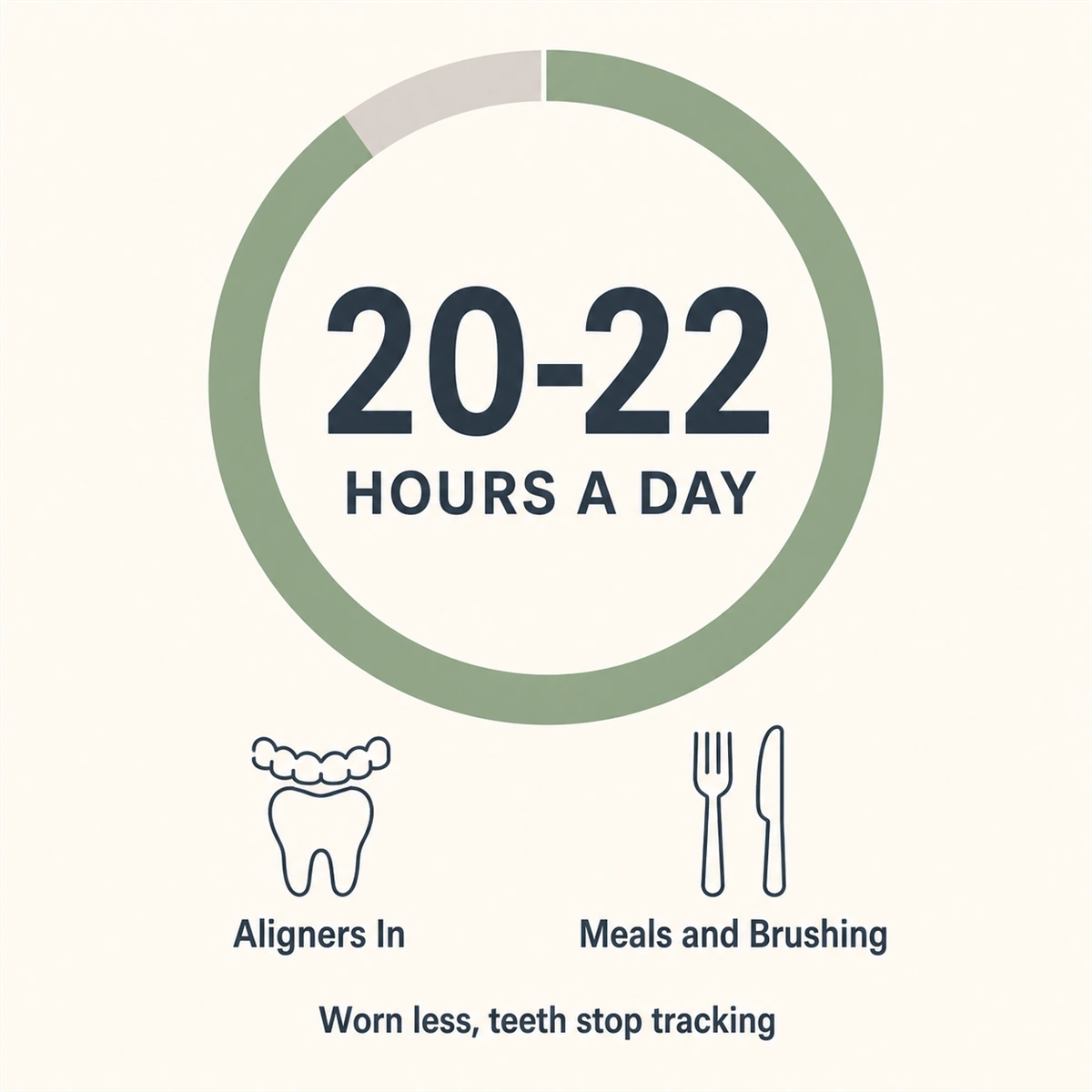
Worth being honest with yourself about, because it is the commonest reason aligner treatment runs into trouble.
Aligners are commonly prescribed for twenty to twenty-two hours a day, and your own instructions come from the dentist treating you. That leaves roughly two hours a day for every meal, every drink that is not water, and cleaning your teeth. Every day, for the whole of treatment.
Worn less than that, teeth stop tracking to the plan. Treatment takes longer, more aligners are needed, and the result falls short of what was planned.
Fixed braces take most of that out of your hands. They are working at three in the morning and on the day you forget everything else. They still ask things of you: keeping appointments, cleaning carefully around the brackets, avoiding the foods that break them, wearing elastics if you are given them. But the appliance itself does not depend on you remembering to put it in.
This is not a character test
Plenty of organised, motivated people find aligners inconvenient in ways they did not anticipate. The removing before every coffee. The case that is not in the bag. The work lunch where taking them out feels awkward.
Knowing that about yourself in advance is useful information, not a failing. It is also a better reason to choose fixed braces than any amount of comparison-table reading.
Side by side
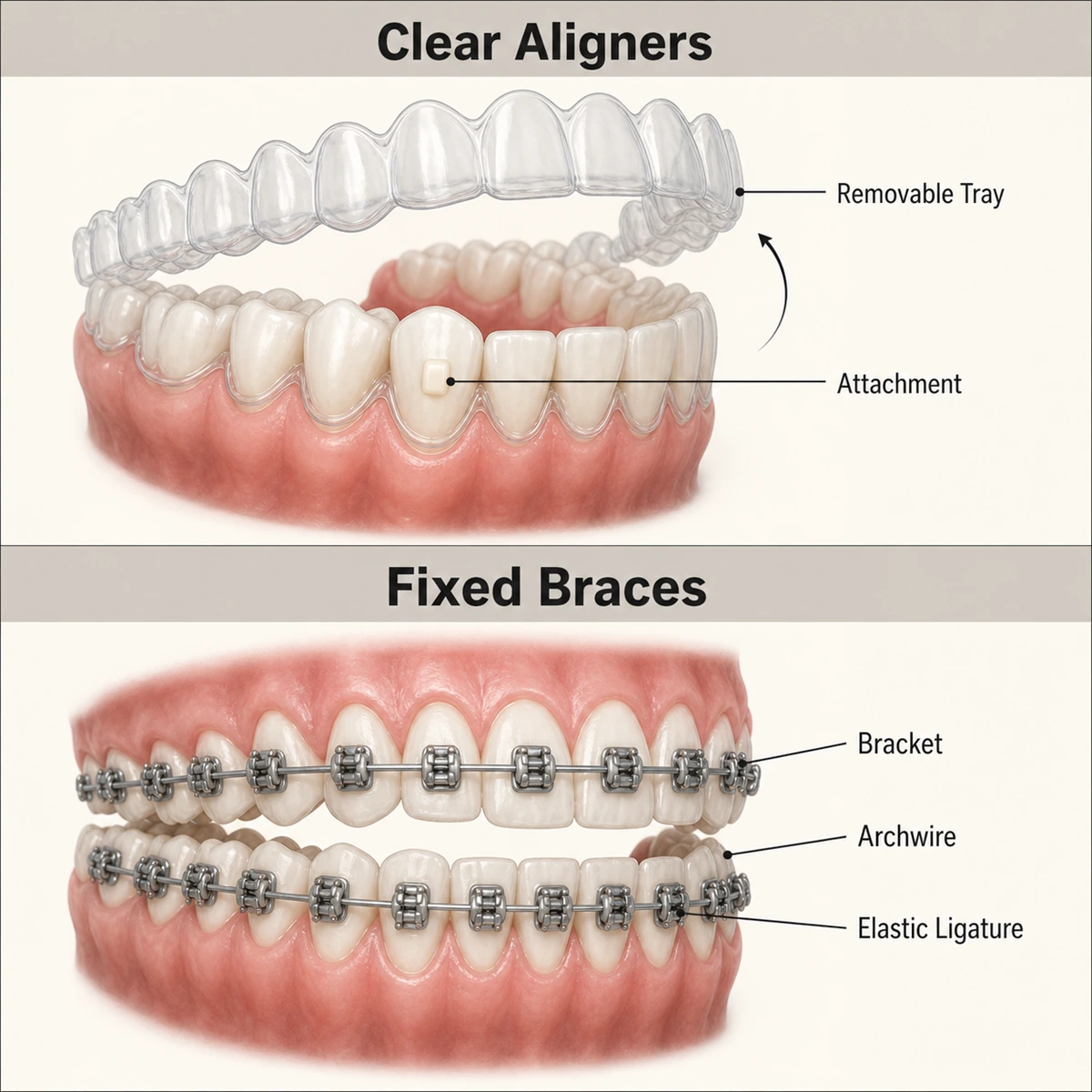
| Clear aligners | Fixed braces | |
|---|---|---|
| Visibility | Generally far less conspicuous than metal, though not invisible | Visible; clear brackets much less so than metal |
| Removable | Yes, which is both the advantage and the risk | No |
| Eating | Normal. Trays come out | Adapted. Hard and sticky foods avoided |
| Cleaning teeth | Normal. Trays come out | More care needed around brackets and wires |
| Depends on you | Entirely. They only work when worn | Less so, though care and appointments still matter |
| Complex movements | Within a range | Handles more |
| Unscheduled visits | Often fewer, though attachments come off and trays get lost | Brackets detach, wires work loose |
| Comfort | Pressure with each new tray | Pressure after adjustments, plus rubbing on the cheek |
| Staining risk | Trays are replaced regularly | Elastics and adhesive around clear brackets can discolour; metal does not |
| Retainers afterwards | Yes, indefinitely | Yes, indefinitely |
| When it is the wrong choice | Complex movement, or a wearing schedule you will not keep | When visibility genuinely matters more to you than anything else |
One row decides most cases, and it is "depends on you."
What both have in common
Both work by pressure
Teeth feel tight for a day or two after each new tray or each adjustment, and it settles. That tightness is normal. It is not by itself proof that teeth are moving as planned. Checking that is what the review appointments are for. Pain that is severe, or that does not settle, should be looked at.
Both need healthy teeth and gums first
Moving teeth through inflamed gums, or around untreated decay, is a bad idea. An examination comes before either. Learn more about dental examinations and check-ups.
Retainers, and why they are not an afterthought
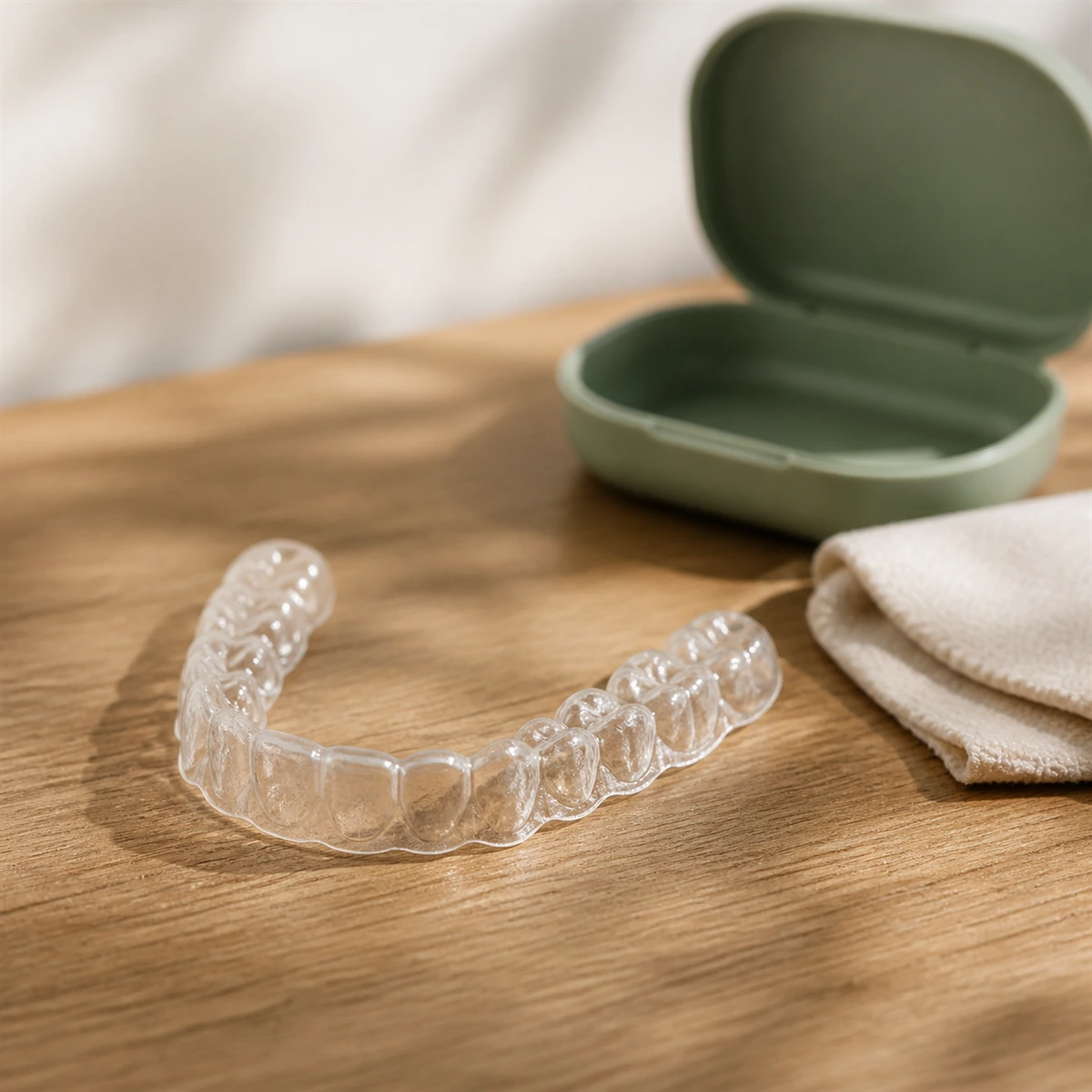
You will need a retainer afterwards, and you will need it indefinitely.
Teeth drift back towards where they started. That is normal biology, not treatment failure, and it applies to both aligners and fixed braces equally.
Retention is not the epilogue. It is the thing that decides whether any of it lasted. Ask about it before treatment starts, not at the end.
Ask about retention at the consultation: what type, how long, and what happens if one breaks.
How long does treatment take?
It depends on how far your teeth have to move, and a meaningful estimate needs an examination and the right records first.
You will see figures published everywhere: twelve to eighteen months for aligners, eighteen to twenty-four for braces, repeated across article after article. They are averages of other people's cases. A case needing small movements may finish well inside them. One needing extractions and significant repositioning may not.
What we will do is examine you, take the records needed to plan the movement, and give you an estimate for your case. That is worth more than an average.
What about cost?
We do not publish prices, and there is a reason worth stating plainly: the figure genuinely depends on the complexity of your case, and a headline number that does not apply to you is not useful information.
What you will get instead is a written estimate before anything starts. The cost varies with what your teeth actually need, and our team will go through the figure with you at the consultation.
What actually drives the number
- How much movement is needed, which is the largest factor
- Whether extractions are part of the plan
- How long treatment runs, since longer cases involve more appointments
- Whether retention is included in what you are quoted, which is worth asking explicitly
On insurance
Where a plan includes orthodontic coverage, that coverage sits under its own limit, and on most plans the limit is a lifetime maximum instead of an annual one. It does not reset.
Ask us to submit a pre-determination. Your insurer replies in writing with what they will pay before you commit. Direct insurance billing is available.
On CDCP
CDCP orthodontic services are not available yet. The plan has said a limited range will become available at a date still to be determined, that it will require approval in advance, and that it will be restricted to severe functional cases, not treatment chosen for appearance.
If you are counting on CDCP for orthodontic treatment, check the current position at canada.ca before making plans.
Adults, teenagers and the difference that matters
Age is not the barrier people assume. Adults make up a large share of orthodontic patients. What matters is healthy gums and bone, not the year on your birth certificate.
For teenagers, the compliance question weighs more heavily. An appliance that works without being remembered removes a variable from a period of life with plenty of variables already. That is a practical judgement for a parent and a teenager to make together, not a rule.
For adults, visibility weighs more heavily. That is a perfectly good reason, and it is why a great many adults start treatment at all.
What happens at the consultation
- Examination. Teeth, gums, bite, and the health of everything being moved.
- Records. Photographs, scans or impressions, and X-rays, so the movement is planned, not improvised.
- A straight answer on suitability, meaning whether your case suits aligners, fixed braces, or either.
- A plan and a written estimate, before anything is agreed.
- Time to think. Leaving with information and deciding later is a normal way for this appointment to end.
When neither is right, yet
If you have active gum disease, that is treated first. There is no point moving teeth through tissue that is actively being lost.
If a tooth needs treatment, that comes first too.
If what is actually bothering you is the colour or shape of one or two front teeth, orthodontics may be more treatment than the situation calls for. Whitening or bonding may address it faster and more conservatively, and we will say so. Learn more about teeth whitening.
What neither option will fix
Worth stating plainly, because orthodontic treatment gets asked to solve things it cannot.
It does not change the colour of your teeth. Straight and yellow is still yellow. If colour is part of what bothers you, plan whitening separately and after treatment, not during.
It does not repair chips, wear or broken edges. Those are restorative or cosmetic work, and they are done after the teeth are in position.
It does not treat gum disease, and it does not compensate for bone that has been lost. Moving teeth in a mouth with active gum disease makes matters worse.
It does not stop teeth moving afterwards. Only retention does that. Learn more about teeth whitening.
Questions worth asking at the consultation
- Which appliance suits my case, and why? Ask for the clinical reason, not the preference.
- What movements does my case actually need?
- What is your honest estimate for my case, not an average?
- Is retention included in the quoted price?
- What happens if teeth stop tracking, or a case needs refinement?
- Would you refer this case to an orthodontist?
- What does the plan look like if I do nothing?
The last one is fair and it is rarely asked. Not every case needs treating.
Dentistry on Britannia is a general dental practice. Our dentists are general dentists, not specialists in any RCDSO-recognised specialty.