
We open at 7:00 am Monday to Thursday with Saturday appointments. The office will tell you the soonest we can see you.
Call 911 now if any of these apply
- Difficulty breathing or difficulty swallowing
- Drooling or not being able to manage your own saliva
- A changed, muffled or hoarse voice along with mouth or facial swelling
- Confusion, faintness or unusual drowsiness
- Heavy bleeding you cannot control
- A head injury with loss of consciousness
- Sudden swelling of the lips or tongue with a rash or itching. This can be an allergic reaction and not a dental problem. It is treated as an emergency
A dental infection that spreads into the tissues of the neck or the floor of the mouth can affect the airway. That is a medical emergency and it is why this list sits above everything else on the page.
Go to a hospital emergency department if you have
- Swelling spreading under the jaw, into the neck or towards the eye
- Swelling under the tongue or in the floor of the mouth
- A fever with facial swelling or feeling unwell and shivery
- Swelling that spreads quickly over hours and not days
- Difficulty opening your mouth
- New problems with your vision
- Bleeding that will not stop
- A serious injury to the face or jaw after an accident
Not sure which list you are on? Treat it as the more urgent one. Nobody will think less of you for arriving at hospital with something that turns out to be manageable.
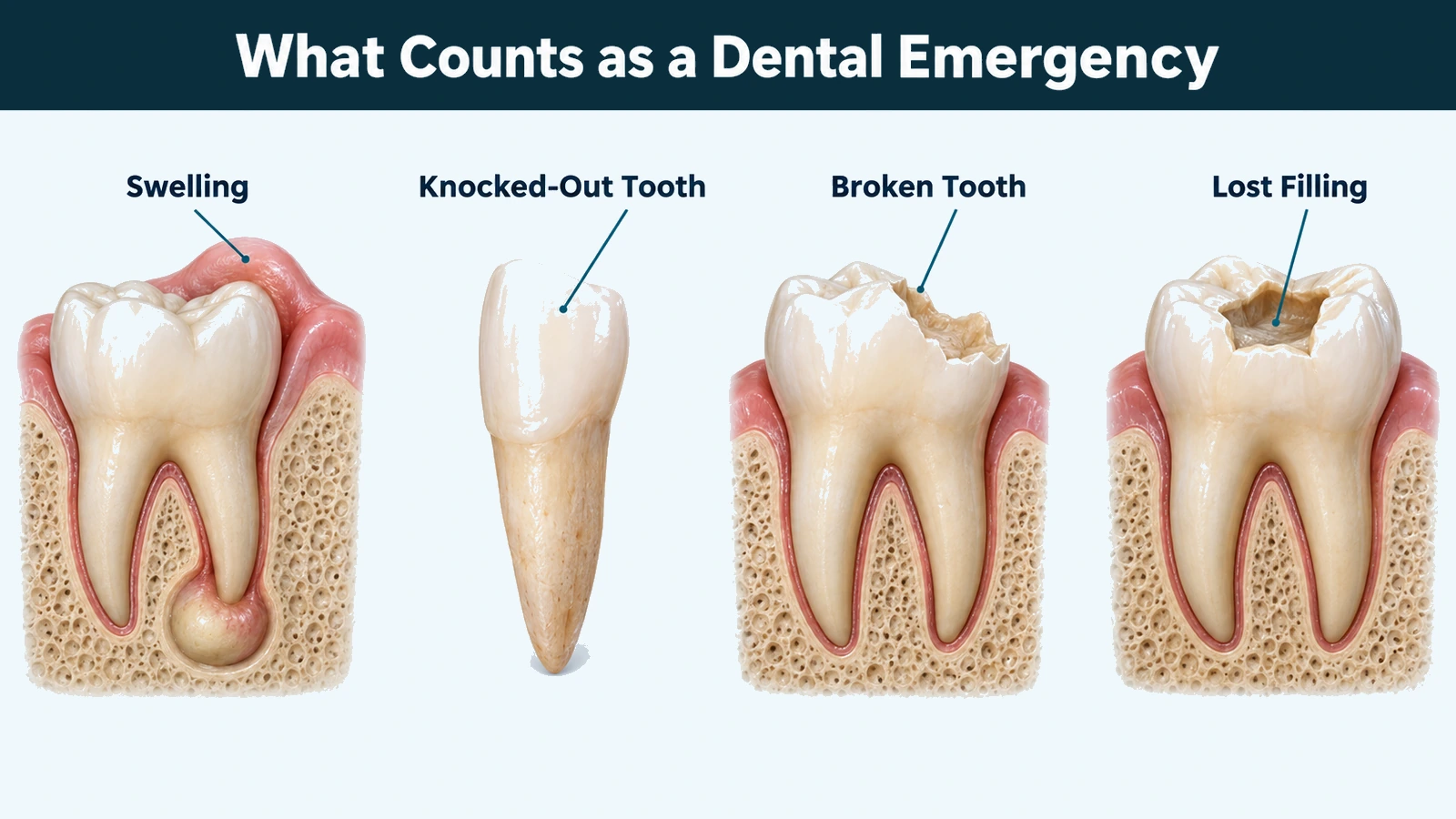
A knocked-out adult tooth
If the tooth was lost in an accident, the injury comes first. Call 911 for loss of consciousness, confusion, unusual drowsiness or heavy bleeding you cannot control. Go to the emergency department first for any other head injury, a suspected broken jaw or bleeding that will not stop. Bring the tooth with you.
- Pick the tooth up by the crown. That is the white part you normally see in the mouth at the opposite end from the narrow pointed root. Do not touch the root. Living cells on the root surface let the tooth reattach and handling can damage them.
- If it is dirty, rinse it briefly in milk or saline, or very briefly in clean water. A few seconds only.
- Do not scrub or dry it. Do not use soap or disinfectant and do not wrap it in tissue.
- If the injured person is fully alert and able to cooperate, put the tooth back in the socket. Ease it in gently and the right way round without forcing it. Then have them bite on a clean cloth to hold it steady. Putting the tooth straight back gives it the best chance where this is safe and possible.
Do not try this if the person is drowsy, confused, a young child or unable to cooperate, or if there is any chance of the tooth being swallowed or inhaled. Put it in milk instead.
- If you cannot put it back, keep it moist. In order of preference:
- Milk, or a tooth-preservation solution if you have one. Reach for this first - Saline if you have it - The injured person's own saliva held inside their cheek. This is a last resort only for a fully alert, cooperative adult. Never use it for a child or for anyone drowsy or confused, because the tooth can be swallowed or inhaled - Water only if there is nothing else. Plain water damages the root cells but still beats letting the tooth dry out
- Come in immediately and call on the way.
Time out of the mouth matters more here than almost anywhere else in dentistry. The chance of saving the tooth drops the longer it is out of the mouth and falls sharply after the first hour.
Never put a knocked-out baby tooth back. Replanting it can damage the adult tooth developing underneath. If you are not sure whether it is a baby tooth or an adult tooth, do not put it back. Keep it in milk and call us.
What we see the same day
Facial or gum swelling
Call us. If the swelling is spreading, or you have a fever with it, use the hospital list above instead.
Swelling means infection has moved out of the tooth and into the tissue around it. Do not put heat on your face. Heat draws an infection outward and makes a spreading swelling worse.
An abscess that has burst has drained, not gone. The relief is real and it is temporary. The source is still there and still needs treating.
Antibiotics on their own do not fix it. They buy time. The tooth still needs the treatment that removes the cause, which is usually root canal treatment or an extraction.
Toothache
Pain that stops you sleeping, working or concentrating is a same-day problem, whatever it looks like from the outside.
Over-the-counter pain relief helps. Keep to the dose on the pack and never take two products with the same ingredient in them.
Never hold aspirin against the gum. It burns the tissue and it does nothing for the tooth. Pain relief works through your stomach, not through your cheek.
Sleeping propped up is easier than lying flat when a tooth is throbbing.
A tooth that stops hurting has not fixed itself. A nerve that dies stops sending pain. The infection at the root tip carries on.
A broken or chipped tooth
A broken tooth with the inside showing, or one that is bleeding or very painful, is same day.
Keep any piece you find and bring it, in milk or in your own saliva, not in tissue.
Cover a sharp edge with orthodontic wax or a piece of sugar-free gum so it stops cutting your tongue or your cheek.
Chew on the other side until you are seen.
A painless chip is still worth booking. Enamel carries no nerve supply, so how much a chip hurts tells you nothing about how deep it went.
A lost filling or crown
Keep the crown. Clean it, put it somewhere safe and bring it. Most can be re-cemented if the tooth underneath is sound.
Do not glue it back yourself. Household adhesives are not made for the mouth, they trap decay underneath, and they can make the crown unusable.
Chew on the other side and keep the exposed tooth clean.
Book within days. An exposed tooth without its filling is sensitive and it decays faster.
Other same-day problems
A tooth loose or pushed out of position after a knock.
Bleeding after an extraction that will not settle under twenty minutes of firm pressure.
A knocked-out adult tooth. Call on your way in. The steps are above.
What can wait a few days
Sensitivity that fades within seconds.
A broken denture, unless it is cutting you.
A wire rubbing. Orthodontic wax over the end, then call in the morning.
Gums bleeding when you brush. Not urgent. Not nothing either. Book a check-up and say that is why you are coming.
Getting worse instead of staying the same? Call sooner. A problem that is changing hour by hour needs a different answer from one that has looked the same for a week.
How to get seen today
Call (905) 821-8632. Tell the person who answers what happened, when it started, and whether anything is swelling. They book from that, so the more specific you are, the better the time you get.
We open at 7:00 am Monday to Thursday, and Saturdays from 8:00 am. Those are the two slots most dental problems otherwise sit and wait through.
No referral. No need to be registered here. Call before you set off, so the office can set aside the right amount of time instead of fitting you between two booked patients.
Free parking is on site, so you are not circling the block with a swollen face.
New here? Learn more about what to expect as a new patient.
Closed when it happens? Red flags go to 911 or the hospital, exactly as listed above. A knocked-out adult tooth goes to whoever can see it fastest, anywhere. For everything else, find an after-hours dental service for the night and call us when we open.
What an emergency visit costs
We do not publish prices, because an emergency visit is priced on what the tooth turns out to need. You get a written estimate before any treatment starts, and a fresh one if the plan changes once we can see what is happening.
We bill insurers directly. Bring your plan details and your CDCP card if you have one, and the office will confirm what your plan covers before treatment begins. Learn more about CDCP coverage at our practice.
Settling the problem and finishing the treatment are two appointments. The first stops the pain or the infection. The second rebuilds the tooth. Being booked back is the plan working.
The full symptom guide
This page is about getting you seen. For what to do in the minutes before you arrive, problem by problem, including swelling, toothache, a broken tooth and bleeding after an extraction: Learn more about when a dental problem is an emergency.
That guide also covers children, pregnancy, blood thinners, and what a hospital emergency department can and cannot do for a tooth. The Canadian Dental Association publishes general guidance on dental emergencies and first aid.
Dentistry on Britannia is a general dental practice. Our dentists are general dentists, not specialists in any RCDSO-recognised specialty.