
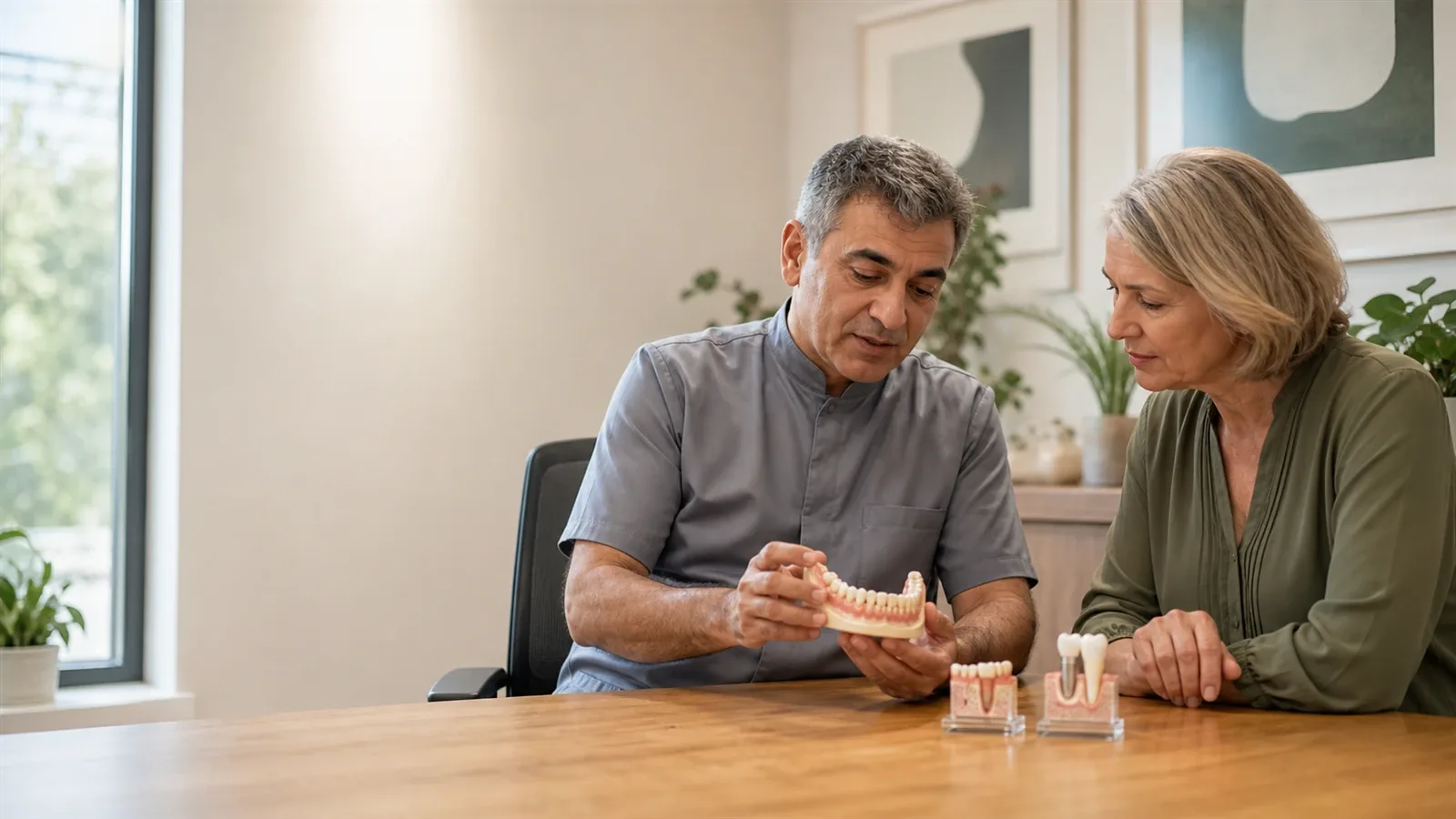
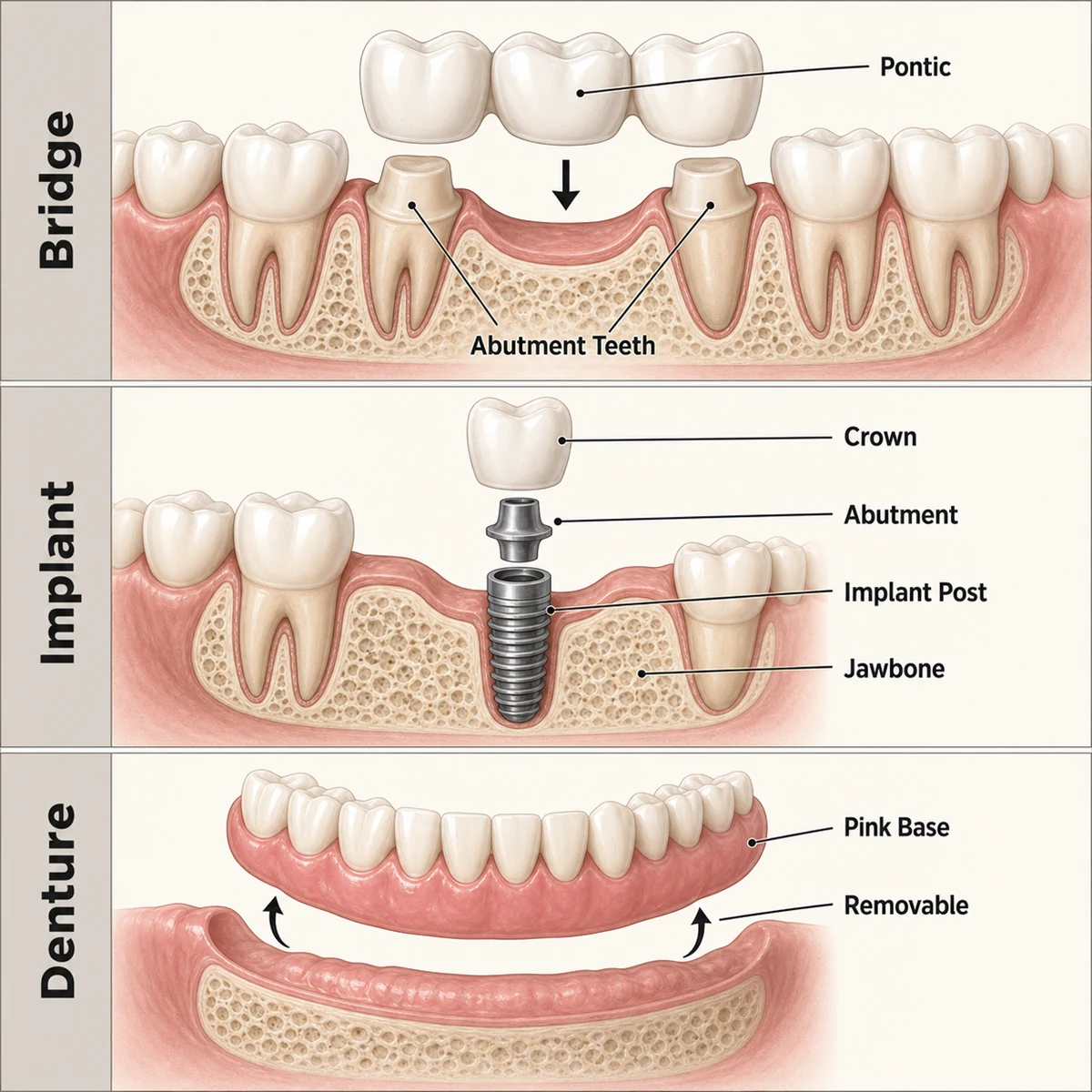
An implant stands on its own and is the only one placed into the bone, but it involves surgery and takes months. A bridge is fixed and quicker but borrows support from the teeth either side. A denture replaces the most teeth for the least intervention, but it comes out and takes getting used to.
There is also a fourth option: leaving the gap. That one has consequences too and this page starts there.
Key takeaways
- Leaving a gap is a decision and not a delay. Neighbouring teeth can drift, the opposing tooth can over-erupt and the bone that held the root gradually reduces
- The condition of the teeth either side is the first thing to weigh between an implant and a bridge. Healthy and intact argues for an implant. Already crowned or heavily filled argues for a bridge
- How much bone you have is the first check for an implant and you cannot judge it by looking
- Dentures are the option CDCP may help with. Implants and fixed bridges are excluded
- Active gum disease is managed first, whichever option you choose
- You can leave a consultation with information and decide later. That is a normal outcome and not a failure
First: what happens if you do nothing?
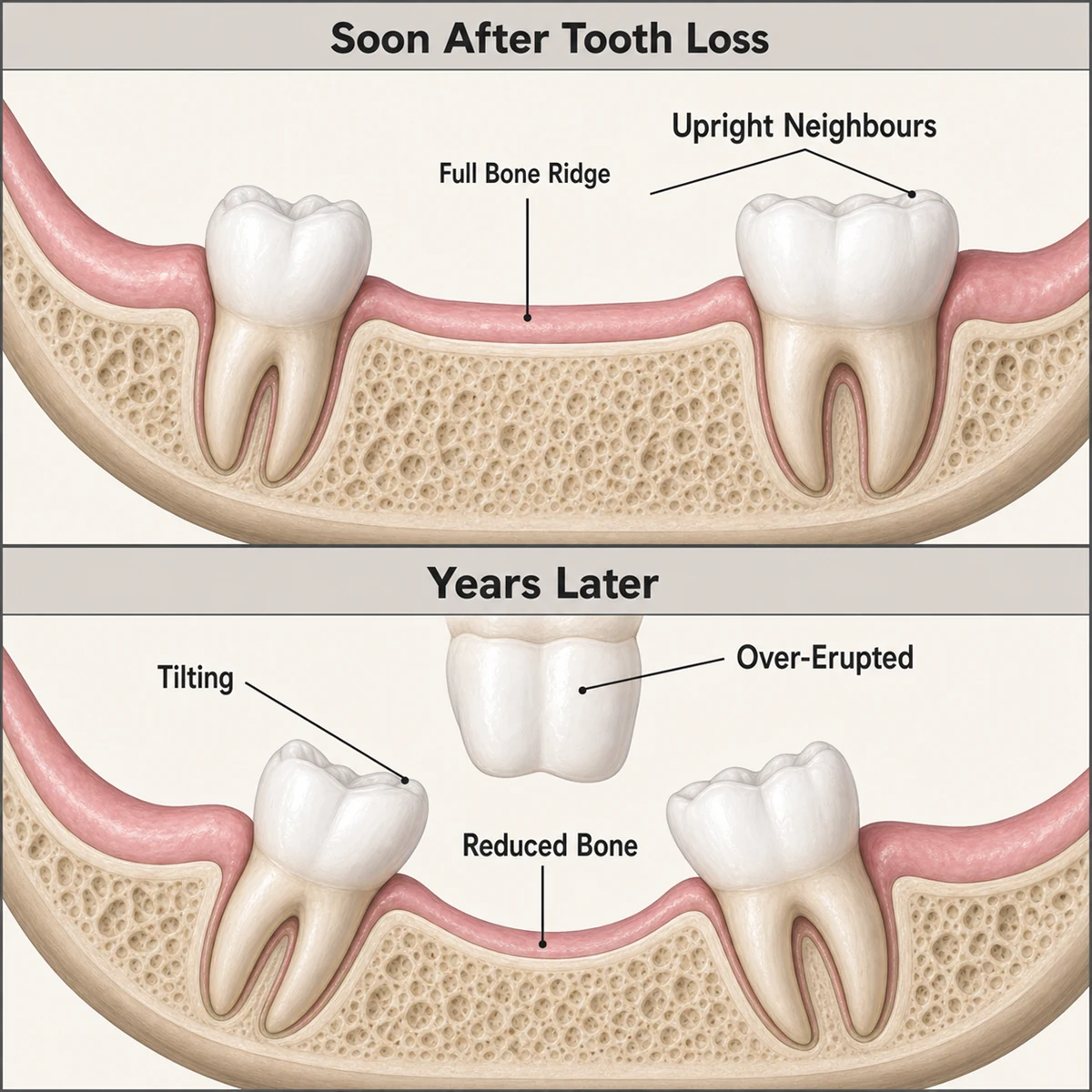
This comes before the options on purpose. It is easy to overlook and it is what you are already doing by default until you decide.
Teeth move
The teeth either side of a gap can drift and tilt into it. The tooth opposite, with nothing meeting it, can over-erupt. It keeps coming through because nothing stops it.
How much of that happens varies a great deal with the site, the bite and the person. Some gaps stay stable for years and others do not.
One gap can become a bigger problem
What began as a simple space can turn into a bite problem involving several teeth. That is more complicated to treat and can cost more.
The bone reduces
Bone responds to being loaded. Once the tooth root is gone that stimulus goes with it, and the ridge slowly loses height and width.
This matters most if you want to keep an implant open as an option because an implant needs bone to sit in. A longer wait can mean grafting first. Learn more about bone grafting.
Chewing habits change without you noticing
You may start chewing on the other side without noticing and that changes how force is spread across the mouth.
None of this means you must decide today. It means things can change as you wait. If you are putting it off, have the site reviewed and not forgotten.
The three options, honestly
A dental implant
A replacement root placed into the jawbone, with a crown fitted on top once it has healed.
What it does well. It stands on its own and the neighbouring teeth are not reshaped. It is the only one of the three that sits in the bone and not on the gum or on the neighbouring teeth. Nothing comes out at night, you clean it like a tooth and it cannot decay.
What it asks of you. Surgery and a healing period between placement and the final crown. That wait is not a delay because it is the bone joining with the implant. How long it takes varies from case to case and the assessment establishes it.
Enough bone of adequate quality and healthy gums are both prerequisites.
It still needs looking after. An implant cannot get a cavity. The gum and bone around it can become inflamed and infected in much the same way gum disease affects a natural tooth. That is an important cause of implants being lost later on, alongside failure to integrate at the start, smoking and overloading.
Low-maintenance is not no-maintenance. An implant needs cleaning at home and reviewing in the chair and you should know that before treatment and not after.
Not covered by CDCP.
Read about dental implants, including what happens at a consultation.
A dental bridge
A false tooth supported by the teeth either side of the gap. Designs vary and which suits a given gap is part of what the assessment decides.
What it does well. It is fixed in place. A conventional bridge involves no implant surgery and no wait for an implant to join the bone, so it suits people who do not want an operation or are not candidates for one. It usually takes a small number of appointments over weeks and not months and it stops the neighbouring teeth drifting.
What it asks of you. Preparing the supporting teeth. With a conventional bridge that means reshaping the teeth either side to carry it. How much preparation is involved depends on the design and on the condition those teeth are already in.
That is the real cost of a bridge and it is worth weighing properly. If the supporting teeth are already crowned or heavily filled, it matters much less. If they are intact and healthy, it matters a great deal. Raise it at the consultation.
Cleaning underneath takes technique. It takes a floss threader or an interdental brush because you cannot floss between a bridge and the gum the usual way.
Not covered by CDCP. Learn more about dental bridges.
A denture
A removable appliance replacing one tooth, several or a full arch.
What it does well. It replaces the most teeth for the least intervention and the denture itself needs no surgery. Extractions can still be part of the same plan. It restores appearance and supports the face once several teeth are missing.
In many cases a denture is adjusted, relined or repaired instead of replaced outright.
It is the option CDCP may help with. Eligible dentures may be partly covered, subject to the plan's criteria, approval in advance where required, frequency limits and any co-payment.
What it asks of you. Getting used to it takes weeks and not days, and speech and eating both take practice at first. It comes out for cleaning. The fit changes over time as the bone underneath reshapes, so relines are part of owning one.
The part worth knowing in advance. A denture does not feel like natural teeth because it is not one. Knowing that at the start matters. A new denture that feels nothing like what you expected can end up in a drawer instead of in your mouth. Learn more about dentures.
Side by side
| Implant | Bridge | Denture | |
|---|---|---|---|
| Fixed or removable | Fixed | Fixed | Removable |
| Involves surgery | Yes | No implant surgery | Not the denture itself |
| Affects neighbouring teeth | No | Yes, usually reshaped | Clasps rest on them |
| Placed in the bone | Yes | No | No |
| Teeth replaced | One or several | Usually one or two | One to a full arch |
| Time to complete | Staged over months | Weeks | Weeks |
| Cleaning | Like a tooth, with technique differences | Threaders or interdental brushes | Comes out for cleaning |
| Fit changes over time | Needs review and maintenance | Needs review and maintenance | Yes, relines may be needed |
| CDCP | No | No | May help, conditions apply |
| When it is the wrong choice | Bone is insufficient, gum disease is active, or surgery is not appropriate | The neighbouring teeth are healthy and intact | A fixed result matters more than cost or intervention |
Weighing up the three? Book a consultation or call (905) 821-8632.
What actually decides it
The decision turns on a small number of things.
How much bone you have
It is the first thing to check for an implant, and you cannot judge it by looking. Where bone is insufficient, grafting may make an implant possible, and that adds time.
Whether an implant will hold in a site with little bone left cannot be settled from across a consultation desk. It depends on how much bone is missing and where. Some sites are grafted successfully and go on to hold an implant well, and some are not suitable even with grafting. Imaging at the assessment shows which and we cannot tell you before looking.
The condition of the neighbouring teeth
If the teeth either side already have crowns or large fillings, a bridge costs you much less in healthy tooth structure. If they are untouched, that is a real argument for an implant.
How many teeth are missing, and where
One gap and several gaps are different problems. A denture starts to make more sense as the number rises.
Your general health, and whether you smoke
Both affect healing and smoking materially affects implant outcomes. Talk about that before treatment and not after.
Gum health
Active gum disease is assessed and managed as part of the plan, whichever option you choose. Placing an implant or a bridge onto support that is being lost is the wrong first move. Exactly how treatment is sequenced depends on the case.
What you can fund
Cost is a legitimate factor and nothing to be embarrassed about. A denture you wear is better than an implant you keep putting off.
What to expect, option by option
If you have an implant
Assessment and imaging come first. Then placement, a healing period as the bone joins with the implant and then the crown.
What can you eat as it heals? Expect to keep to softer food around the surgical site in the early days and to avoid chewing directly on it until it heals. You will be given instructions for your case and they matter more than any general rule.
Aftercare is the part you control. Clean around the implant and keep your review appointments so we can check the gum and bone. Placement, your general health, smoking and gum history all affect how long an implant lasts. Aftercare is the factor in your hands.
If you have a bridge
Expect one appointment to prepare the teeth and take an impression, a temporary in between and a second appointment to fit the final bridge. The number of appointments depends on your case.
A temporary is not the finished article. It is deliberately easier to remove. Treat it gently and call if it comes off instead of waiting.
Cleaning underneath is the easiest part to skip, and it decides how long the bridge lasts.
If you have a denture
Do partial dentures need adhesive? A well-fitting partial does not. It holds by its own clasps and fit, and adhesive is more associated with complete dentures. Leaning on adhesive heavily is a sign the fit needs checking and not a reason to buy more.
Expect adjustments early on. Sore spots in the first weeks are normal, and review appointments are for checking and adjusting them. Do not put up with them.
If grafting is needed first
Grafting adds time and it is fair to ask how much. Grafted bone needs a healing period before an implant goes in, and that lengthens the overall treatment. How long depends on the graft and the site and it is established at the assessment and not assumed. We will not quote you a number before imaging.
What affects the cost
We do not publish prices. The cost depends on what you need. You get a written estimate before treatment begins.
What moves the number:
- Whether grafting or extractions are needed first
- How many teeth are being replaced, and whether they sit next to each other
- Where in the mouth they sit
- The condition of the supporting teeth, for a bridge
- Whether the case is straightforward or complex
On longevity: you will find figures published freely, such as bridges at ten to fifteen years, implants at twenty or more and dentures relined every five to ten. We do not quote them because an average describes other people's teeth and not yours. We can tell you what affects longevity in your case: cleaning, the bite, gum health, grinding and smoking.
CDCP and insurance
CDCP: eligible dentures may be partly covered, subject to criteria, approval where required, frequency limits and any co-payment. Implants and fixed bridges are excluded.
Private insurance: plans set their own rules for each of these. Ask us to submit a pre-determination so you have your insurer's answer in writing before you commit. Direct insurance billing is available. Learn more about CDCP coverage for dental implants.
Can you change your mind later?
To a degree.
Having a denture now can leave an implant possible later. Bone keeps changing in the meantime, grafting may be needed, and even that is not guaranteed to work.
A bridge is harder to move away from because the supporting teeth have already been prepared. That is worth knowing before and not after.
What we will actually do
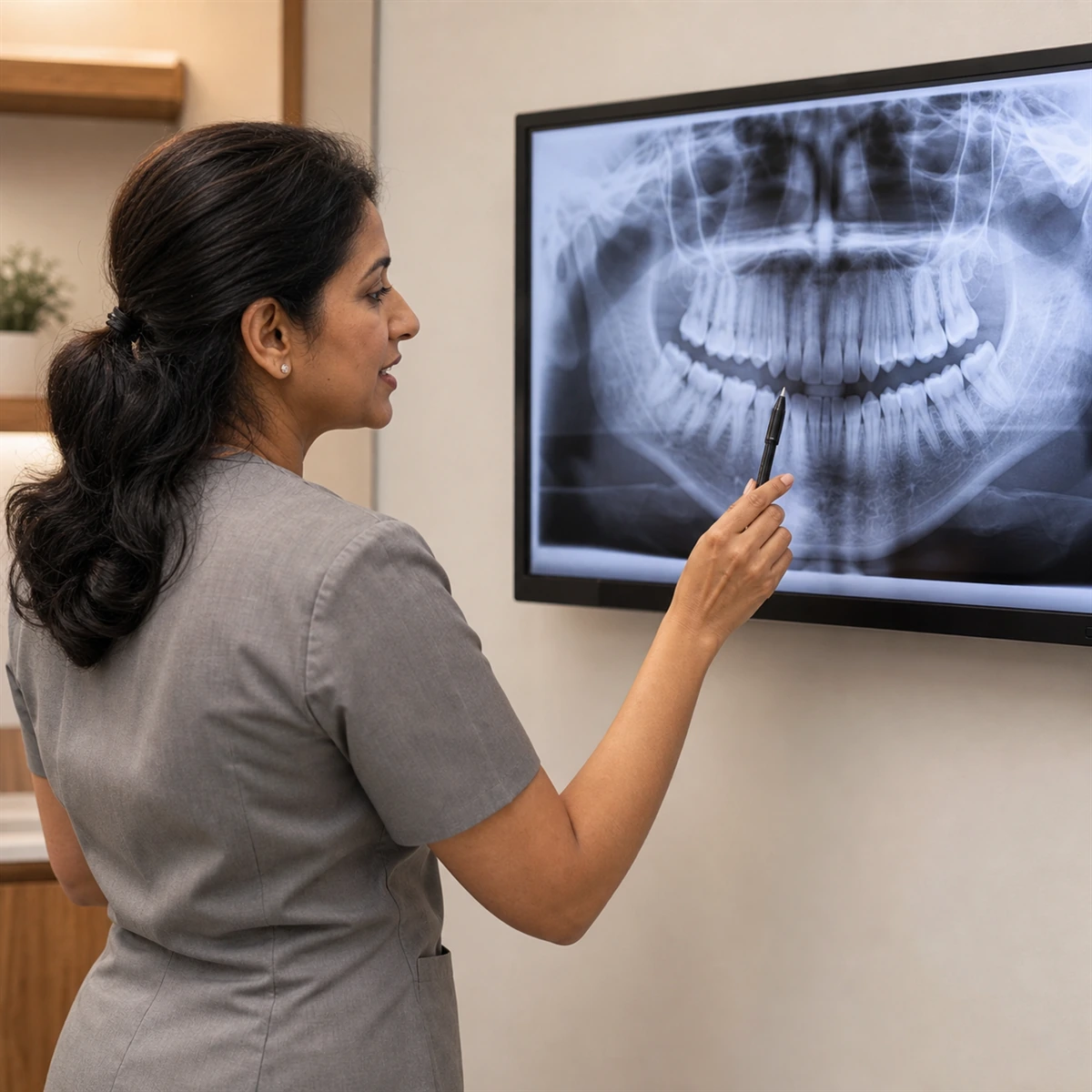
Examine and image before recommending anything. How much bone is there, what condition the neighbouring teeth are in, and what the gum and bite are doing.
Tell you every option that fits your case. Now and then there is only one, and for some gaps the honest answer is to leave it and review it.
Say when an option is a poor fit for you, including when that option is the more expensive one. A practice that recommends an implant to every patient with a gap is not assessing.
Give you a written estimate before treatment begins.
Refer where a case needs a specialist instead of stretching to keep it in-house.
What each option asks of you afterwards
Treatment is the start. What differs most is what each option asks of you over the following decade.
An implant is cleaned like a tooth, with some differences in technique at the gum margin. We review it at appointments to check the gum and bone around it. It cannot decay, but the tissue around it can become inflamed and infected, and that is an important reason implants are lost later on.
A bridge needs cleaning under the false tooth with a floss threader or interdental brush, because you cannot floss between it and the gum the ordinary way. Decay at the margins of the supporting teeth is a common reason a bridge fails. The bridge does not decay. The teeth holding it do.
A denture comes out for cleaning every day, over a basin of water or a folded towel so a drop does not land on a hard sink. The mouth underneath needs cleaning too. The fit changes as the ridge reshapes, so relines are part of owning one and not a sign of failure.
The maintenance is not equal, and it is not proportional to the cost. A denture is the least expensive and asks the most of your daily routine. An implant is the most expensive and is closest to simply having a tooth.
Combining options
Several missing teeth do not have to be replaced the same way. A partial denture in one area and a bridge in another is a normal plan. So is replacing some teeth now and reviewing others later.
Planning matters more when options are combined, because the pieces have to work together in one bite. That is a reason to have the whole mouth assessed and not to treat each gap as it arises.
What to bring to the consultation
- A list of your medications, because several affect healing and bone
- Your insurance details so we can submit a pre-determination
- Any previous X-rays you have, if they were taken elsewhere
- Your actual constraint, whether that is cost, time, anxiety about surgery or something else. It changes what gets recommended, and it is nothing to be embarrassed about
Questions worth asking
- What are all my options here, including the ones you would not recommend?
- Which would you choose, and why?
- What happens if I do nothing for a year?
- What does this ask of me afterwards, day to day?
- What is the plan if this does not work?
- Is any of this covered, and what would my co-payment be?
Ask "What happens if I do nothing for a year?" even if you ask nothing else.
Dentistry on Britannia is a general dental practice. Our dentists are general dentists, not specialists in any RCDSO-recognised specialty.