
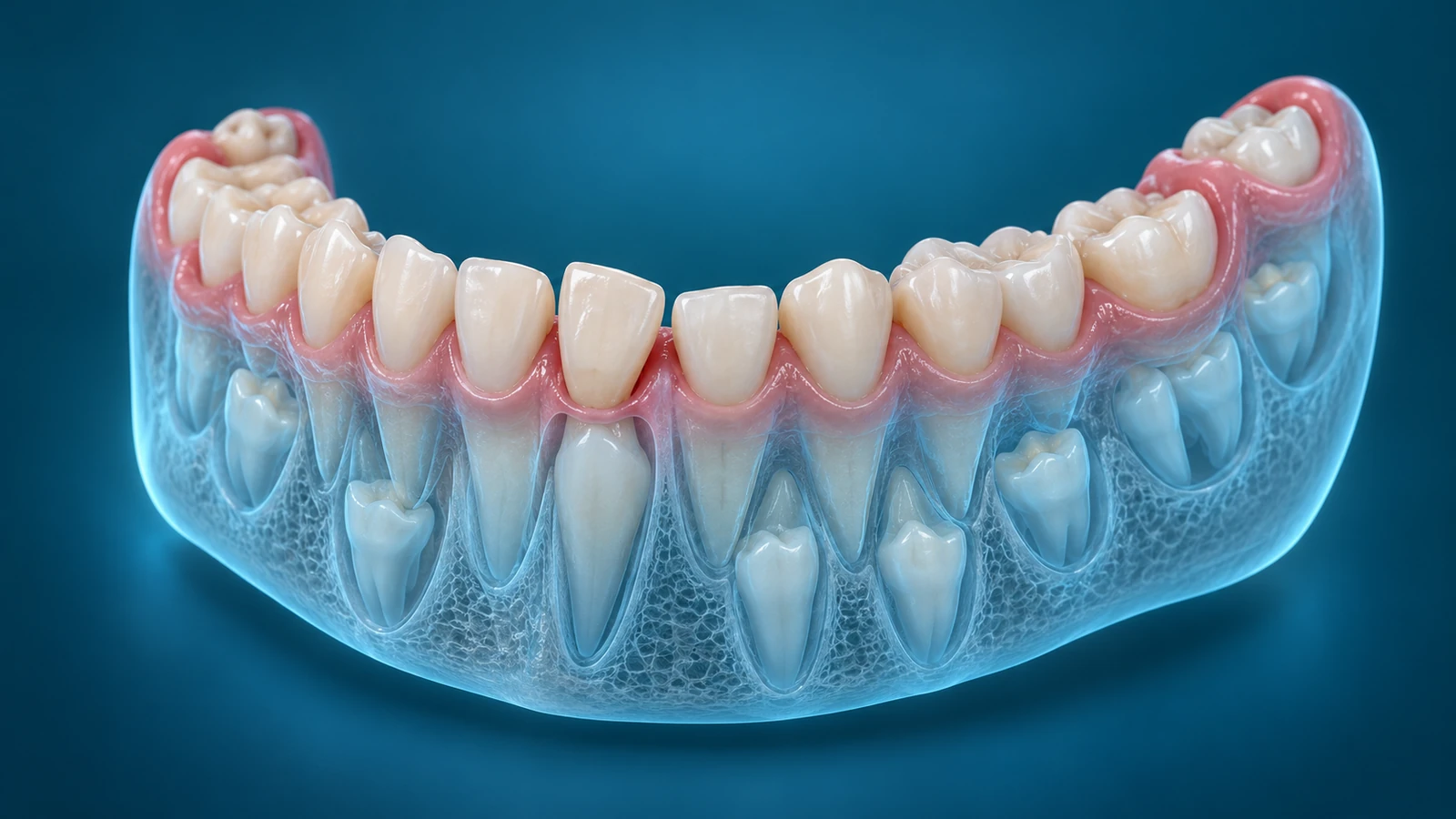
Here is the order the teeth come out, why they loosen, what to do with a wobbly tooth and which signs mean your child should see a dentist.
Key takeaways
- Age 6 is the common start. A first loose tooth anywhere from about 5 to 7 is normal.
- Teeth leave in the order they came in. The lower front teeth go first and the back baby molars go last.
- Let a loose tooth come out on its own. Pulling a tooth that is not ready can tear the gum and hurt.
- Some timing needs a check. A loose tooth before age 4, no loose teeth by age 8 or a tooth loosened by a fall should be seen.
- New adult molars arrive without a gap. The six-year molars come in behind the baby teeth and need extra care.
At what age do kids start losing baby teeth?
Most kids lose their first baby tooth at about age 6, and anywhere from 5 to 7 is a healthy start. By about age 13, most children have all their adult teeth apart from the wisdom teeth.
Children have 20 baby teeth, 10 on top and 10 on the bottom. Dentists call them primary teeth. Losing all of them takes about six years, and the 20 make way for 28 adult teeth by the early teens.
Timing runs in families. If you or your partner lost teeth late, your child is likely to follow the same pattern. On average, girls start a few months ahead of boys. Babies whose first teeth came in early also lose them earlier as a rule.
No food, vitamin or amount of wiggling speeds this clock up. Inside the normal range, the age is not a sign of a health problem.
In what order do baby teeth fall out?
Baby teeth fall out in about the same order they came in. The two bottom front teeth go first, then the two top front teeth, and the back molars go last.
The front teeth leave in a rush between 6 and 8. A quiet stretch of a year or two with few lost teeth comes next. The canines and molars then follow from about 9 to 12. Teeth also come out in left and right pairs, a few months apart.
| Baby tooth | Where it sits | Age it falls out |
|---|---|---|
| Lower central incisors | The two bottom front teeth | 6 to 7 |
| Upper central incisors | The two top front teeth | 6 to 7 |
| Lateral incisors | Next to the front teeth, top and bottom | 7 to 8 |
| First molars | Back chewing teeth behind the canines | 9 to 11 |
| Lower canines | Pointed corner teeth on the bottom | 9 to 12 |
| Upper canines | Pointed corner teeth on the top | 10 to 12 |
| Second molars | The last baby teeth at the back | 10 to 12 |
These ages are averages. A child a year ahead of the chart or a year behind it is still on track. The order matters more than the exact age. If one front tooth fell out months ago and its twin on the other side is still firm, mention it at your child's next dental checkup.
Why do baby teeth get loose?
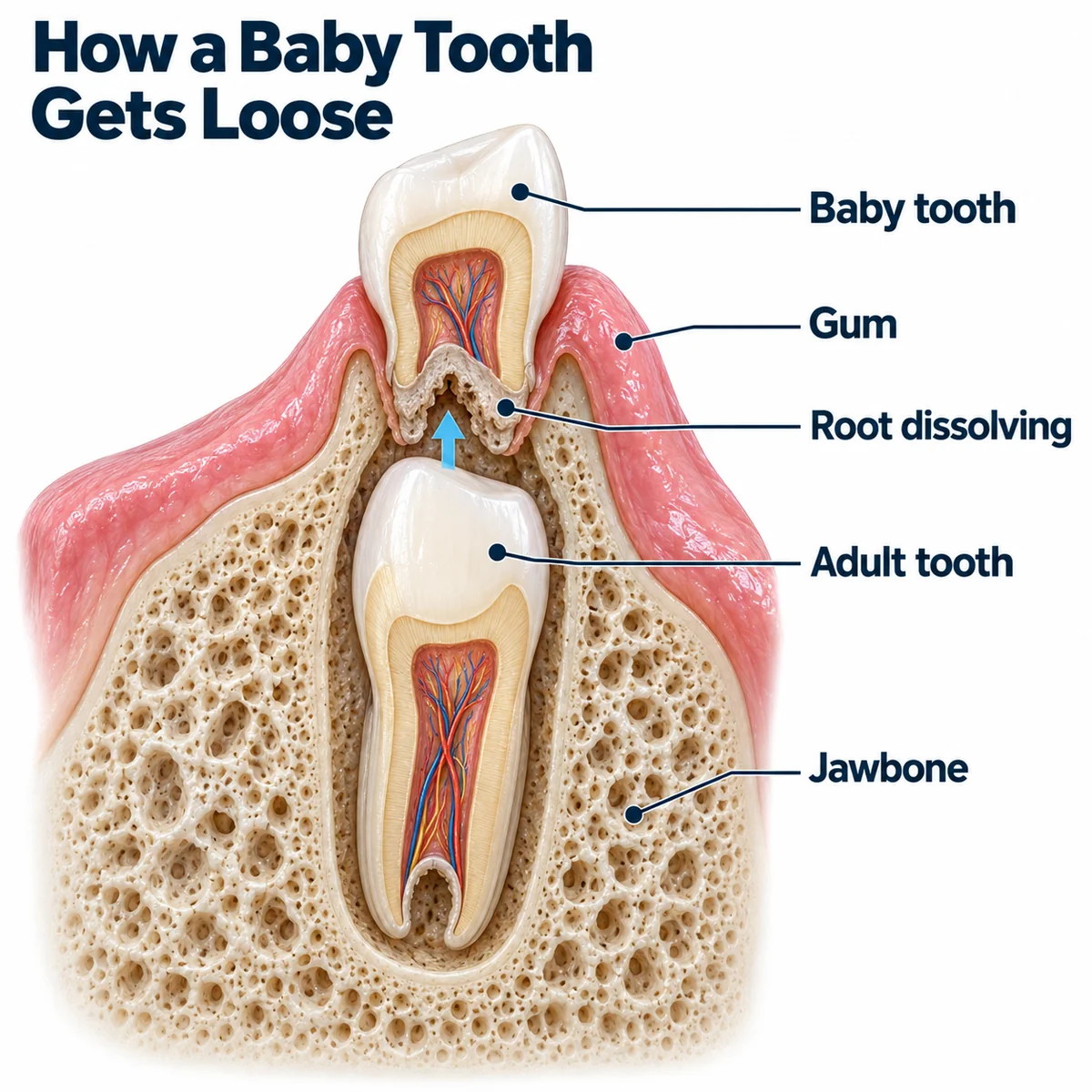
A baby tooth gets loose because the adult tooth under it dissolves its root. Once the root is almost gone, nothing holds the tooth in place and it wiggles free.
Each adult tooth grows in the jaw below the baby tooth it will replace, and it starts to form before birth. As the adult tooth grows and moves up, it presses on the baby root. The body breaks that root down bit by bit over a few months. This is why a baby tooth that falls out looks small and hollow, with almost no root left.
A baby tooth with no adult tooth below it gets no push, so it can stay in place for years. A tooth knocked loose by a fall still has its full root, so it hurts more and needs a dentist instead of patience.
Is it a problem if my child loses teeth early or late?
Inside the normal range, early or late is not a problem. A tooth lost before age 4, or no loose teeth by age 8, is worth a dental visit to find out why.
Losing a tooth too early
Natural shedding rarely starts before 4, because the adult tooth has not begun to dissolve the root yet. A tooth that loosens this early more likely has another cause:
- an earlier fall or knock, even one from weeks ago
- tooth decay that weakened the tooth or infected the gum around it
- less commonly, a health problem that affects the gums or bone
A baby tooth lost early also leaves a gap. The teeth on each side can drift into it, so the adult tooth arrives to find less room than it needs. A dentist can check the space, and tells you if your doctor should look at a possible health cause too. Our page on children's dentistry explains why baby teeth matter as space holders.
No loose teeth by age 8
A late start is most often a slow family clock. If nothing has moved by about age 8, a dentist can take an x-ray to see the adult teeth forming in the jaw. The x-ray can show an adult tooth that never formed, an extra tooth or a tooth growing in at an angle.
What should you do about a loose baby tooth?
Let your child wiggle the tooth with a clean finger or the tongue, and let it come out on its own. A tooth that is ready comes out with almost no force.
- Let your child do the wiggling. Kids stop where it hurts.
- Use a tissue only at the very end. If the tooth hangs by a thread, fold a clean tissue over it and squeeze gently. If it does not come out right away, leave it.
- Skip the string and the doorknob. A tooth that needs a yank still has root holding it.
Pulling a tooth too soon can snap the root, tear the gum and let infection in. Call the clinic if a loose tooth stops your child from eating or causes a lot of pain. Call as well if it hangs at an angle where it could be swallowed in sleep.
What is normal after a baby tooth comes out?
A little bleeding and a tender spot for a day are normal. Have your child bite on a folded piece of clean gauze for a few minutes, and the bleeding should stop.
The socket can look dark for a day or two before the gum smooths over. Keep brushing as normal and go gently around the gap.
Call the clinic if the bleeding has not slowed after about ten minutes of firm pressure. Pain past the first day or a swollen gum also needs a call. Both point towards an infection. Facial swelling with a fever, or swelling that spreads, goes to a hospital emergency department. If your child coughs, chokes or struggles to breathe after a tooth comes loose, call 911. If you think the tooth was breathed in, see a doctor even after the coughing stops.
What if a baby tooth is knocked out by a fall?
A baby tooth knocked out by a fall or a hit is an injury and not a milestone. Never put it back in the mouth. Keep it in milk and call the clinic the same day.
Putting a baby tooth back can damage the adult tooth growing below it. If you are not sure whether it is a baby tooth or an adult tooth, do not put it back. Never store a tooth in a child's cheek, because your child can swallow or inhale it.
A tooth that is loose or pushed out of place after a knock needs a dentist the same day. A knocked-out adult tooth needs care right away, because the chance of saving it drops sharply after the first hour. Hold it by the crown and never the root, keep it in milk and get to a dentist at once. Dentistry on Britannia in Mississauga sees dental emergencies during opening hours only. When we are closed, a knocked-out adult tooth goes to whoever can see it fastest. Our guide on when a dental problem is an emergency lists more signs. Call 911 for a head injury with loss of consciousness, confusion or unusual drowsiness. Any other head injury or a suspected broken jaw goes to the emergency department first.
What are "shark teeth" in kids?
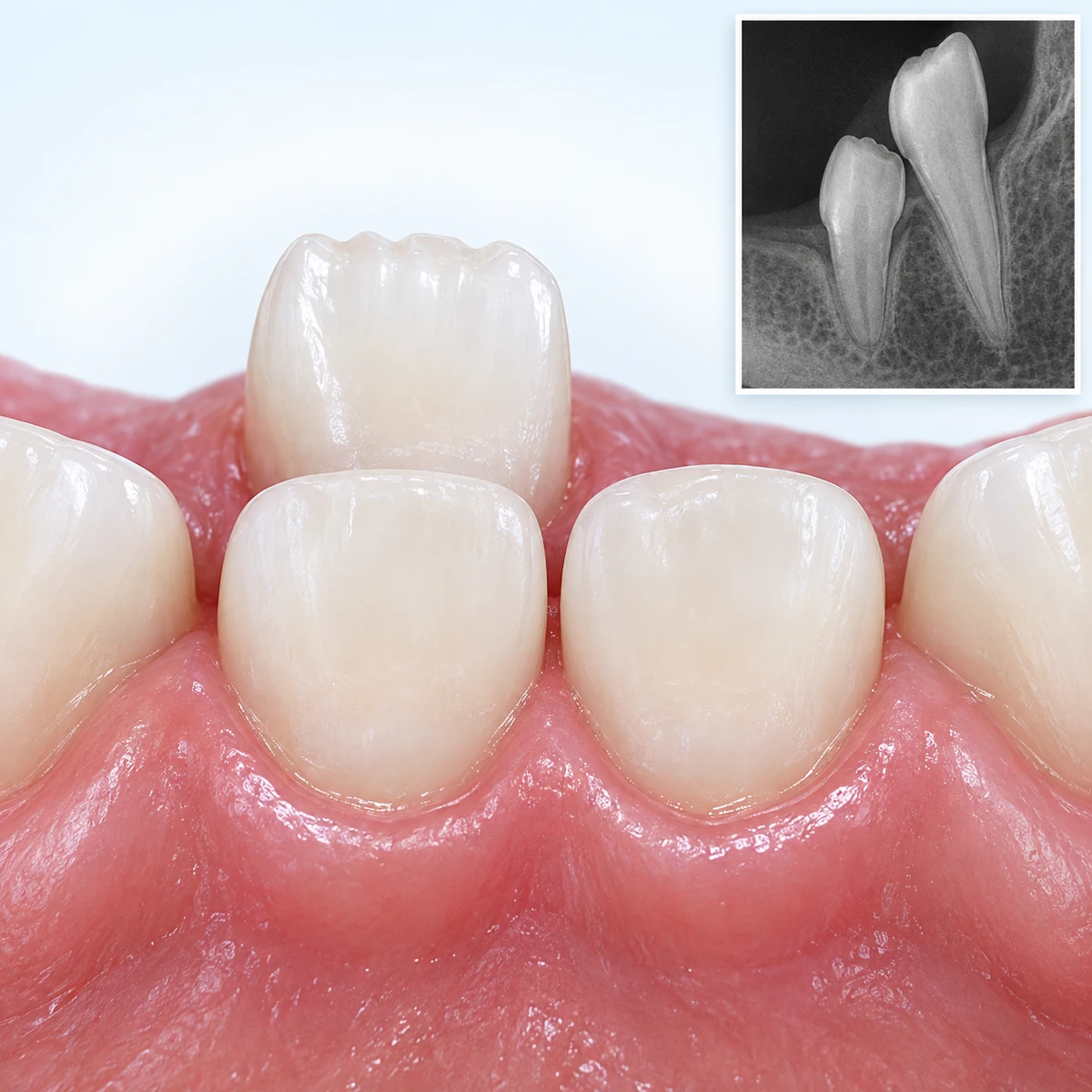
Shark teeth are adult teeth that come in behind baby teeth that have not fallen out yet. The result is a short double row, seen most in the lower front teeth at about age 6.
The adult tooth grew in a little to one side of the baby root, so that root never fully dissolved. Once the baby tooth falls out, the tongue helps push the adult tooth forward into line. Your child can help by wiggling the baby tooth each day.
If the baby tooth is still firm once the adult tooth has fully come through, book a visit. The dentist may suggest taking the baby tooth out so the adult tooth has room to move into place.
What changes in your child's mouth from age 6 to 12?
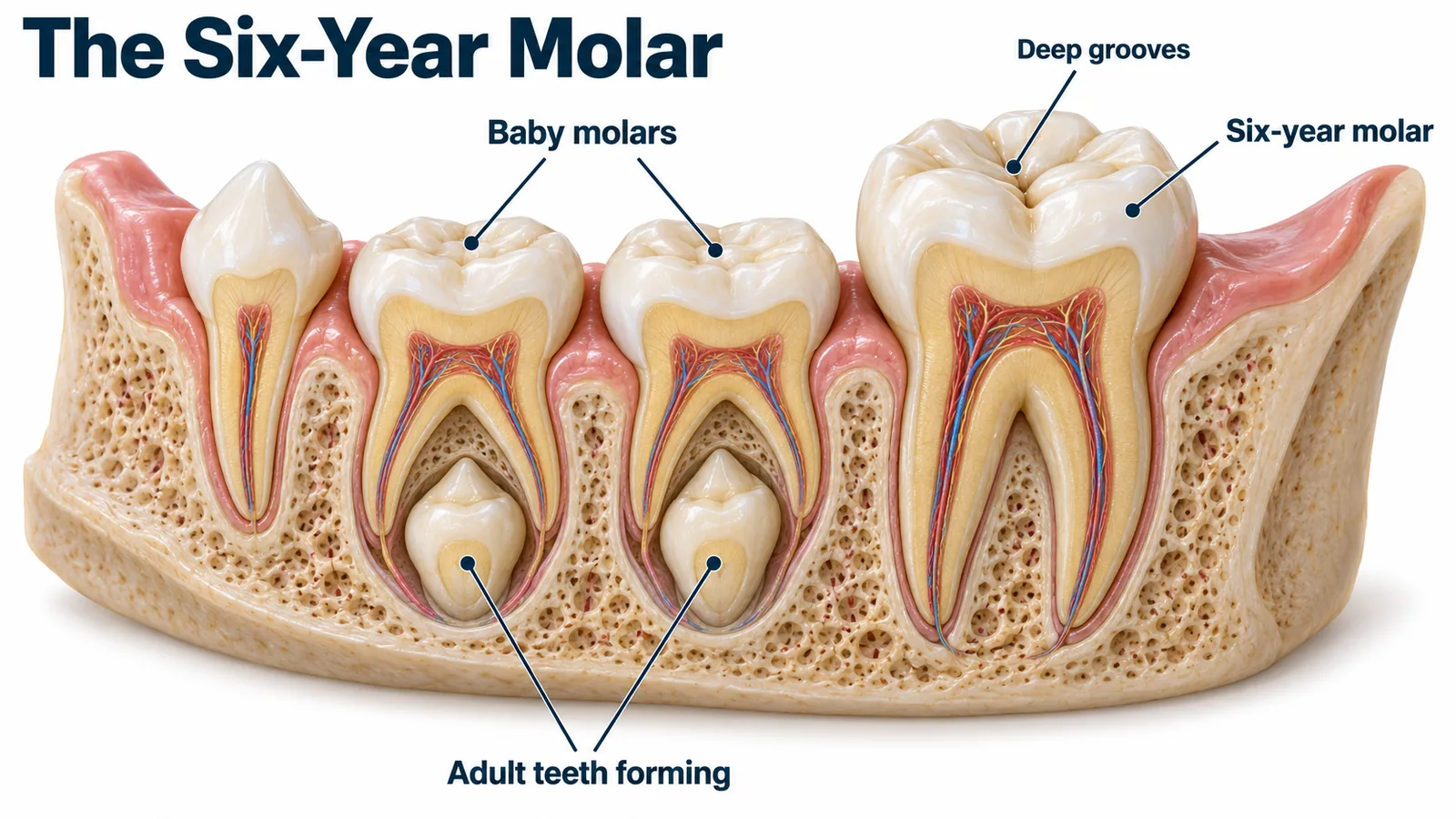
From about age 6 to 12, your child has a mix of baby and adult teeth. Gaps, teeth of different sizes and a crooked-looking smile are all normal in these years.
The biggest change is easy to miss. At about age 6, the first adult molars come in at the very back of the mouth, behind the last baby teeth. No baby tooth falls out to make room, so many parents take them for more baby teeth. These six-year molars are permanent and do much of the chewing for life. Their deep grooves trap food in a spot young children do not reach well with a brush. The second adult molars follow at about age 12.
- Look for them. Check behind the last baby tooth at about your child's sixth birthday, where the gum can feel sore for a few days.
- Ask about sealants. A dental sealant is a thin coating painted into the grooves, with no needle and no drilling.
- Watch the bite. Your dentist checks how the adult teeth line up as they arrive. If the bite needs a closer look, ask about orthodontics at the checkup.
How do you keep the new adult teeth healthy?
Brush twice a day with fluoride toothpaste, keep sugar to mealtimes and book regular checkups.
- Supervise brushing. Children cannot clean well on their own for longer than most parents expect, and the new back molars are the hardest spot.
- Spit and do not rinse. Rinsing washes the fluoride off before it can work. Ask at the visit how much toothpaste suits your child's age.
- Keep sugar to mealtimes. How often your child has sugar matters more than how much. Water is the best drink between meals.
- Add fluoride at the clinic. A fluoride treatment at a checkup adds protection for teeth that are coming in.
- Use a mouthguard for sports. A sports mouthguard protects new front teeth from a knock.
Decay in a baby tooth hurts as much as decay in an adult tooth, and it can need a filling. A baby tooth lost to decay also leaves the early gap described above. Our post on sweets and tooth decay has tips for treat season.
The clinic offers direct insurance billing. It also accepts the Canadian Dental Care Plan for families with no access to dental insurance, adjusted family net income under $90,000, tax returns filed and Canadian residency. For a child, the plan covers exams, x-rays, cleanings, preventive care and fillings inside its limits. You pay any co-payment and any gap between our fee and the plan's fee.
Frequently asked questions
Can a 4-year-old lose a tooth?
A loose tooth before age 4 is early for natural shedding. Book a visit to check for an old knock or decay and to protect the space for the adult tooth.
Why hasn't my 7-year-old lost any teeth yet?
Most often your child is on the late side of normal, which runs in families. If no teeth are loose by about age 8, a dentist can take an x-ray to check the adult teeth.
Does losing a baby tooth hurt?
Not much for most kids, because the root has already dissolved. Your child may feel odd pressure and see a little blood that stops with gauze.
Should I pull my child's loose tooth?
No. Let your child wiggle it until it comes out with almost no force, and use a gentle tissue squeeze only when it hangs by a thread.
When should a child first see a dentist?
Early, and before there is a problem. Bring your child along to your own visit first so the dental chair feels familiar.