
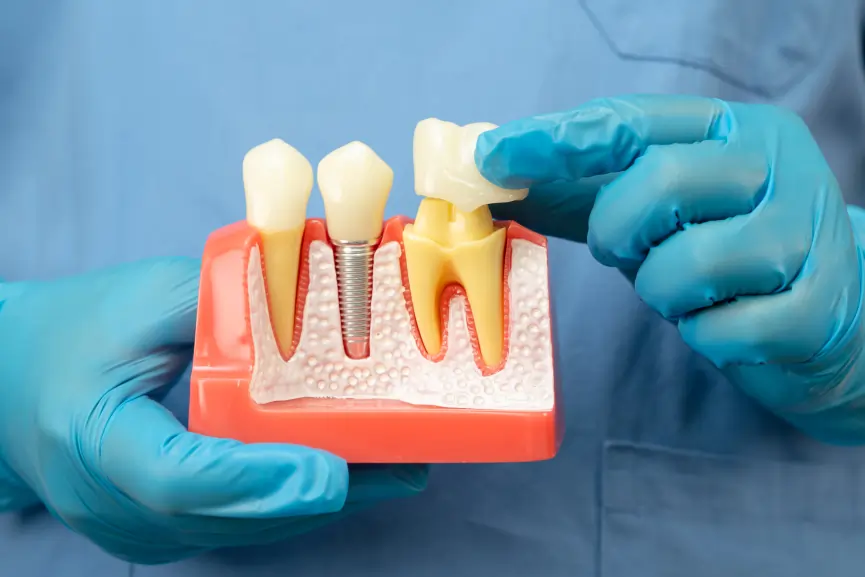
We place gold crowns. Fewer practices offer them now, and most patients are never told why they would want one.
A gold crown is a cast metal cap cemented over a tooth. It gets picked for how it behaves under a chewing load rather than for how it looks. On a molar nobody sees, that trade is worth making.
Why anyone still chooses gold
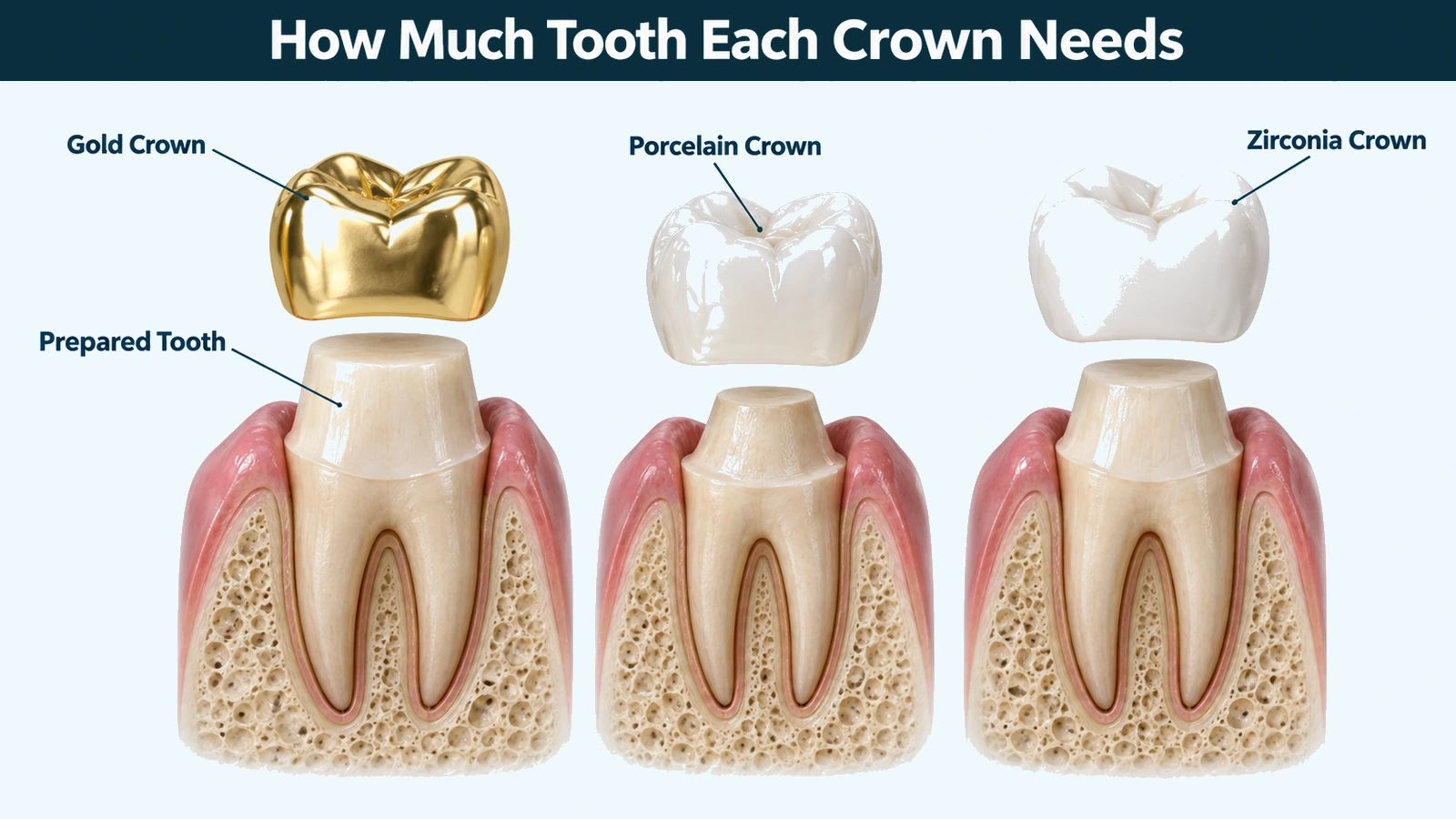
Less drilling. This is the real argument and it comes down to millimetres. A full gold crown needs 0.5 to 1mm of clearance where metal alone covers the tooth, and about 1.5mm over a working cusp. An all-ceramic crown needs 1.5 to 2mm, because ceramic has to be built thick enough not to fracture.
That difference is tooth you keep. One honest exception: full-contour zirconia prepares almost as conservatively as gold. Ask about that if you want tooth-coloured and conservative both.
It is easy on the tooth it bites against. Polished gold alloys wear at close to the rate of enamel. Some ceramic surfaces wear the opposing tooth faster, especially when they are rough or poorly polished, which matters most if you grind.
It takes a fine edge. Cast gold finishes to a thin close margin where the crown meets the tooth. Getting that fit right is a job for the preparation, the impression and the laboratory together.
It bends before it breaks. Ceramic can chip or fracture. Gold alloys are more ductile, so under a heavy bite they deform instead.
Is it actually gold?
Yes, and not only gold.
A dental gold crown is an alloy. Gold supplies the working properties and other metals are added for strength. We use high noble and noble alloys, and Type IV, which is the hard casting gold made for crowns that take real load.
High noble is the top class of dental alloy and the bar is set by weight. Published work on dental casting alloys puts high noble at 60% noble metal or more with gold at 40% or more. That is real gold content. It is still a long way from 24 carat jewellery.
This is not the soft metal of jewellery. Pure gold is too soft for a full crown, so dental alloys are mixed for strength.
Where a gold crown makes sense
- A back molar carrying heavy load if you grind
- A tooth with little height left, where a ceramic crown would need more reduction than it can spare. A short tooth raises its own questions about holding any crown and that gets assessed first
- Second molars, which almost nobody ever sees
- A tooth that has already broken a ceramic crown once
- A tooth opposite one that already carries a gold crown so the two wear evenly
- Anyone who wants a hard-wearing crown and is untroubled by the colour
And where it does not
Anywhere it shows. That is the whole case against gold and it is a fair one. On a front tooth or a premolar that appears when you smile, appearance wins and you want porcelain or zirconia instead.
Some people would simply rather not have metal in their mouth. That is a reasonable preference and not one we will talk you out of.
Want to know which suits your tooth? Call (905) 821-8632 or book online.
Gold, porcelain or zirconia
| Gold | Porcelain or ceramic | Zirconia | |
|---|---|---|---|
| Tooth removed to fit it | Usually least | Usually most | Between the two |
| Passes for a tooth | No | Yes | Yes |
| Wear on the opposing tooth | Low | Varies with the surface | Varies with the surface |
| Clearance it needs | 0.5-1mm, 1.5mm on a working cusp | 1.5-2mm | 1.5-2mm, less in full contour |
| How it tends to fail | Deforms | Chips or fractures | Chipping of any veneer |
| Right for a visible tooth | No | Yes | Yes |
These are general tendencies. The particular ceramic system, the design and your bite move all of them. That is why the choice is made tooth by tooth.
There is no single right answer here. We supply all three, so it is a clinical choice and not a stock one. Tell us which of those rows matters most to you and it gets a good deal easier.
One more material mixes the two. Porcelain fused to metal lays a ceramic surface over a metal core. The crowns page covers that one alongside the others.
Getting one fitted
Two visits here, and occasionally more if the tooth needs building up first. A gold crown is cast, so it is never a same-day job. Smaller work often is, and the dentist decides after looking.
At the first we shape the tooth, record it with an impression and fit a temporary. The laboratory casts your crown from the alloy. At the second we try it in, check how it sits against the neighbouring teeth and how it meets your bite, then cement it.
Call us if the temporary loosens or comes off. The prepared tooth is exposed and teeth either side start to move. Call the same day if there is real pain, a swelling, or a fever.
Gold has one quiet advantage on the day. It adjusts and repolishes in the mouth, so fine-tuning the bite is straightforward, within what the thickness of the crown allows.
Looking after a gold crown
Brush and floss it as you would a tooth, minding where metal meets gum.
The metal itself cannot decay. The tooth can, at and under the edge of the crown, where it stays hard to see until it is no longer small.
Gold will not chip on a nut the way ceramic does. The cement seal and the tooth under it still take the load. Cleveland Clinic puts ice cubes and hard nuts on its avoid list for crown wearers along with popcorn kernels and toffee.
Cleveland Clinic also tells anyone who grinds or clenches to ask their dentist about a custom mouth guard. Bring it up at the assessment if you know you do it. A crown takes the same hammering your own teeth do.
That is one of several ways a crown ends. Others are losing its grip, the tooth fracturing and gum disease around it. Keep your check-ups, because that is how any of them get caught early.
What a gold crown costs in Mississauga
A gold or metal alloy crown runs about $800 to $2,500 in this area. The spread is wide because the laboratory bills for the alloy it casts, and that tracks the metal market. The same crown quoted a month apart can come back at a different number for that reason alone.
Four things move the number.
- How much alloy the crown takes, which follows the size of the tooth
- The precious metal content of the alloy your laboratory casts
- Whether the tooth needs building up before a crown can sit on it
- What the gold market is doing that month
That is an area range, not our price list. The cost of your own crown comes in a written estimate before treatment starts.
Ontario has no fixed price for a crown. The Ontario Dental Association publishes a suggested fee guide each year and says a dentist's fees may sit above or below it. Two offices on the same road can quote different figures for the same tooth.
The two fees and what to ask about
Your quote has a professional fee for the dentist's work and a laboratory fee for casting the gold. The Ontario Dental Association says the lab charge reaches your bill at the exact amount the lab billed the dentist. Ask for a lab fee estimate so the likely alloy cost is on paper before you agree.
A tooth with little left may need a core build-up first. A root-treated tooth may need a post and core, and a tooth with an infected nerve needs root canal treatment before any crown. Ask for each to be named on your estimate.
Ask what else the quoted figure already covers. The x-rays, the local anaesthetic, the impression and the temporary crown are each worth naming out loud. An itemised quote is the one you can hold against another office.
A pre-determination sent on your behalf gets the insurer's answer in writing before you decide. Most plans treat a crown as a crown whatever it is made from. Some cap what they contribute towards precious metal, so read yours. Plans also have a yearly maximum that a crown eats into, and many pay from an ODA fee guide a year or more behind.
We take the Canadian Dental Care Plan. Its age limit has gone, the income test has not, and it approves certain treatment in advance. A family with adjusted net income below $70,000 pays no co-payment. Between $70,000 and $79,999 you owe 40% of the plan's fee and between $80,000 and $89,999 you owe 60% plus any difference up to the dentist fee (Government of Canada).
The plan will consider three kinds of single crown and cast metal is one of them. Crown coverage starts at 18 and every crown needs approval before the work begins. The limits are four crowns per patient in any 120 months and one crown per eligible tooth in any 96 months (Government of Canada). Crowns supported by implants are outside the plan.
Read about coverage and the CDCP.
Dentistry on Britannia is a general dental practice. Our dentists are general dentists, not specialists in any RCDSO-recognised specialty.